
Now Reading: Australian Youth Orchestra shows the connection between maths and music at World Science Festival
- 01
Australian Youth Orchestra shows the connection between maths and music at World Science Festival

Australian Youth Orchestra shows the connection between maths and music at World Science Festival
Old stereotypes often paint creative pursuits like music as worlds apart from subjects such as maths and science.
But for the people who dedicate their lives to these fields, music, science and maths are closely connected, from harmonics to the circle of fifths.

Jonathan Radford joins forces with AYO’s Momentum Ensemble to premiere a new saxophone concerto. (Supplied: Australian Youth Orchestra)
“Pattern, symmetry, proportion and the search for beauty are ideas we all recognise,” says Jonathan Radford, a UK-based saxophonist.
Radford is about to premiere a new concerto inspired by pure mathematics, Three Mathematical Diversions.
The work is part of a broader program by Australian Youth Orchestra’s Momentum Ensemble.
The concert, Beautiful Equations, brings together music, maths and the sciences as part of the World Science Festival in Brisbane, inviting audiences to hear how these disciplines intersect.
Making music through mathematics
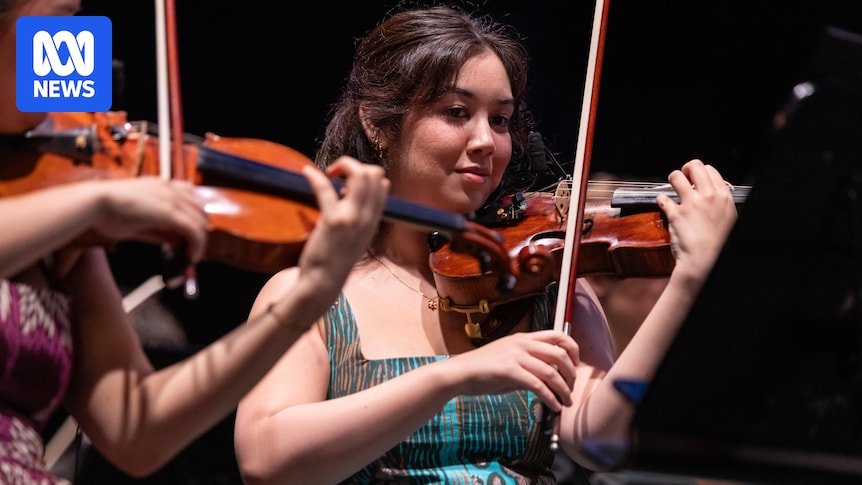
For 18-year-old violinist Katherine Ma, exploring the connection between music and maths is a way to make a deeper connection with her family.
“My dad and my brother work in engineering and research, and my mum was a maths teacher,” she says.
“Growing up, maths was pretty much everywhere.”
Ma says although she’s “the weakest of maths in my family”, being a musician allows her to explore the subject in her own way.
While studying physics in high school, Ma found a connection between music and maths.
“Once we started learning about how sound waves work, then learning about harmonics, I connected it to playing the violin,” Ma says.
String players create harmonics by lightly touching certain spots on a string without depressing it.
“It’s mathematical, it’s all in fractions,” Ma explains.
“You split up the strings, so you get two or three different equal lengths, and it creates higher-pitched overtones,” Ma describes.
Ma is referring to the whistling sounds string musicians use for artistic effect, such as in Igor Stravinsky’s Rite of Spring.
The harmonics can create an eerie flute-like sound.
The young musician is relishing the chance of exploring the connection between music and maths in the upcoming Australian Youth Orchestra concert, which will also feature mathematician and physicist Yang‑Hui He.
Combining pure mathematics and music
Music has been a constant presence throughout Professor He’s life.
Professor He Yang Hui is bringing his maths and science expertise to a new project with the AYO. (Supplied: Australian Youth Orchestra)
He grew up in Melbourne and Sydney before pursuing further studies in the US and the UK.
“My two biggest passions in life have always been math and music,” he shares.
“[While studying, I spent] all of my free time playing the violin for the orchestra and singing tenor for the choir.”
Professor He is a Fellow at the London Institute and concurrently holds a Professorship of Mathematics at City St George’s, University of London, the Chang-Jiang Chair Professorship at NanKai University, China as well as being a tutor and lecturer at Merton College, Oxford.
At Merton College, Professor He started collaborating with British composer Cheryl Frances-Hoad, which resulted in the new concerto for saxophone and strings.
“[Frances-Hoad] was a visiting fellow at Merton College when a 13-sided Einstein tile was discovered in 2023,” Professor He says.
This newly discovered shape, which tiles endlessly without repeating, forms the basis for the first section of the three mathematical diversions that Radford will premiere with Australian Youth Orchestra at the World Science Festival.

The Australian Youth Orchestra’s Momentum Ensemble is for young musicians at the cusp of their professional careers. (Australian Youth Orchestra: Mark Gambino)
Another section explores the mysterious behaviour of elliptic curves and prime numbers, which Frances-Hoad illustrates by visually representing the concept as shapes on the music score.
The final section is inspired by Professor He’s lecture series: The Search for the Theory of Everything.
“It’s the search for a unifying theory that might explain the universe itself,” Radford says.
Professor He has been working on the interface between geometry, number theory and string theory in pursuit of “this unified theory of everything”.
“This is what Einstein in the 50s dreamt of,” Professor He says.
While the concept might be hard to grasp, the enthusiasm from musicians like Radford is real.
Loading Instagram content
“There’s a sense of wonder, beauty and amazement in the fact that that maths and music can explain the universe itself,” Radford says.
Music inspired by mathematical concepts
Professor He says that music and maths are “probably the only two universal languages.”
This isn’t a new concept. The idea that music and maths are linked through the theory of universal harmony has been attributed to ancient philosopher Pythagoras.
There is a long history of music inspired by maths and science. (Australian Youth Orchestra: Mark Gambino)
And even though its universality has been repeatedly questioned, the basics remain.
“In mathematics, you have a definition of an integer, a prime number, and then you can just start seeing patterns,” Professor He explains.
The same can be said about music.
Sometimes, the link is even more explicit.
One example Professor He cites is John Cage’s famous piece 4’33”, which is sometimes considered a bit of a joke because it’s completely silent.
“That number was chosen for its precise numerical reason,” Professor He says.
“Four minutes equals 240 seconds. If you add up 240 plus 33 seconds, you get 273 seconds,” he says.
“Minus 273 Celsius is exactly 0 Kelvin, the absolute zero temperature, [hence] the piece is of a complete silence.”
While you won’t hear John Cage at the Australian Youth Orchestra’s upcoming concert, there will be plenty of music and maths connections, from Alex Baranowski’s Musica Universalis to Philip Glass’s A Brief History of Time — Signature.
Momentum Ensemble members will perform music from Stravinsky to Australian composer Elena Kats-Chernin. (Australian Youth Orchestra: Mark Gambino)
Radford says audiences will be invited “to find the connections and patterns that sound, numbers and the world around us.”
To do this, Ma says “you really have to pay attention to what you hear and find patterns in the music that your brain can latch on to.”
Australian Youth Orchestra’s Momentum Ensemble will present Beautiful Equations as part of World Science Festival at the Queensland Performing Arts Centre on March 26 and 27, and the Sydney Conservatorium of Music on March 28.