

Now Reading: Tesla Driver Charged With Murder After 142 MPH Crash Killed Mother and Toddler
- 01
Tesla Driver Charged With Murder After 142 MPH Crash Killed Mother and Toddler

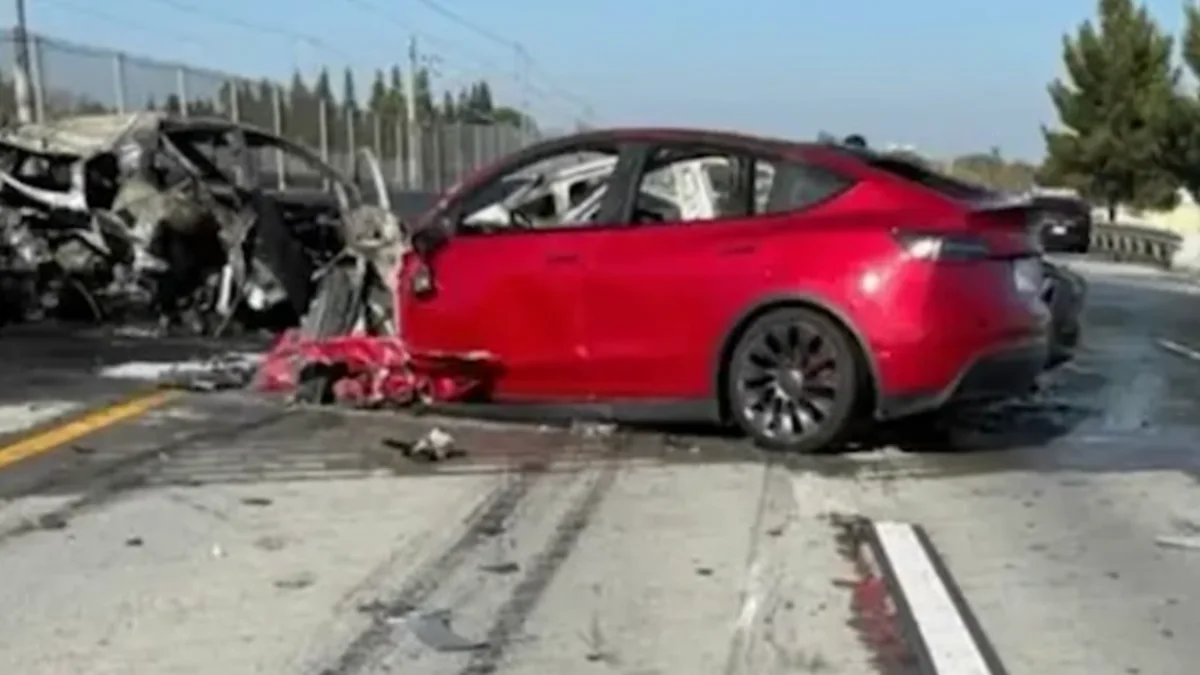
Tesla Driver Charged With Murder After 142 MPH Crash Killed Mother and Toddler
A California man is facing two counts of murder after prosecutors say his Tesla was traveling 142 miles per hour just seconds before a fiery four-car pileup on Highway 87 in San Jose. Zachary Chernicky, 31, was arrested on Monday, July 13, more than seven months after the December 2, 2025 crash that killed 29-year-old Ivana Balistreri and her 1-year-old daughter, Lilliana.
According to the California Highway Patrol, Chernicky was driving one of two Teslas involved in the collision, which also included a Lexus and a Toyota Sienna. Investigators say Chernicky slammed into the back of the Lexus, setting off a chain reaction that left both Teslas and the Lexus engulfed in flames on the busy northbound highway near Curtner Avenue. Balistreri and her daughter, who were riding in the Lexus, did not survive. The Lexus driver was hospitalized, reported KRON 4.
The CHP’s monthslong investigation reconstructed the final seconds before impact with striking precision. Investigators say Chernicky was clocked at 142 mph fifteen seconds before the crash, still doing 126 mph five seconds out, and hit the Lexus at 102 mph. For context, the posted speed limit on that stretch of Highway 87 sits nowhere close to triple digits, which is part of why prosecutors chose to file the charges they did.
Santa Clara County District Attorney Jeff Rosen didn’t mince words when announcing the murder charges, comparing reckless high speed driving to firing into a crowd, with the car standing in for the weapon. It’s a blunt comparison, but it reflects a legal strategy prosecutors have increasingly leaned on in extreme speeding cases: treating grossly excessive velocity, not just impairment, as evidence of the kind of implied malice that can support a murder charge rather than a lesser vehicular manslaughter count.
Why Murder Charges and Not Just Manslaughter
Vehicular homicide cases usually land as manslaughter, which doesn’t require proving intent. Murder charges in a traffic fatality are rarer and typically require prosecutors to show the driver acted with a conscious disregard for human life, sometimes called implied malice.
Triple digit speeds on a public highway, especially when documented second by second through vehicle telemetry, give prosecutors a much stronger case for that standard than a simple speeding ticket ever could.
The Role of Vehicle Data in the Investigation
One detail worth noting for anyone who follows this kind of case: the specificity of those speed figures, logged at fifteen seconds, five seconds, and the moment of impact, almost certainly came from the Tesla’s own onboard data recorder.
Modern EVs log an enormous amount of driving telemetry, and it’s increasingly common for that data to end up as the backbone of a prosecution.
Chernicky was arraigned on the two murder counts this week.
The case now heads through the Santa Clara County court system, where his attorneys will have the opportunity to respond to the charges.
If you want more stories like this, follow Guessing Headlights on Yahoo so you don’t miss what’s coming next.