
Now Reading: Is hydroponic produce safer during foodborne illness outbreaks? :: WRAL.com
- 01
Is hydroponic produce safer during foodborne illness outbreaks? :: WRAL.com

Is hydroponic produce safer during foodborne illness outbreaks? :: WRAL.com
At the State Farmers Market in Raleigh, Mary Kelley has noticed a change in what shoppers are asking for.
“People are looking for lettuce,” said Kelley, who works for Walker Farms in Randolph County. “They come here looking for lettuce and herbs and jalapeños and the things they’re concerned about from the grocery stores.” Some tell her they are deliberately trying to stay out of grocery stores.
The anxiety comes after a summer of unusually prominent foodborne illness outbreaks, including the largest Cyclospora outbreak ever tracked in the United States. The outbreak, linked to iceberg lettuce sourced from central Mexico, has sickened 10,930 people in 17 states, including North Carolina. At least 454 people have been hospitalized and two have died, according to the Food and Drug Administration.
The recalled lettuce is no longer expected to be on store shelves or in restaurants. The outbreak investigation remains open, however, and it has left some consumers asking a more lasting question: Is there a safer way to buy produce?
The answer is more complicated than choosing one type of lettuce over another. Hydroponic farming can remove some of the environmental hazards associated with growing crops outdoors. Locally grown produce can have a shorter trip from farm to plate, creating fewer opportunities for contamination. And buying a whole head of lettuce rather than a pre-cut bag can eliminate some of the processing steps where contamination can spread.
“There’s always a risk,” said Chip Simmons, an area specialized agent at North Carolina State University who focuses on fresh produce food safety. “The goal is always to reduce the risk.”
A different way to grow lettuce
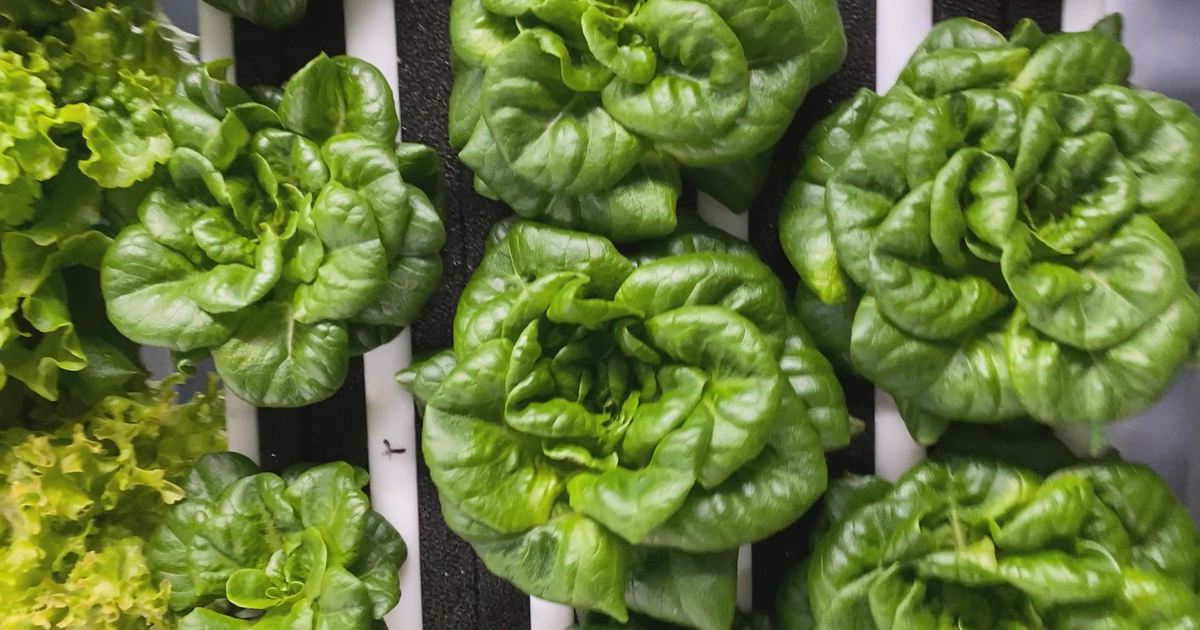
Inside a shipping container in downtown Raleigh, there is no soil, rain or sunshine. At Nanue Farms, lettuce grows vertically under LED lights. Water mixed with nutrients drips through panels to the plants’ roots, drains into a holding tank and circulates through the system again.
It is a form of controlled environment agriculture that allows owner Trevor Spear to manage many of the variables an outdoor farmer cannot. “Once you go inside the container, everything is under your control,” Spear said.
The farm grows lettuce and other plants hydroponically, meaning without soil. Spear said each container can hold thousands of plants, while the growing rooms are kept between 60 and 65 degrees. The operation uses considerably less water than conventional farming, he said, though it consumes more electricity because of the lighting and air conditioning.
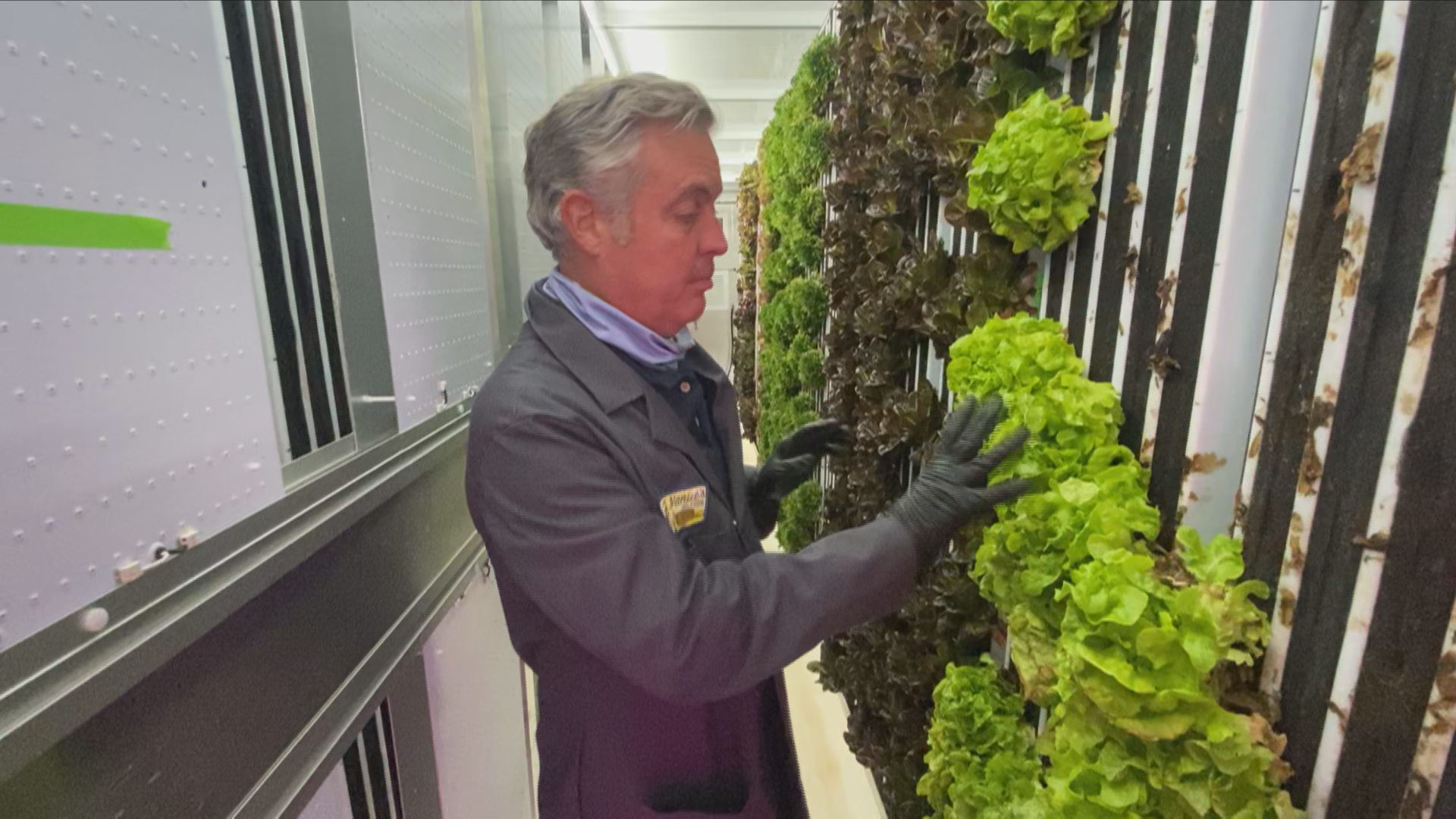
The controlled environment also keeps out many of the things that can introduce pathogens to an outdoor crop. “No wildlife, no pests, no bugs,” Spear said.
Simmons said traditional farms have to account for potential contamination from animals, irrigation water and soil. Listeria monocytogenes, for example, occurs naturally in soil. Other pathogens can enter the growing environment through animal waste. E. coli can be associated with cattle, while Salmonella can be carried by poultry. Water has been a particularly important pathway in large outbreaks, Simmons said.
Moving lettuce indoors does not make those risks disappear. It changes them.
“I wouldn’t say that hydroponics are any better than any other,” Simmons said. “Each different way that produce is grown has its own risks.”
A hydroponic operation still has workers, equipment and surfaces that can introduce contamination. Indoor growers have their own pest-control challenges. Water, particularly in a system where it is recirculated, still has to be carefully managed.
At Nanue Farms, Spear said the water tanks are flushed and cleaned monthly, and the farm cleans its growing areas regularly. During a recent visit, one shipping container had been taken apart for its annual deep cleaning. Spear believes the ability to control those conditions makes his product safer.
For Simmons, the important distinction is not whether a farm is indoors or outdoors. It is whether growers identify the risks particular to their operation and follow good agricultural practices, including worker hygiene, water testing, sanitation and animal or pest control.
The surprising problem with “triple washed”
Growing is only one part of lettuce’s journey from farm to plate. How it is handled and processed after harvest can introduce another set of risks.
That is particularly relevant to Cyclospora, a microscopic parasite spread when food or water is contaminated with feces from an infected person. Unlike Salmonella or E. coli, Cyclospora is not a bacterium. Humans are its only known host.
It also presents a challenge for a reassuring phrase found on countless bags of greens: “triple washed.”
Simmons described the commercial process this way: Produce may be washed with water, then a sanitizer, then rinsed. Cyclospora is not susceptible to the sanitizer used in that process, he said.
If contaminated lettuce enters a processing facility, washing it does not necessarily solve the problem. Instead, Simmons said, moving chopped lettuce through the processing and washing system can spread contamination to other produce.
“With each one of those washing steps, with a pathogen like Cyclospora that’s not susceptible to that sanitizer, it’s just being spread to all of the produce,” Simmons said.
Once that lettuce enters a large distribution network, a localized contamination problem can become a multistate outbreak. That makes the number of “touch points” in the food supply chain important, Simmons said.
A head of lettuce harvested from a nearby farm and sold whole may have relatively few. A bagged salad could be harvested, transported to a processing facility, chopped, washed, handled by equipment, packaged, moved through distribution centers and shipped hundreds or thousands of miles before reaching a refrigerator.
At Nanue Farms, Spear sells the entire plant, including its root ball. “There’s no processing,” Spear said. “We sell the whole head of lettuce and when you receive it, it’s still alive.”
That traceability is part of the appeal for William D’Auvray, chef and owner of East End Bistrot in Raleigh, who buys lettuce from Nanue Farms.
“I can trace all the origins of all our lettuce,” D’Auvray said. “I think it’s a responsibility.”
Customers have been paying attention, too. D’Auvray said more diners are asking questions about the salad during the Cyclospora outbreak.
Could local be the bigger advantage?
For consumers trying to reduce their risk during this particular outbreak, Simmons said the more meaningful distinction may not be hydroponic versus field-grown. It may be local versus a long supply chain.
“Particularly with Cyclospora, I would say that there are less risks from buying local,” Simmons said. “The reason that I say that is because there are fewer touch points for contamination.”
Cyclospora is endemic in tropical and subtropical regions. It is not endemic to North Carolina, Simmons said, making the likelihood of encountering it on produce grown here lower than on produce from areas where the parasite regularly circulates.
That does not mean imported produce is subject to weaker food safety standards. The federal Food Safety Modernization Act applies to food grown domestically and food imported for U.S. consumers.
Taylor Farms de Mexico voluntarily removed iceberg lettuce sourced from central Mexico from the U.S. market in July after federal investigators linked it to Cyclospora illnesses. The affected lettuce was distributed widely through food-service channels, including in North Carolina. The FDA says the recalled products are now past their best-by dates and should no longer be available in stores or restaurants. The investigation remains open.
Federal regulators continue to investigate several other foodborne illness outbreaks. Recent public health advisories have involved sprouts, jalapeños, eggs and frozen blueberries, among other foods.
The string of outbreaks can make it seem as though the food supply has suddenly become more dangerous.
Are there really more outbreaks?
Scientists are increasingly able to find connections among illnesses that might once have appeared unrelated.
Simmons said improvements in testing and public health surveillance have lowered detection thresholds. Whole-genome sequencing allows investigators to compare the genetic fingerprints of pathogens and connect cases across different places and even different points in time.
“Is this happening more frequently, or are the methods getting better? That’s a hard question,” Simmons said. “I can tell you the methods are getting better.”
Better reporting by the health system could also contribute to the perception that outbreaks are becoming more common, he said.
The FDA currently lists several active outbreak investigations, including some in which investigators have not yet identified the food responsible.
The FDA’s Food Traceability Rule requires more detailed recordkeeping for certain foods so investigators can follow products through the supply chain more quickly during an outbreak. Businesses covered by the rule were originally supposed to comply by Jan. 20, 2026. That deadline has been delayed until July 20, 2028. Congress directed the FDA not to enforce the rule before then.
The rule is not designed to prevent the initial contamination. Its purpose is to make it easier to determine where a contaminated food came from and where it went, potentially allowing regulators and businesses to remove it from the market faster.
How to lower your risk
For all the unsettling headlines, Simmons does not want people to stop eating fresh produce.
“The system is really good, as things go,” he said. “It’s a very safe food supply.”
There is no way to make eating raw produce entirely risk-free. Unlike meat or eggs, lettuce typically never reaches a temperature that kills pathogens before it is eaten.
“Fresh produce is consumed raw, and because of that, there will never be a zero risk,” Simmons said.
Consumers can, however, reduce it. Buying locally can mean fewer stops between the farm and the kitchen. Choosing whole produce instead of pre-cut products can eliminate some processing and handling. Hydroponic produce can reduce certain environmental exposures, though the growing method itself is no guarantee of safety.
At home, Simmons said one of the most important steps is preventing cross-contamination. A cutting board used for raw chicken, for example, should not be given a quick rinse and then used to chop lettuce. Hands, knives, countertops and other surfaces can all move pathogens from one food to another.
People who are young, older, pregnant or immunocompromised should be particularly mindful of foods associated with higher risks. When appropriate, cooking provides the “kill step” that raw produce lacks.
Consumers should continue to wash fresh produce under running water. Washing can reduce contamination even though it cannot guarantee every pathogen will be removed.
For Kelley, the recent concern has brought more shoppers face-to-face with the people growing their food.
“It’s a good thing to support your local farmers,” she said. “You know where your food’s from, and it’s fresh.”
That may be the clearest lesson from a summer of unsettling food recalls. There is no label that makes lettuce risk-free. Not “hydroponic.” Not “local.” Not even “triple washed.”
The fewer stops between the farm and your fork, the fewer opportunities there may be for something to go wrong.