
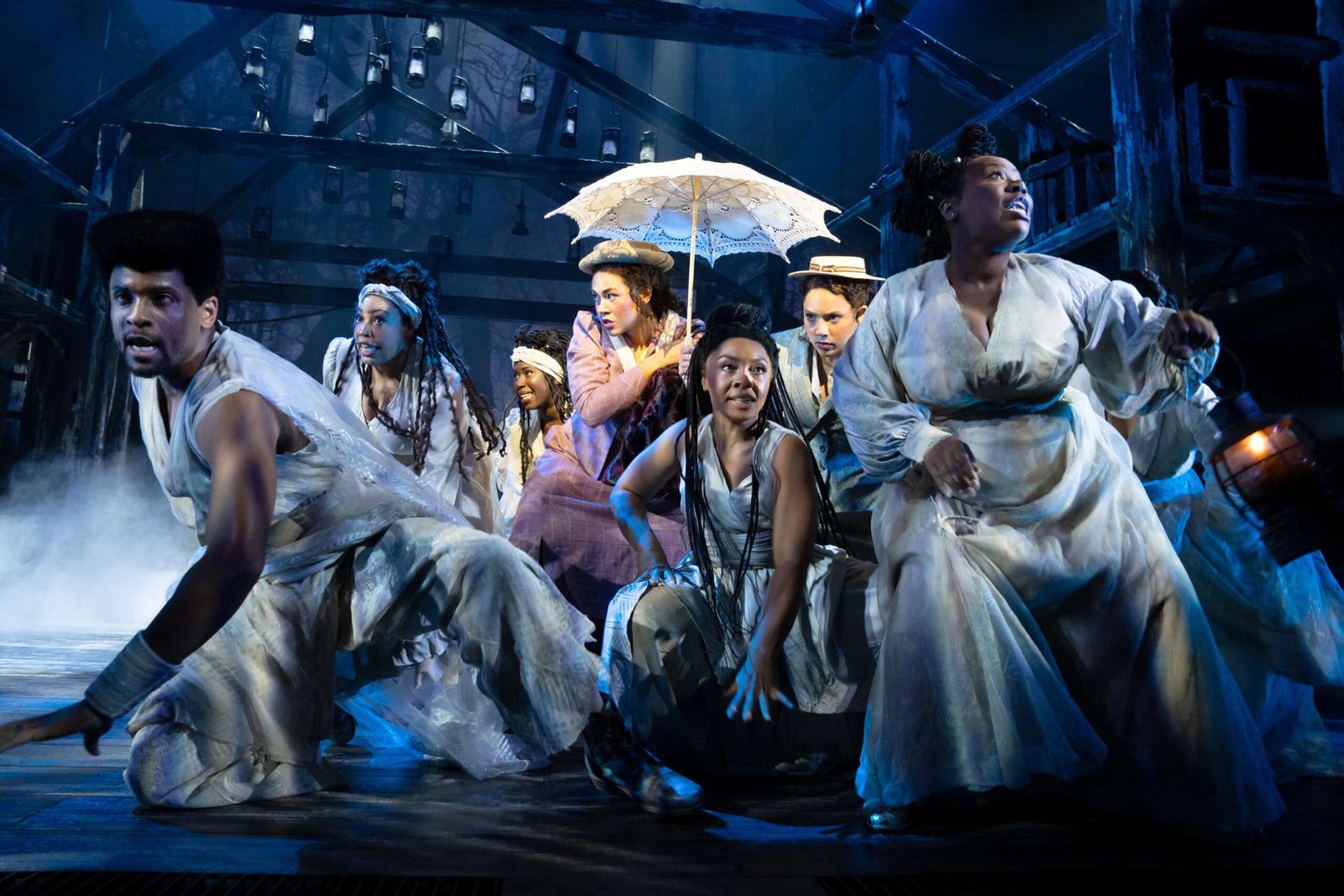
NEW YORK — Dual female protagonists — or, in the parlance of the musical “Chicago,” sister acts — frequently are a key to Broadway success, especially given that women are the buyers of most theater tickets. And, in the case of the new Broadway musical “Wanted,” not only are the sisters actual sisters drawn from U.S. history, but they come armed with a risky but potentially riveting resolve.
Born in Texas in 1893, Martha and Mary Clarke decide to exit the cotton fields and use their light-colored skin to pass as white to help their feisty but struggling sharecropper mother fight a landowner who wants to keep the three of them down like they are slaves. But they don’t get jobs as bank tellers. Rather, the sisters Clarke become gun-slinging outlaws with weapons hidden in their skirts. Simply put, they figure out how to exploit the debilitating prejudices of the dumb racists who surround them, and set about turning themselves into a two-woman reparations machine. Cash only, suckers.
The marketing for this show makes them look like a Black Thelma and Louise. And for the first several minutes of a musical stacked with a cast of Broadway newcomers, this all works out just fine.
The loving twins, played by Solea Pfeiffer and Liisi LaFontaine, are engaging and their Act 1 relationship with Talullah (Ledisi) is warm and fun. And it’s fun to watch the gun-toting sibs stick up various racist idiots. This is basically an empowering feminist caper-quest musical (structured not unlike Dolly Parton’s “9 to 5,” actually), and Ross Baum’s score has a stirring kind of musical energy (not dissimilar to the score for “The Color Purple”) and comes with rich choral arrangements for the terrific choir-like ensemble, known here as the Kinfolk, a Black chorus instantly making the musical point that it is only white folks who are the Clarke sisters will be fooling.
It’s far from easy to lightly tone what starts out — and to my mind should have remained — a rollicking musical satire when your topic is racism and its legacy. But at first, the lively book and lyrics writer Angelica Chéri pulls that off with the help of an accessible and populist song suite that rightly doesn’t give a damn about being period-specific. Yet more importantly, there is something cheering about a show inherently subverting the “one drop of blood” plot line in Dion Boucicault’s infamous 1859 melodrama, “The Octoroon,” which once played just a couple of blocks from the James Earl Jones Theatre on this very same Broadway.
But the bookwriter Chéri, who is a descendant of one of the protagonists, also has a moral story to tell, and the satire drops away as she complicates her plot by making one sister, Pfeiffer’s Mary, fall in love, improbably, with Jesse (Bradley Jaden), one of her white marks. Meanwhile, the other sister, LaFontaine’s Martha, is quicker to become weary of this self-erasing ruse, hooking up instead with one of Jesse’s Black servants, Elijah (the sweet-voiced Luke James) and waiting to return to her Black identity. Now we’re in a teaching musical, wherein Mary has to learn Who She Really Is.
As part of that pedagogy, Martha even raises her gun on her sister’s new partner. If you can imagine a jealous Glinda deciding to take out Elphaba’s Fiyero, you can imagine what that does to the plot and the relationships between the two young women at its heart.
To say that Martha’s sudden takedown of her sister and her new arrangement comes out of nowhere is to wildly understate. We’ve just spent half a show, staged on a witty set from Beowulf Boritt, dedicated to showing us their love and shared determination and then suddenly they’re one step away from sororicide. I mean, they recover, but the show really does not.
The central problem here is that Chéri can’t have it both ways.
She wants us to love these spunky sib-outlaws and celebrate the clever ways Black Americans found ways to fight back against racism. All of that is great, especially since a highlight of the show is a pair of smart, reactive servants — Sissy and Flo, hilariously played by Aurelia Williams and Awa Sal Secka — who energize Ross’ music by figuring out the Clarke sisters long before anyone else. But Chéri is not about to send Mary and Martha off a cliff, metaphorical or otherwise, even though the show truly would be better if they went down with guns blazing, ideally having previously dispatched a few racist Texans.
Ergo, a problem not uncommon with new musicals, which is to moralize instead of letting characters go where they would logically travel, with the audience providing the wing beneath their wings.
Such a satire would not be for the matinee crowd, perhaps. But if it was to remain in that niche, then the show needed to show us far more sisterly warmth, à la “The Color Purple.” Alas, the two leads don’t connect emotionally with each other anywhere near as much as the audience craves, partly because there is no song that really does that for them and partly because the actors are so busy with all of this plot as Chéri tries to find a way to get them back home.
Add in a less-than-riveting performance from James, who has weak sauce to work with, and “Wanted” ultimately falls off what initially looked like very promising rails.
Chris Jones is a Tribune critic
cjones5@chicagotribune.com
At the James Earl Jones Theatre, 138 W. 48th St., New York; wantedmusical.com
