

Sadie Carroll couldn’t quite believe she was here: backstage at Alice Tully Hall, the famous concert venue in New York’s world-renowned Lincoln Center for the Performing Arts, rehearsing with the Frost Symphony Orchestra (FSO) for a sold-out performance of “San Juan Hill: A New York Story,” a sweeping jazz-orchestral work by Frost School professor Etienne Charles conducted by FSO music director Gerard Schwarz.
“It’s surreal,” said Carroll, a cellist and junior at the Frost School of Music. “I feel so honored to be here. I’ve been smiling non-stop, just trying to take it all in. This is such an incredible opportunity, and I’m so grateful.”
Her awe and excitement were shared by everyone involved in the October 23 performance. For the Frost School’s premiere classical ensemble to be presented by one of the world’s great cultural centers in a grand, cross-genre work commissioned from its faculty represents a new level of achievement for the Frost School—accompanied by a ratcheting up of ambition to meet a new sense of possibility. As the Frost School celebrates its 100th year, “San Juan Hill” at Lincoln Center represents both a fulfillment of the school’s legacy and new potential for the century ahead.
“This is Lincoln Center presenting us,” said Charles. “And it’s them presenting us based on what we have been doing. The word is out on what is happening at the Frost School.”
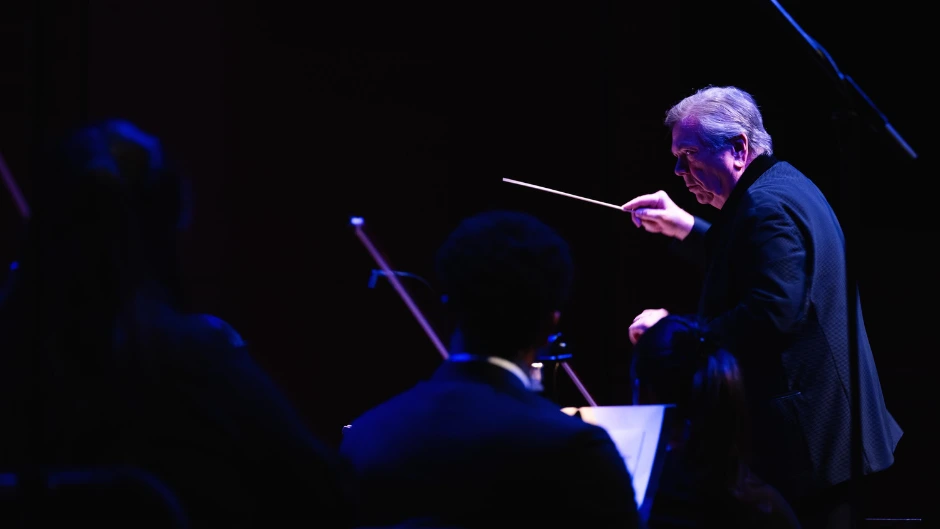
Schwarz, who began his stellar career at Lincoln Center, was thrilled to bring his students and orchestra there. “They trusted us to do something great,” he said. “It’s a very exciting experience to have all of us here together representing the Frost School, but also to play this phenomenal piece.”
Lincoln Center commissioned “San Juan Hill” from Charles as a tribute to the neighborhood of the same name that was torn down to build Lincoln Center. The work premiered at the 2022 re-opening of David Geffen Hall, when it was played by the New York Philharmonic and Charles’ jazz sextet Creole Soul. Lincoln Center brought the work back as a centerpiece of Legacies of San Juan Hill, an expansive program of concerts, film, talks, and scholarly writing on the neighborhood that was the setting for “West Side Story,” whose rich cultural and musical history was largely lost after it was demolished in the 1950s.
Jordana Leigh, Lincoln Center’s vice president of programming, said they wanted to keep “San Juan Hill” alive. “We want to establish this piece as part of the canon and continue its musical life,” she said. “It’s too good not to be heard again.”
For two bright, picture-perfect fall days, Lincoln Center, with its iconic plaza and soaring venues, was home to 70 Frost School students. They stayed at the Empire Hotel across the street; rehearsed in Alice Tully Hall, with its exquisite acoustics; attended chamber music and jazz performances and a rehearsal of the New York Philharmonic; and reveled at being in the heart of New York.
“There’s so much cultural history in this place, and being here makes us feel a part of it,” said Angie Bolivar, a violist and doctoral student.
Charles and Schwarz’s own histories with Lincoln Center were crucial to enabling the Frost School students to join that history. Both men attended The Juilliard School. Charles has played frequently at Jazz at Lincoln Center, which had commissioned him once before. Schwarz began his career as co-principal trumpet with the New York Philharmonic, played with the orchestras for the center’s resident opera and ballet companies, and led the Mostly Mozart Festival for many years. He also taught at Juilliard, where one of his students was Wynton Marsalis, the famed director of Jazz at Lincoln Center.
“Lincoln Center has a long and wonderful relationship with Etienne Charles,” Leigh said. “It’s such a wonderful, full circle moment to have Maestro Schwarz back [here], conducting this important piece.”
When Charles proposed the project to Dean Shelton G. Berg as part of the Frost School’s centennial, Berg immediately said yes, and backed the fundraising that made the trip possible.
“San Juan Hill” required everyone involved to up their game. Charles did extensive research on a neighborhood that fostered jazz greats Thelonious Monk, Benny Carter, and James P. Johnson, who created the Charleston. It was home to a unique mix of Black Southern, Cuban, Puerto Rican, West Indian, Italian, Irish, and Jewish residents who created culture-shifting artists and music.
Charles incorporated that rich range of styles, as well as archival and contemporary film and photos, animation and graphics, live poetry, and even a hiphop turntablist, to create a grand musical and multimedia tapestry. “It was significant because it was such a big project,” he said. “Not just to write for orchestra, but because I wanted to do storytelling.” Although he had arranged for orchestra, he had never composed for one before. He was undaunted. “It was just ‘let’s go, let’s figure this out.’”
Schwarz, a consummate, veteran interpreter of classical scores, said the mix of rhythms and styles in “San Juan Hill” was a challenge for him. “The great education for me was spending time with Etienne,” he said. “He would play or sing every phrase and every rhythm so I could digest it and communicate what was intended.”
The Frost School students were uniquely qualified to fulfill Charles’s vision. A number of FSO members are familiar with jazz, whether as members of the Henry Mancini Institute (HMI) Orchestra or other ensembles. Others come from backgrounds that made styles like mambo or Venezuelan waltz familiar. “Once they got the feel of what Etienne wanted they ran with it,” Schwarz said. “At the Frost School, we do this organically, because it’s the right thing to do musically. And when you do that it’s really successful.”
“The Frost School is a place where you can do a piece like this,” said Charles, who said Schwarz and the FSO illuminated elements of the score he had forgotten composing. “They have a great feel for the music.”For Justin Kinchen, an HMI fellow who plays classical violin and jazz trumpet and composes in both genres, “San Juan Hill” helped vindicate his ambition to work in both.
“It’s very impactful to perform with these worldclass musicians who are doing exactly what I want to do with my career,” Kinchen said after a rehearsal at Alice Tully Hall.
For classical violinist Angela Wang, the FSO concertmaster, the close interaction and new rhythms required for “San Juan Hill” were a revelation. “Etienne can hear everything at the same time and he knows exactly what he wants,” she said after a rehearsal. “It’s amazing to see how precise and creative he is.” The acoustics of Alice Tully Hall amplified her experience. “We can hear each other perfectly,” Wang said. “We embrace each other’s sound. It’s like a chamber music experience.”
Charles and Schwarz are from very different generations and backgrounds. But they bonded working together, developing a profound mutual respect and appreciation. Charles refers to the conductor as “Maestro,” and speaks reverently of his prowess on their shared instrument and Schwarz’s illustrious career, which he touted to Lincoln Center. Schwarz calls Charles a dear friend and “one of the most gifted people I know, as a player, as an arranger, as a composer, as an educator, and as a leader.”
Bringing a new generation of students to a place that fostered them was another powerful shared experience for the pair. When the two educators took the FSO trumpet players to see Marsalis leading a Jazz at Lincoln Center rehearsal, Marsalis stopped rehearsal and introduced Schwarz as his teacher.
“For me it’s a great thing to see these people studying with me play here,” said Charles, who has Frost School student Brenten Handfield playing drums in Creole Soul. “Our job is to train the next generation of professionals. This is what we’re supposed to do.”
“This is a coming home for us,” said Schwarz. “For me to bring these students I care about so much here, especially in a piece by my dear friend Etienne Charles, is very important.”
On the night of the performance, hundreds of people filled the lobby of Alice Tully Hall, including a beaming Dean Berg and his wife Julia, a number of Frost School donors, staff, faculty, and proud parents of FSO musicians from as far away as Boston and Taiwan.
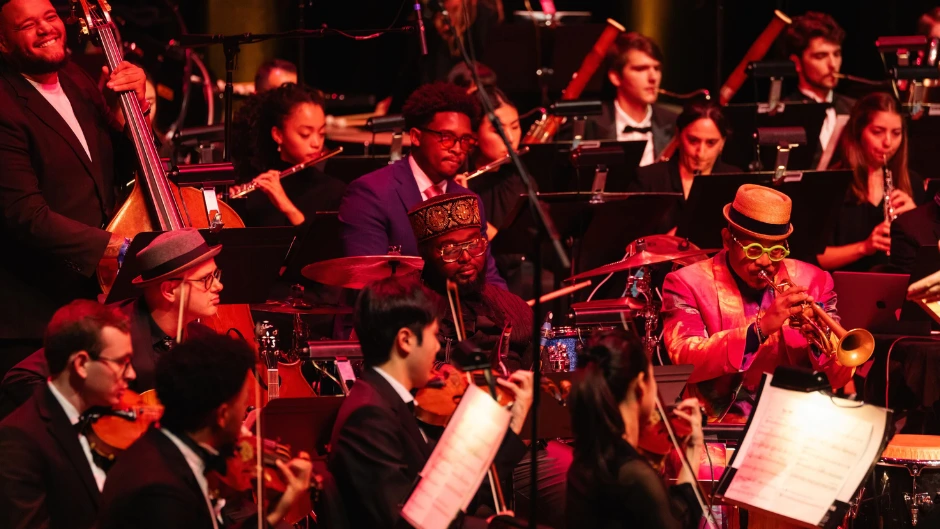
Inside the theater, the Frost Symphony Orchestra fanned out around Creole Soul to fill the stage. Charles, in a multi-colored suit so bright he seemed to glow, sat at the center on trumpet, congas, cajon, and a red tambourine; with Schwarz at the podium directly in front of him.
The audience was rapt as “San Juan Hill” unfolded, starting with Creole Soul in segments that were lyrical and swinging by turns. As the orchestra joined them, the sound swelled, massive, yet rhythmically agile and melodically rich. Schwarz led the strings, brass, percussion, and woodwinds in intricate counterpoint with Creole Soul, anchored by Charles in aching trumpet solos or intense drumming. Live poetry from spoken word artists Eljon Wardally and Carl Hancock Rux, and a flow of imagery on a giant screen, illuminated sections like the lush “Negro Enchantress” which told the story of Hannah Elias, who created a scandal when she inherited a fortune from her married lover; and “Charleston at the Jungles” a driving, exuberant rendition of the famous dance.
For the finale, “House Rent Party,” Charles invited the audience to imagine a gathering of “everybody from everywhere” in San Juan Hill, as the orchestra swung into an irresistible celebration, from ragtime to mambo to calypso to funk, dynamic and sumptuous. The audience responded with an enthusiastic standing ovation, while Charles and Schwarz stood, visibly emotional, arms across each other’s shoulders, with the awed-looking musicians standing around them.
In coming together to bring a community and an era to musical life, these Frost School artists had opened the way to another era for the school itself.
Photos 1-2 the Frost Symphony Orchestra at Alice Tully Hall, by Lawrence Sumulong, © Lincoln Center. Photo 3 of Etienne Charles and Gerard Schwarz, photo 4 of Etienne Charles with Dean Shelton G. Berg and Julia Berg, both courtesy Frost School of Music.