

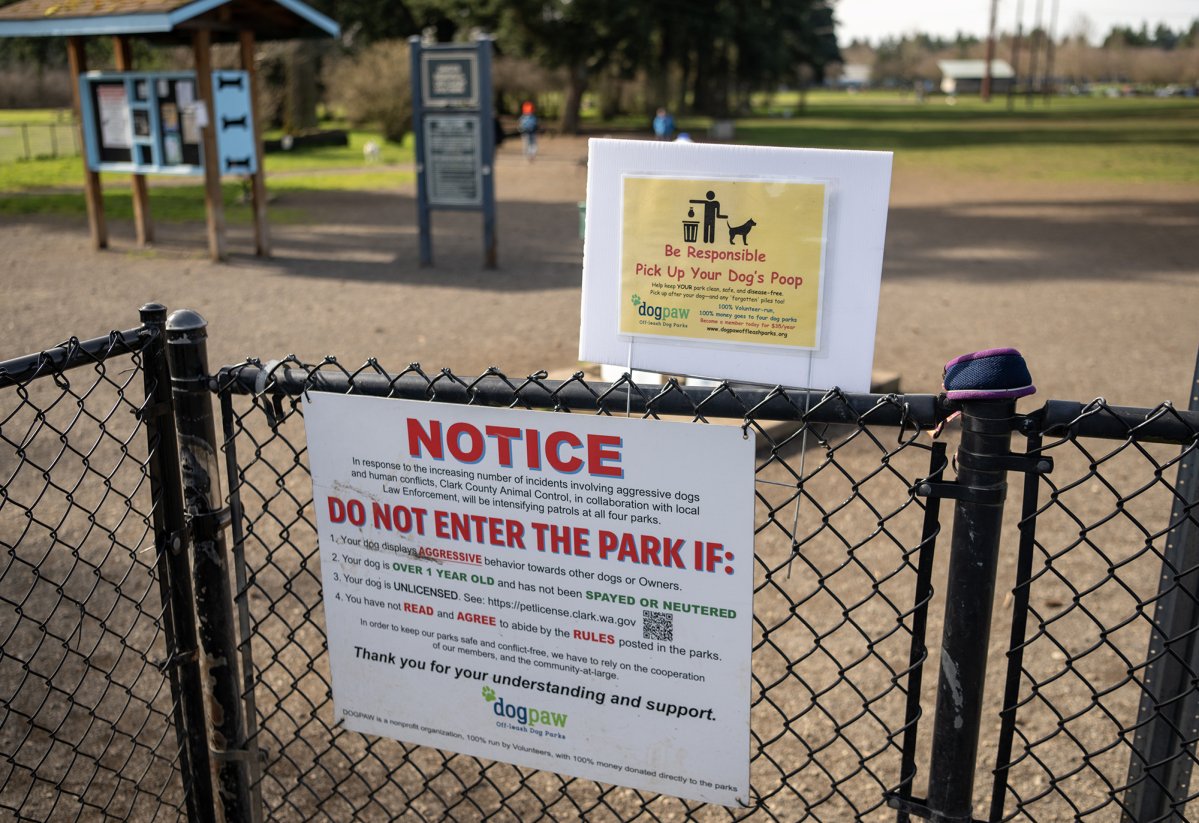
Washougal and other cities have a message: Please pick up after your pet.
When pet owners don’t, rainwater carries the waste into drains, ditches, lakes and rivers.
“If people forget their bag, they think, ‘Well, it’s natural. It will decompose.’ And that’s not the case. Bacteria and pathogens are in pet waste,” said Rita Fallin, stormwater program coordinator for Washougal.
While dog waste can take a couple months to break down in warmer, humid climates, here in the Pacific Northwest it can take six months to a year or longer. Meanwhile, rain carries fecal matter bit by bit into nearby water sources. E. coli, salmonella, giardia and roundworms can end up in fish and shellfish in the river, which can then be passed on to humans.
Fallin said the city gets a lot of complaints about pet waste left behind at city parks, especially at Schmidt Family Park and Elizabeth Park, both near the Washougal River.
To demonstrate the severity of the problem, Washougal staff went to both parks in January to plant yellow flags at every waste spot they could find, an idea Fallin said she copied from Kirkland.
“We found 133 piles of unscooped pet waste — and that was just at Schmidt Family Park,” she said. “We found another 20 in Elizabeth Park, but we were only able to cover about half of the park that day.”
Washougal’s municipal code enables the city to fine pet owners $250 if they don’t pick up after their dogs.
“Those 133 piles just in Schmidt Family Park that were unscooped — that’s $33,250 in potential fines. We do take it seriously,” Fallin said.
Fallin said the city hopes to see the same improvements Kirkland saw from its programs.
“The city of Kirkland used this type of outreach and it was very low cost. By the time they went out to do their second round of flagging, unscooped poops had gone down 80 percent,” she said.
The problem goes beyond Washougal. Clark County, the cities of Vancouver, Ridgefield and Camas, Clark Conservation District and others are also working to get the word out about the importance of picking up pet waste.
Founded by Clark Conservation District, Poop Smart Clark is a collaborative effort with Clark County and Washington State University Extension focused on identifying and correcting water pollution sources.
“Many of Clark County’s streams and lakes exceed the state standards set by the Department of Ecology for bacteria, such as E. coli. These bacteria can make people and animals sick when ingested or contacted, meaning that contaminated water poses a significant threat to public and environmental health,” said Mackenzie Barron-Tai, project manager for Clark Conservation District.
She said bacteria and other material from pet waste in stormwater runoff can be made worse in areas with a lot of impervious surfaces such as roads and sidewalks. According to the Stormwater Partners of Southwest Washington’s Canines for Clean Water program, the county’s 110,000 dogs collectively produce 20 tons of waste daily.
Each gram of dog waste contains over 23 million fecal coliform bacteria.
“It is critical to scoop, bag and dispose of pet waste every time to reduce the amount of bacteria polluting the water, even at home,” Barron-Tai said.
Additional testing completed by the county’s clean water division identified livestock, dogs and deficient septic systems as the three primary sources of fecal bacteria pollution in the region, she said.
“We are also partnering with local pet waste removal services to distribute educational materials and raise awareness of the impact that pet waste has on water quality,” Barron-Tai said.
Since its inception in 2021, Poop Smart Clark has invested $1.9 million in septic and livestock-related financial assistance for Clark County residents and has reached thousands of community members through educational materials and outreach events, she said.
Washougal has installed 14 waste bag stations at city parks and another four stations at stormwater facilities used as informal parks to help combat the problem.
“Over the last two years, we have consistently given out over 36,000 bags each year at those 14 stations … and about 9,000 bags at the others,” Fallin said. “The city is bearing the cost of 45,000 bags a year, which is potentially 182,000 pounds of dog waste in our small city.”
Fallin plans to do another flag planting at one of Washougal’s parks prior to the city’s Earth Day celebration on April 25 and will present the findings then.