

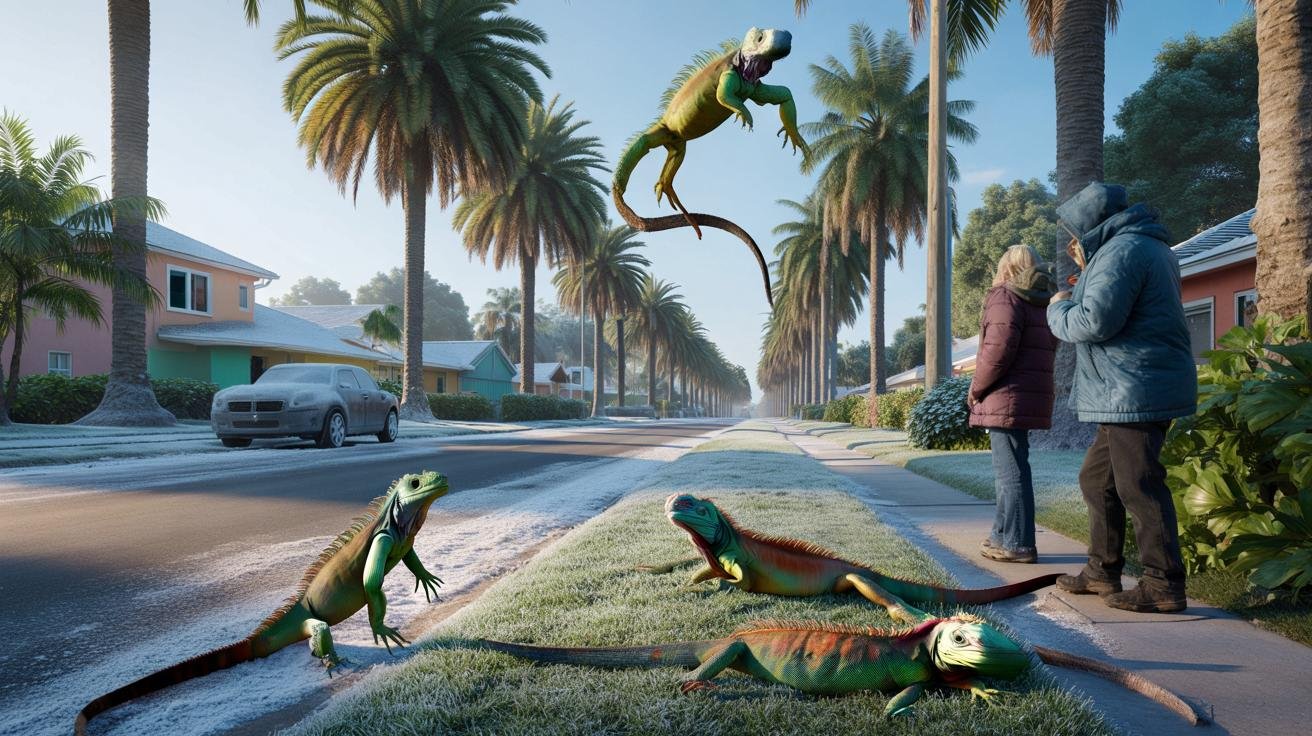
From Florida’s beaches to North Carolina’s mountains, a fast-moving winter storm flipped the script on the usually mild South, triggering traffic chaos, power cuts, and a bizarre sight in Miami: stunned iguanas tumbling out of trees.
Cold snap turns Florida’s tropical scene upside down
Florida did not wake up to blankets of snow like some of its neighbours, but the state’s trademark warmth vanished overnight. Orlando hit 24 °F (-4 °C), the lowest February temperature recorded there since at least 1923. Normally, central Florida in late winter hovers between cool nights of around 12 °C (mid‑50s °F) and comfortable daytime highs of about 23 °C (mid‑70s °F).
The rapid plunge left many residents shivering in homes built for heat and humidity, not Arctic gusts. Heat pumps strained, citrus growers worried about frost damage, and social media filled with photos of frost-coated lawns under palm trees.
Orlando’s early‑February low of 24 °F (-4 °C) broke a century-old record and signalled just how far south the Arctic air had reached.
In Miami and other parts of South Florida, the cold wasn’t only a human problem. It turned into an emergency of a different kind for one of the state’s most notorious invasive species: the green iguana.
‘Raining iguanas’ as reptiles freeze and fall
Local TV station WPLG in Miami described Sunday morning as “raining iguanas”, and the phrase quickly spread online. Residents stepping outside found large, motionless lizards scattered on pavements, car bonnets, and beneath backyard trees.
Green iguanas, originally from Central and South America, are cold‑blooded. They rely on external heat to regulate body temperature. When the air dips towards freezing, their muscles stop working properly. The animals enter a stunned, torpor‑like state and can no longer grip branches.
When iguanas lose muscle control in a cold snap, they can literally drop from the trees while still alive but immobile.
People posted videos showing seemingly lifeless reptiles lying on the ground, their limbs stiff. Wildlife experts stressed that many of these animals were not dead. Once temperatures climb again, a good number of them recover and scramble away.
➡️ The return of the aircraft carrier Truman, a signal badly received by the US Navy facing future wars
➡️ Meet the K-222, the fastest nuclear submarine in history, capable of exceeding 80 km/h
➡️ Leggings are over: Decathlon hits hard with a new ultra‑comfortable, on‑trend winter trouser
➡️ Legendary rock band retires after 50 years “the hit everyone knows”
Jessica Kilgore, who runs “Iguana Solutions”, a removal and control service in South Florida, reported collecting hundreds of pounds of iguanas during the cold spell, both living and dead. For professionals like her, a freeze can be a brief window to capture a species that usually evades control.
Why cold knocks iguanas out of trees
The phenomenon is dramatic but grounded in basic biology. As reptiles, iguanas cannot generate their own body heat. Their internal temperature closely tracks the environment.
- Around 10 °C (50 °F): iguanas become sluggish and move less.
- Close to 4 °C (40 °F): muscle control can fail, leading to falls.
- Below freezing: tissue damage, frostbite and death become likely.
South Florida’s wild iguanas evolved in warmer climates where such cold snaps are rare. When temperatures crash, they have no time to adapt, and the result is the now familiar “iguana rain” that occasionally follows Florida cold fronts.
Authorities respond to an invasive species opportunity
The Florida Fish and Wildlife Conservation Commission (FWC) issued an executive order allowing people to transport iguanas to agency offices. In Florida, the species runs wild but cannot be kept as a pet without a permit, reflecting concerns about its impact on local ecosystems.
Green iguanas dig burrows that can undermine seawalls and sidewalks, raid gardens, eat native plants and bird eggs, and add pressure to already stressed habitats. Cold weather, as harsh as it seems, sometimes offers a natural check on their growing populations.
| Issue | Impact of cold snap |
|---|---|
| Invasive iguanas | Increased capture and mortality, temporary population reduction |
| Public safety | Falling reptiles pose minor hazards; guidance needed to avoid handling bites |
| Wildlife management | Chance to remove invasive animals with reduced effort |
Officials urged residents not to panic if they saw frozen-looking iguanas but also warned against picking them up. A revived animal can thrash or bite, creating an unexpected risk for well‑meaning helpers.
Snow, crashes and power cuts across the southern states
While Florida dealt with reptile rain and record lows, states farther north wrestled with a more familiar winter threat: heavy snow and ice. North Carolina, a state that usually reserves deep snowfall for its highest peaks, found lowland communities buried.
Lexington reported around 16 inches (40 cm) of snow, while Faust, a community in the Walnut Mountains, measured 22 inches (56 cm). These totals ranked among the highest in the region for this storm.
North Carolina recorded more than 1,000 road collisions over the weekend, with at least two deaths blamed on the hazardous conditions.
Governor Josh Stein urged residents to stay off the roads as plough crews and emergency services struggled to reach stranded vehicles. He also reminded people to watch for frostbite symptoms, especially in those who had to spend time outdoors clearing snow or working in the cold.
The coastal Outer Banks, famous for holiday homes and sweeping beaches, saw overwash along its main highway. Powerful winds and high tides pushed ocean water across the narrow strip of road, shutting sections and delaying reopening.
Air travel took a heavy hit. At Charlotte Douglas International Airport, a key hub for American Airlines, more than 800 flights were cancelled on Sunday alone, stranding thousands of passengers across the country.
Storm follows a deadly winter onslaught
This latest system arrived barely a week after a massive winter storm that had swept across much of the United States, killing more than 100 people and leaving communities encased in ice and snow. For many in the South, it felt like yet another blow in an already punishing season.
The National Weather Service said snowfall in the Carolinas would ease on Sunday, with the storm’s core sliding offshore and evolving into an intense cyclone over the Atlantic. High winds, though, were forecast to race up the East Coast, threatening more travel disruption and coastal flooding.
By Sunday, around 158,000 electricity customers were still without power, mainly in Mississippi, Tennessee, Florida, and Louisiana. Outages in freezing temperatures raise concerns about hypothermia, carbon monoxide poisoning from unsafe heating, and strain on hospitals and shelters.
Understanding frostbite, hypothermia and cold risks
With temperatures plunging far below normal for the region, doctors and officials redoubled warnings about cold-related health risks. Two main conditions worry them most: frostbite and hypothermia.
- Frostbite is damage to skin and underlying tissue caused by freezing. Fingers, toes, ears and noses are most vulnerable.
- Hypothermia occurs when the body’s core temperature drops below about 35 °C (95 °F), affecting the brain and heart.
Early signs of frostbite include numbness, tingling and pale or waxy skin. Hypothermia can cause intense shivering, confusion and slurred speech. In both cases, quick warming, without direct high heat, can reduce long-term damage.
What ‘bomb cyclone’ means and why it matters
Forecasters have warned that the East Coast could be brushed by a so‑called “bomb cyclone” this weekend. The term sounds dramatic, but it describes a specific process: a mid‑latitude storm whose central pressure drops very quickly, at least 24 millibars in 24 hours.
A deepening cyclone of this kind can generate strong winds, heavy precipitation, and rough seas. When it forms close to the coast, it can intensify existing problems from an earlier storm, like coastal flooding, beach erosion, or more snowfall inland where cold air lingers.
For residents, that means staying alert even after the snow stops. A clear morning can turn into an afternoon of renewed gales, fresh power cuts and travel disruption as the system races northeastward offshore.
Climate context: rare cold, rising warmth
Episodes like “raining iguanas” and snow-choked roads in the South tend to trigger debate about climate change. One cold outbreak does not disprove global warming; long-term averages still show rising temperatures across the US.
Some climate researchers are studying whether a warming Arctic might sometimes disrupt the polar jet stream, letting pockets of frigid air spill farther south. The science is still contested, but people in Florida watching iguanas fall from trees can feel how abrupt those Arctic incursions can be.
At the same time, warming trends lengthen the hot season and make heatwaves more intense in the very same regions. That means ecosystems and infrastructure must cope with a wider range of extremes: from freeze‑triggered reptile falls in winter to brutal humidity and storm‑fuelled hurricanes in summer.
For now, communities across the southern US are balancing immediate clean‑up with longer-term questions. How do you build roads, grids and homes ready for both 40 °C heat indices and sudden freezing nights? And in Florida, how do you manage a landscape where even a cold snap turns into an unexpected shower of stunned iguanas?