
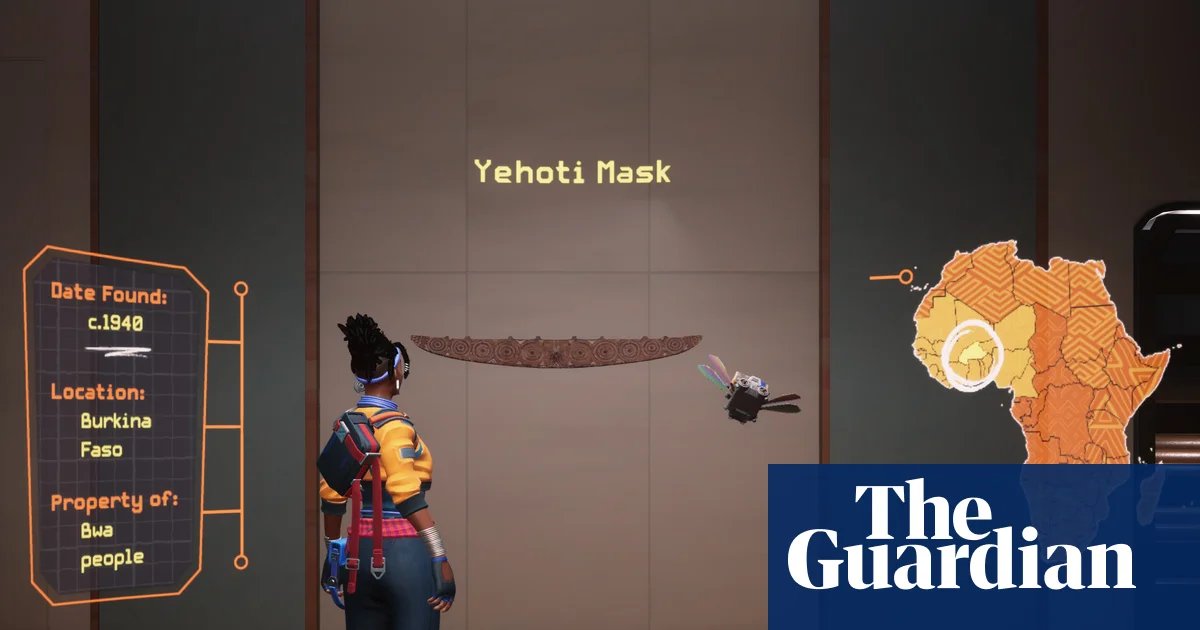
A new South African video game lets players take back African artefacts held in western museums in a series of heists, amid a growing campaign to repatriate treasures looted by colonial armies.
Players of Relooted become South African sports scientist and parkour expert Nomali, as she leaps and dives through museums to retrieve 70 real objects. They include an Asante gold mask that was taken by the British army when it destroyed the Asante empire’s capital, Kumasi, and is now in the Wallace Collection in London. Another object is the skull of the Tanzanian king Mangi Meli, which was taken to Germany after its colonial regime executed him in 1900.

Hundreds of thousands of culturally and spiritually significant items were looted from Africa during the 19th and 20th centuries, when European countries carved up the continent into colonies. A 2018 report commissioned by the French president, Emmanuel Macron, estimated that more than 90% of Africa’s material cultural heritage was held outside the continent.
Berlin’s Ethnologisches Museum and Cambridge University are among the institutions to have returned Benin bronzes to Nigeria, for example. Others, including the British Museum, have resisted calls to return bronzes and other looted objects.
Ben Myres, chief executive of Nyamakop, which developed Relooted, said: “Real-life repatriation is enormously complicated and it’s been ongoing for decades, in some cases even a century or more … We’re giving people this hopeful, utopian feeling … of what it’s going to feel like when all these artefacts finally come home.”
Myres started creating the game in 2018 after his mother returned from the British Museum outraged at seeing the Nereid Monument, a Lycian tomb from Turkey. The museum says it was brought to the UK “with the full permission of the Ottoman Turkish authorities”.
“She was shocked by the audacity of stealing a building … and she very flippantly said you should make a game about taking this back to where it belongs,” he said.
The game was created by a team from more than 10 African countries, while voice actors were hired from the countries of the characters that make up Nomali’s heist crew.
Mohale Mashigo, the game’s narrative director, said: “If we were going to go as far as researching real artefacts, getting a pronunciation guide for the artefacts, creating these characters from Cameroon, DRC, Malawi and [more], I wanted to make sure it sounded like different voices from different places.”
Mashigo created an “Africanfuturist” vision of the continent at the end of the 21st century, with cities and countries that “work for people”, rather than the more fantastical genre of Afrofuturism.
In contrast, Europe and the United States were intentionally made generic, as “The Old World” and “The Shiny Place” respectively. “We wanted to parody the way the west represents Africa,” Myres said.
The museums are also not real, apart from the Museum of Black Civilisations in Dakar, where players return the looted objects to an symbolically empty hall before they make their final journey to their home country.

For the game producer, Sithe Ncube, it was important that the Kabwe Skull, a 300,000-year-old fossil discovered in her country, Zambia, was included. The skull, also known as Broken Hill Man, is in London’s Natural History Museum.
She said: “Even before I started working at Nyamakop … I just felt like … someone should get it back and it would be cool for someone to do this in some form of media, in a game.”
Creating Relooted was an eye-opening experience, Ncube said. “Learning about the scale of artefact looting in Africa, up to now I still can’t wrap my head around the numbers. It seems quite ridiculous and probably underestimated as well.”