Sign up for Executive Dysfunction, a newsletter that highlights one under-the-radar story each week about how Trump is changing the law—or how the law is pushing back. You’ll also receive updates on the latest from Slate’s Jurisprudence team.
For as common as food poisoning is—according to the Food and Drug Administration, there are approximately 48 million cases in the U.S. each year—rarely do outbreaks go viral, both literally and culturally, like Cyclospora has over the past month. One reason this outbreak has proved the exception is likely due to the pathogen’s “explosive diarrhea” side effect, and the lowbrow comedic opportunities that naturally arise. But an even bigger reason is that we continue to know relatively little about its origin. Given the state of epidemiology and data analysis, food poisoning probably shouldn’t be a monthlong mystery, and yet here we are.
Surely the decimation of federal government agencies, among them the Centers for Disease Control and Prevention and the FDA, factors into why this outbreak remains a mystery. The Foodborne Diseases Active Surveillance Network, a collaborative federal-state program led by the CDC, saw its funding drastically cut by Health and Human Services Secretary Robert F. Kennedy Jr. in July 2025, when FoodNet went from surveilling eight pathogens to two, with Cyclospora joining Campylobacter, Listeria, Shigella, Vibrio, and Yersinia on the ignored pile.
To use the terminology of the late Supreme Court Justice Ruth Bader Ginsburg, Kennedy has been throwing away umbrellas in the middle of a storm left and right since he took the helm: Monitoring for measles, screwworm, flu, and Ebola all saw funding cuts. Who needs umbrellas when you’ve got a tanning bed, a chin-up bar, beef-tallow stockpiles, and a gallon of only-sometimes-poisonous raw milk? The CDC and FDA have lost at least 6,000 workers, many arbitrarily, many in crucial positions. Kyle Diamantas, a lawyer with no public health credentials and a hunting buddy of Donald Trump Jr., now leads the FDA, while Jay Bhattacharya, who made a name for himself advocating for herd immunity during the COVID-19 pandemic, leads the CDC.
Poop jokes and memes aside, cyclosporiasis is a serious parasitic foodborne intestinal illness whose symptoms include nausea, fatigue, and explosive diarrhea that can last weeks or even months without antibiotic treatment. Tracing its source poses particular difficulties for two reasons: an incubation period of up to two weeks before symptoms first appear, and lack of a genetic fingerprint, unlike, say, E. coli. Monitoring like FoodNet had previously been doing, is helpful, but it’s difficult to make direct causal connections based on what-ifs, no matter how likely. Moreover, one expert I spoke with, Sarah Taber, a small farmer and crop scientist, describes FoodNet as a “long term library of disease data,” not a reactive tool that’s useful in real time. There are more obvious culprits for HHS’s failure to protect Americans from this outbreak.
The purpose of the Food Safety Modernization Act, passed in 2011 and signed into law by President Barack Obama, with strong bipartisan support, was to shift the federal response to foodborne illnesses from reaction to prevention. Per the act, the FDA was ordered by Congress to establish traceability standards for high-risk foods, but the food industry pushed back, asking for additional time to comply with recordkeeping and coordination demands, citing complexity. As the most recent due date approached this past January, Congress stepped in, instructing the agency to delay enforcement of the Food Traceability Rule until July 20, 2028. Seventeen years after the FSMA was passed, the FDA is still reacting to the sorts of foodborne illness breakouts the act was intended to preemptively address.
The FTR, if it ever becomes enforceable, would require entities directly involved in the food supply chain to keep electronic records documenting “critical tracking events” and predefined “key data elements” of any foods on a “Food Traceability List,” enabling the FDA to track contaminated food through the supply chain much more rapidly during outbreak investigations.
Everyone I spoke with described the current process of tracing foodborne illnesses as laborious and slow and hampered by an absence of a unified approach. State health agencies take the lead in interviewing patients, and those agencies are disparately funded. Impacted companies also do much of the investigative legwork, out of necessity and self-interest.
Last week, Taco Bell announced that it had voluntarily removed potentially affected lettuce from its supply chain; the FDA followed up the same night with an announcement of its own, stating that per “epidemiological information collected by CDC,” 1,644 people infected with Cyclospora reported having also eaten at Taco Bell in five states between May 13 and July 13. The FDA’s release also noted that its own investigation identified a “single supplier of iceberg lettuce from Mexico used by Taco Bell,” but oddly declined to name the supplier.
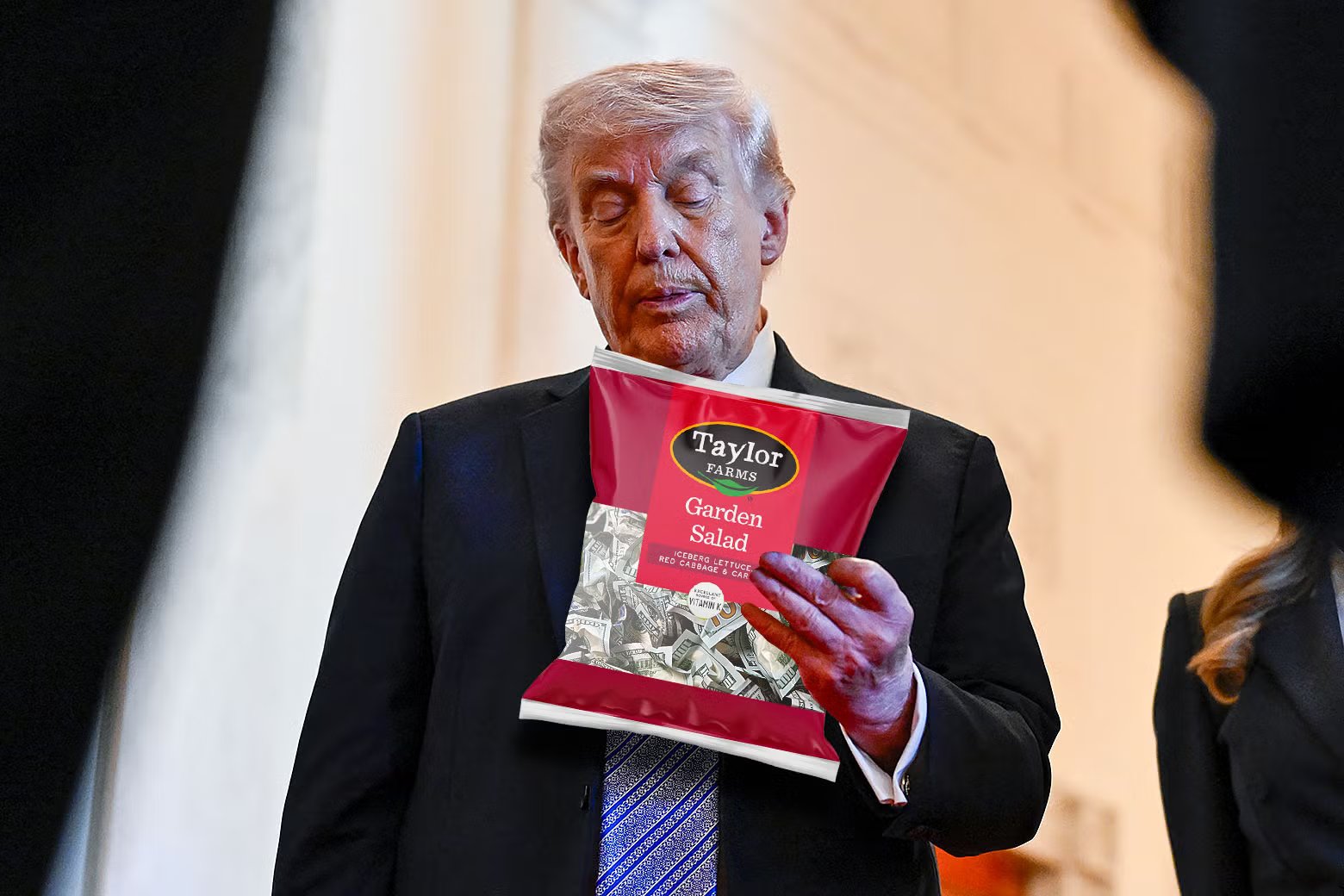
The next day, that name emerged: California-based Taylor Farms, the third-largest producer of fresh produce in the U.S., specializing in packaged salad kits and fresh-cut vegetables. The company, which employs at least 20,000 people and operates an estimated 30 processing plants, reported $6 billion in revenue in 2022.
Less than 24 hours after the FDA had warned the public about Taco Bell in five states, Taylor Farms quietly issued a recall notice identifying a string of products from its plant in Central Mexico that had been distributed between June 29 and July 16 to 29 U.S. states. The recall notice is remarkable in its opacity, identifying the outlets by internal code names instead of ones the public would recognize (e.g., MARK, rather than Walmart). The FDA’s accompanying announcement was also odd, choosing to pinpoint the supplier as “Taylor Farms de Mexico of Guanajuato, Mexico,” as if to subtly insinuate that the company was Mexican instead of a Californian company operating a plant in Mexico.
Taylor Farms provided more fuel for suspicion after it removed a note from its website that had claimed that “no Taylor Farms–branded salads or kits are associated with this outbreak,” an omission that was caught by Consumer Reports’ Paris Martineau, who pointed to the inclusion of a TF brand in Taylor Farms’ recall notice. Does TF stand for Taylor Farms? Maybe, and perhaps even probably, but who can actually say? Not the public.
According to the New York Times, the very same night the agency was blaming Taco Bell, Taylor Farms executives were meeting with officials from the White House and the FDA “to try and distance the company from the outbreak and air concerns about the official investigations into the outbreak.”
If the obfuscatory messaging and attempts to duck transparency by the seemingly concerted efforts of the FDA and Taylor Farms aren’t yet painting a clear picture, consider also that Taylor Farms (as Taylor Fresh Foods Inc.) donated $1 million to the MAGA Inc. super PAC on March 26, 2025, less than a week after the agency announced that it would delay enforceability of the FTC until 2028. Taylor Farms has donated more than $3.8 million to conservative groups, and CEO and founder Bruce Taylor has personally donated more than $1 million to Republican-aligned PACs over the past two decades.
Then, on Sunday, the story got much stranger when the FDA announced that the sample provided by “Taylor Farms de Mexico,” which had initially tested positive, was actually a false positive. Taylor Farms quickly issued an audacious statement: “Today, FDA apologized to us,” which is not what the agency did. Did the FDA run interference for Taylor Farms? That seems exceedingly likely. Did it confuse the public? Definitely.
Jennifer McEntire, a food safety consultant, assured me that this statement in no way exonerates Taylor Farms, because it “does not change the traceback (combing through supply chain records to reconstruct the path products took in order to see if, when looking at all the places ill people ate, they have a common source) and epidemiology that led the agency to implicate Taylor Farms Mexico facility.”
I also spoke with Bill Marler, a Washington-based attorney who has litigated numerous food poisoning cases against the food industry, who made a similar point on his blog: “The lots that sickened more than a thousand confirmed cases—against state-reported numbers many times higher—were eaten and thrown away long before anyone thought to swab anything. A negative product sample in a Cyclospora outbreak, or the absence of a positive one, proves nothing.”
Indeed, both the FDA and Taylor Farms made clear that the company, “in an abundance of caution,” will go through with the “voluntary” recall. But the public messaging could not be more duplicitous. At a time when the CDC has tracked nearly 7,000 confirmed cases nationwide, 4,300 of them in Michigan—all surely undercounts, given that many people won’t bother to seek medical care for diarrhea—the FDA appears preoccupied with affording Taylor Farms a degree of plausible deniability, while amplifying its clunky attempts to shift blame onto Mexico and Taco Bell. These tasks are in sharp conflict with the agency’s congressional mandate to serve the public, whose trust in the government is already at a historic low.
Of course, so much of what’s otherwise known points a finger directly back at Taylor Farms, false-positive atom splitting notwithstanding, and there’s only so much the company can do to deflect. Its PR team would likely better serve Taylor Farms by being fully transparent with the public, but it perhaps shouldn’t surprise anyone that a company willing to align itself with this administration, as Taylor Farms has, would approach admitting fault as a third rail.
Improving food traceability in response to foodborne illnesses was unambiguously addressed by Congress 15 years ago, but the players to whom it would apply and obligate, Taylor Farms prominent among them, are squarely in the way of its implementation.