
You May Also Like


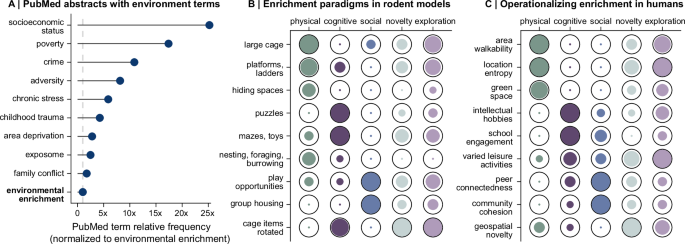
Environmental enrichment paradigms in rodents comprise physical, cognitive, and social stimulation, novelty, and exploration opportunities (Fig. 1B). Enrichment encourages animals to engage with their surroundings and conspecifics while necessitating continuous learning and adaptation to experiential diversity. Decades of research have established that enrichment is protective preclinically: it attenuates depression- and anxiety-like behaviors following maternal separation in juvenile animals, mitigates adolescent behavioral deficits in genetic and pharmacological models of schizophrenia, and reduces stress-induced drug self-administration and fear behaviors in adults. Enrichment thus fosters healthy outcomes across ontogeny despite biological perturbations, stress, and adversity, distinguishing it as a driver of resiliency.
Enrichment likely facilitates resilience through coordinated cognitive and neural effects. Compared with standard housing, rodents in enriched environments exhibit a 10% improvement in learning and memory, a pro-cognitive effect seen during adolescence and adulthood that increases to 25% in animals exposed to stress [1]. Enrichment also enhances neural plasticity—it increases neocortical and hippocampal plasticity during development and reactivates juvenile-like plasticity in adulthood—by modulating plasticity-regulating factors including parvalbumin interneurons, myelination, perineuronal nets, and BDNF [2]. Together, these findings suggest that enrichment may reduce susceptibility to psychiatric phenotypes by inducing cognition-linked increases in plasticity that promote adaptability. Indeed, enrichment alleviates stress-induced cognitive deficits in adolescent mice by upregulating parvalbumin interneuron activity [3] and adult mice with extended critical period plasticity are resilient to depression [4].
