

How Dead Are Democrats? – by Michael A. Cohen

I’m Michael A. Cohen, and this is Truth and Consequences: A no-holds-barred look at the absurdities, hypocrisies, and surreality of American politics. If you were sent this email or are a free subscriber and would like to become a paid subscriber, you can sign up here.
If money is tight or you’re already up to eyeballs in subscriptions, here’s another idea — share this article. Email it to a friend (or even an enemy). Post it on Facebook, Twitter, or LinkedIn. Text or email it to your wife, husband, mother, father, brother, sister, or even your creepy second cousin who lives in Tombstone, Arizona. Word of mouth is often the best way to build support for a creative endeavor, so if everyone here sends it to just one person, it would be much appreciated.
Last week’s chat is still open, so if you have questions, particularly about this piece, please click below and fire away.

Axios this morning has nothing but bad news for Democrats:
-
The party has its lowest favorability ever.
-
No popular national leader to help improve it.
-
Insufficient numbers to stop most legislation in Congress.
-
A durable minority on the Supreme Court.
-
Dwindling influence over the media ecosystem, with right-leaning podcasters and social media accounts ascendant.
-
Young voters are growing dramatically more conservative.
-
A bad 2026 map for Senate races.
-
Democratic Senate retirements could make it harder for the party to flip the House, with members tempted by statewide races.
-
There are only three House Republicans in districts former Vice President Harris won in 2024, a dim sign for a Democratic surge. There were 23 eight years ago in seats Hillary Clinton won.
-
And, thanks to the number of people fleeing blue states, the math for a Dem to win the presidency will just get harder in 2030.
But it’s this quote from Doug Sosnik jumped out to me:
[Sosnik] told us this is Dems’ deepest hole in at least the 45 years since Ronald Reagan’s victory in 1980. Sosnik said the 2024 election was at least as much a repudiation of Democrats as it was a victory for Trump
Historically, Sosnik is a bit off-base here. 1981 Democrats still controlled the House — and won 26 seats in the 1982 midterm. Compare that to 2004, when Republicans held the White House and picked up seats in the Senate and House, which they already controlled. In 2016, Republicans won control of all three branches of government. In 1988, Republicans won a third straight presidential election, and in 1994, when Republicans ended Democratic control of the House of Representatives for the first time in 40 years. Democrats are in bad shape right now, but we’ve also seen this movie before.
A Vote For Trump Or A Vote Against Democrats?
However, my bigger problem with Sosnik’s argument is his claim that 2024 was a repudiation of Democrats as much as it was a victory for Trump. I think it’s fair to say that 2024 was a rejection of the Biden/Harris presidency. But down-ballot, the story is more complicated. In four states that Trump won, Senate Democratic candidates prevailed (Michigan, Wisconsin, Arizona, and Nevada). Democrats lost the Senate, but except for Pennsylvania, a race Bob Casey lost by 0.22 points, Dem losses were restricted to red states that Trump won handily. In North Carolina, a state that Trump also won, Democrats won all the other major statewide races, including governor, lieutenant governor, secretary of state, and attorney general.
In the House, Democrats picked up a seat (though they should have done better considering the number of vulnerable Republicans). Considering the reversal of fortune for Democrats on the presidential level (Biden won by 4.5 points in 2020,) one would expect down-ballot Democrats to have fared worse. The 2024 election might have been a rejection of the Biden presidency, but it’s far from clear that it was an overall rejection of the Democratic Party.
Trump arguably did better than congressional Republicans, which suggests that at least some portion of his vote was Trump-centric rather than GOP-centric. And there’s no guarantee that the voters who put Trump over the top in 2024 will turn out for a different Republican presidential candidate in 2028.
One of the takeaways from 2024, as well as the 2022 midterms when Democrats picked up a Senate seat, limited their losses in the House, and overperformed based on historical precedent, is that Republicans have a difficult time when Trump is not on the ballot (and he won’t be in 2028). In 2018 and 2022, Republicans underperformed (and they’ve been regularly smoked in special elections). In 2020, Republican candidates generally ran even with Trump (only one Republican Senator won a state that Trump lost); in 2024, his coattails were relatively small.
The 2026 Electorate
One of the key arguments for why Dems are in serious trouble is recent polling by Democratic pollster David Shor that suggests Democrats have a significant problem with immigrants and young voters.
Shor estimates a 23-point swing against Democrats among immigrants. The swing is very pronounced among Hispanics who consider themselves conservatives: Democratic support dropped by 50%.
…. “[Y]oung people have gone from being the most progressive generation since the Baby Boomers, and maybe even in some ways more so, to becoming potentially the most conservative generation that we’ve experienced maybe in 50 to 60 years.”
… A gender gap has exploded: 18-year-old men were 23 points more likely to support Donald Trump than 18-year-old women, which Shor called “just completely unprecedented in American politics.”
This data is bad news for Democrats, but a lot depends on whether these negative trends continue. The sample size that Shor is using here is small. After all, in 2020, Biden won young voters by 24 points, Hispanic voters by 21 points, and topped 90 percent among Black voters (Biden did 7 points worse than Clinton among Hispanic voters, which suggests that the Democratic drop-off among these voters is more than a one-time event). These trendlines were also evident in the 2022 election. Then, the Dems won 18-29 year olds by a 68-31 margin (an 11-point improvement over 2020). Among Hispanics, Dems had a 21-point edge in 2022, 26 points worse than their performance with this voting cohort in the 2018 midterms but only 4 points worse than Biden in 2020.
Moreover, Shor’s data provides very good short-term news for Democrats. In 2024, Kamala Harris did particularly well among midterm voters.
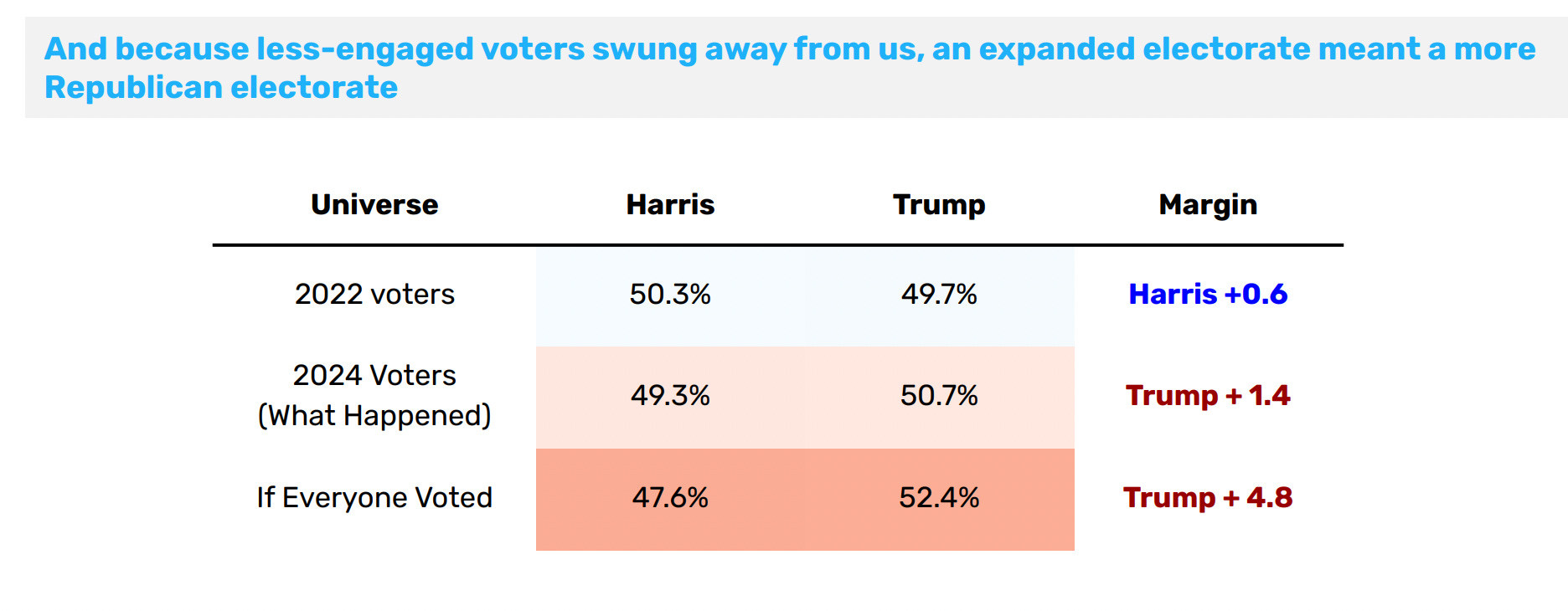
Midterm voters tend to be a high-information and high-engagement coalition. When you combine strong Democratic support among those disproportionately likely to cast a ballot in midterms with historical trends, which generally favor the out party, Democrats are well-positioned for 2026.
Interpreting 2024
How we think about the Democrat’s future political prospects depends a great deal on what you think happened in the 2024 election. If one believes that the short-term trends among young and non-white voters continue — and that there’s been a major cultural vibe shift to the right — then Democrats will be in the wilderness for a very long time. If 2024 was primarily about woke, immigration and trans rights, Democrats have their work cut out going forward.
If, however, one views the 2024 election as part of a global phenomenon of incumbent parties losing voter share and general dismay with Joe Biden and the state of the economy, then 2024 may be a one-off result. Moreover, Trump’s lack of political coattails, combined with the fact that no obvious heir is apparent in the Republican Party, means that the GOP’s temporary political high could be short-lived.
Then there is this:
Trump’s numbers have fallen 13.3 points since his inauguration — and Americans are increasingly freaking out about the economy. It’s possible that these numbers could reverse themselves, but as Elliot Morris points out, Trump’s decline in support mirrors what happened to his approval ratings in 2017. In addition, there is growing evidence that the scale of public protests against Trump is actually outpacing what we saw in 2017.
The dominant trend in American politics over the past decade is political backlash.
In the last eight years, we’ve had three different governing trifectas: 2016 (GOP), 2020 (DEM), and 2024 (GOP). If one goes further back, there was also a governing trifecta in 2008 (Dem) and 2004 (GOP). Over the past 12 years, Presidential elections have gone Democrat, Republican, Democrat, and then Republican. That hasn’t happened in America since the late 19th century.
The current president is increasingly unpopular, and the economy is on a downward trend. Based on historical precedent—and growing Democratic support among highly engaged voters—Democrats are well-positioned to reverse their political fortunes in 2026 and potentially 2028.
Don’t get me wrong: Democrats are in a bad place right now. They have no leverage on Capitol Hill, their supporters are deeply unhappy with them, and there’s a leadership crisis at the top of the party. While they have a reasonable chance of winning back the House in 2026, the Senate is probably out of reach.
However, it also bears noting that Republicans had a governing trifecta in 2004 and 2016, and Democrats were stuck in the doldrums. By 2008, Democrats had won a governing trifecta and a filibuster-proof majority in the Senate, and by 2020, They had completely reversed the GOP’s governing trifecta.
If the last few years should have taught us anything, American politics tends to change rapidly. While Democrats might be down now, a lot can change in four years.
If you enjoyed and want to discuss this article, click the chat above. However, remember that it’s for subscribers only. So, if you’re not a subscriber … you know what to do.
Musical Interlude