
You May Also Like

The Environment Agency’s shift from a project-based to a capital programme-wide approach for low-carbon technologies trials could become an exemplar of how infrastructure clients can accelerate the decarbonisation of their activities.
Decarbonisation is a huge challenge for public and private infrastructure clients, as many have set ambitious targets on their net zero journey. Achieving those targets requires drastic changes to their operations, as well as the way they build and maintain assets.
Capital programmes constitute a big part of infrastructure clients’ overall carbon footprint. Many are using procurement to push their delivery teams to cut the carbon footprint of individual projects, but the degree of carbon reduction varies from project to project.
“From my experience in working on projects across infrastructure, to deliver a project you have to balance a lot of competing demands – programme, costs, efficiency, safety and carbon come into the mix. The prioritisation depends on the client and the programme you are working under,” says Stuart Manning, project manager at Arup and Modern
Methods of Construction theme lead for the Environment Agency’s Decarbonisation Technology Accelerator (DTA). DTA is a programme designed to realise a 20% reduction in carbon emissions and introduce new ways of working in the client’s capital programme by 2030.
Manning adds that the adoption of new low-carbon technologies or processes at project level is often hindered by the amount of “legwork” required of project teams who are often already under intense pressure to deliver schemes.
This is something he has observed through his past involvement as implementation lead at another Environment Agency programme, ‘Net Zero carbon for infrastructure’, where he helped projects assess and adopt low carbon solutions. He found that despite the wealth of ideas for such solutions, many were ultimately unadopted.
“There’s often a lot of uncertainty, and challenges around really understanding what adopting these solutions is going to mean for a project and how much has been done with these different solutions to date. For each project to go and figure all that out is a big task.
“So the DTA came along as an opportunity to say, ‘We’re going to look nationally at various solutions, and try to get them ready to be adopted, making it easier for projects to just pick them up and use them’. That’s when it really clicked into place for me; this is how we can get decarbonisation happening at scale – with projects not having to start from scratch every time and having more solutions ready to be adopted across various schemes.”
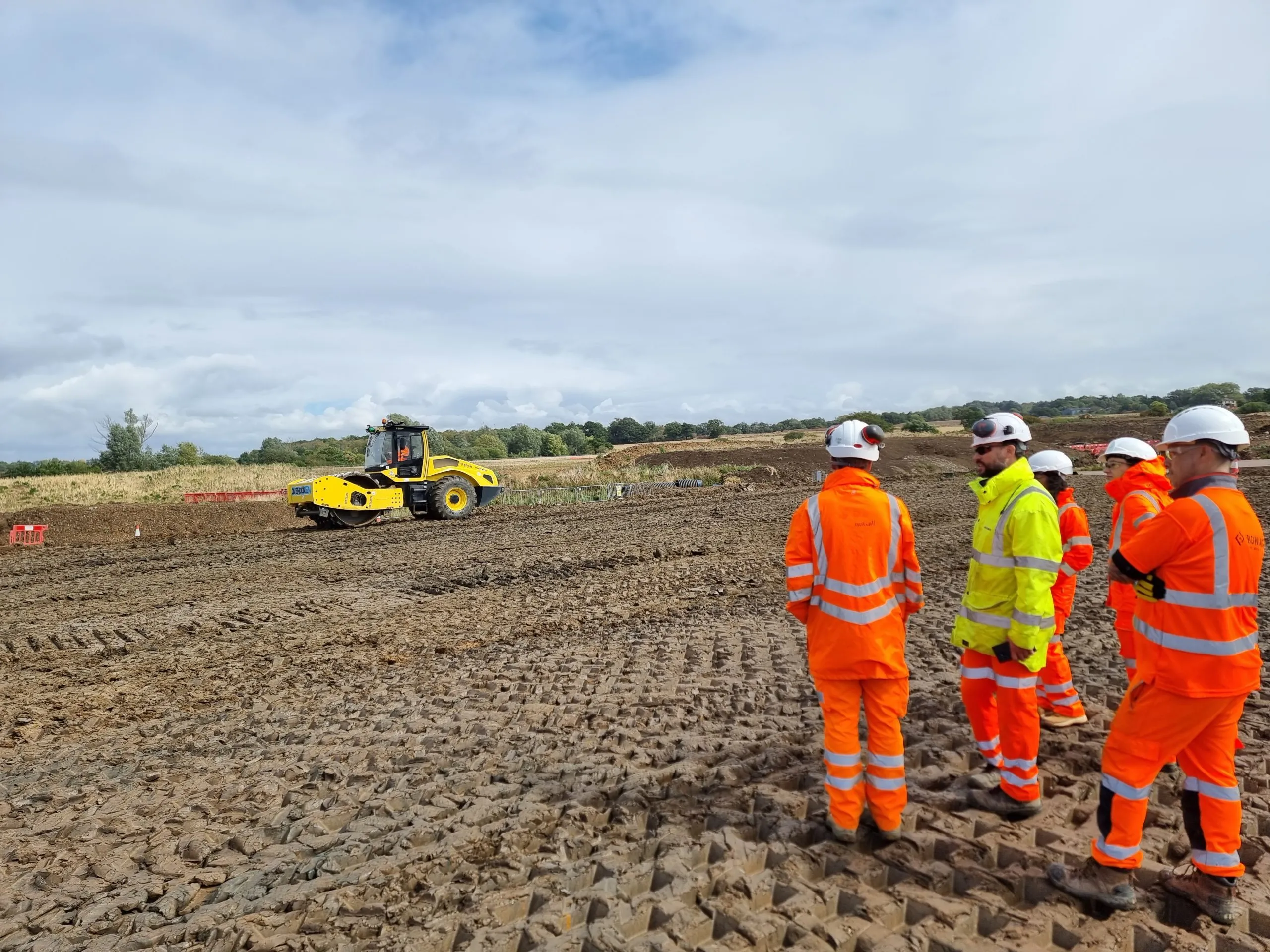
The River Roding project was selected for an MMC theme trial of an enhanced compaction control to inform a future optimisation of earthworks specifications
Capital programme
As an operator and regulator, the Environment Agency has a leading role in helping the country get to net zero by 2050, a commitment the UK government set out in law in 2019. It aims to become a net zero organisation by 2045 to 2050, having set an interim target to cut carbon emissions by 45% by 2030 compared to 2019 levels.
“The way the Environment Agency delivers projects gives low carbon solutions a good chance of being adopted. For example, most schemes have to include a carbon calculator and an appendix explaining how low carbon decisions have been made,” says Manning.
Over the years, the organisation has allocated innovation funds and has been running individual pilot projects with an aim to cut carbon. An example was the successful trial of low carbon concrete mixes at the Hexham flood defence scheme (NCE August 2023), where Environment Agency’s senior user for the DTA Vanessa Collins was the organisation’s project executive.
“This approach where we take products or technologies, trial them and then subsidise them to a scalable size was the nursery for the DTA,” says Collins.
This approach where we take products or technologies, trial them and then subsidise them to a scalable size was the nursery for the DTA
The DTA, launched in November 2023 and running until April 2027, is progressing a range of low carbon solutions through a three-stage maturity model of testing, optimising and scaling. It is the first Environment Agency programme to bring together all delivery partners from the Collaborative Delivery Framework – Arup, AtkinsRéalis, Bam, Jacobs, Jackson, JBA, Kier and VolkerStevin – under a single national decarbonisation initiative.
“The Environment Agency’s capital projects are a huge part of our carbon emissions, so targeting the big-ticket item is how we can get things to happen faster,” says Collins. “If an individual project has to reinvent the wheel, change British Standards and get a new product that doesn’t exist in market, it’s going to take years. Getting a dramatic change is about scaling. Different capital programmes have different shapes, and different clients have a different asset base; from our perspective we realised that we needed to go beyond the project-by-project approach and move to an organisational-level change.”
She admits that the scale of the DTA led to challenges. “Some of our earlier board meetings were spent grappling with some real challenges that you get from a programme-level change project, rather than a project-level change project, where governance and relationships are very clear.”
As to some of the main challenges of the DTA, Collins points to the setting up of contracts and systems to get all the data from the delivery partners, as well as finding a consistent way of reporting for a reliable forecast. “We need to achieve things on time and we need to make that delivery accountable and visible,” she says.
The DTA brings together over 200 people across a national programme management office, six specialist themes and regional hubs working directly with host projects.
The six specialist themes, led by delivery partners, focus on products and processes. They are: modern methods of construction (MMC), earthworks optimisation, novel/ultra‑low carbon concrete, low carbon concrete, low carbon steel and
alternatives and asset management.
Initially, theme leads identified the best solutions which could be adopted, tested and refined in the course of the programme, and the best projects for them to be deployed on. Now that the programme is running, they focus on managing the process, analysing the data, addressing any barriers and working with other delivery partners to plan how these solutions can be deployed at scale.
Trials and evidence
The DTA team has already completed nearly 40 trials across the different themes. The trials include testing new technologies and materials, and exploring whether established solutions used in other industries could be adopted widely on Environment Agency projects.
“We are now at the point where we’re starting to see completions and getting a really meaningful forecast of what the carbon savings from the three years will be,” says Collins.
An example of a new technology trialled which has brought significant benefits is the EcoSheetPile Plus, a new metallurgically identical alternative to conventional steel sheet piles made from 100% recycled steel in an electric arc furnace (EAF), using 100% renewable energy. It was trialled at the Littleborough Flood Risk Management Scheme and the River Roding project.
The River Roding project involves the construction of a new flood storage area upstream of the M25 near Shonks Mill Bridge in Stapleford Tawney, Essex. The scheme includes a reinforced concrete flow control structure, a clay earth embankment and diversion of the existing river through the structure. It will reduce flood risk to communities downstream, including Redbridge and parts of London, and has a design life of over 100 years.
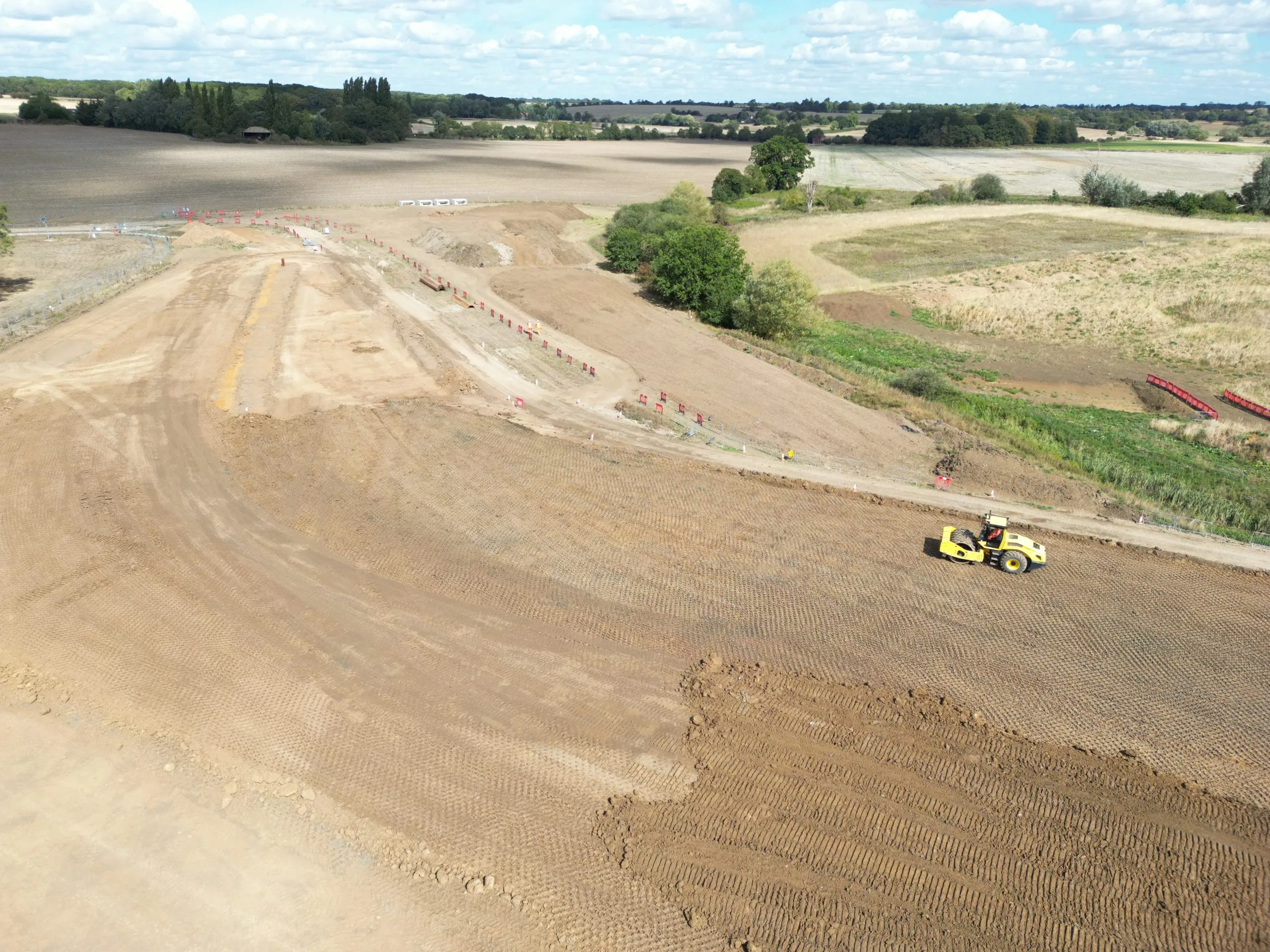
The River Roding project involves the construction of a new flood storage area upstream of the M25 near Shonks Mill Bridge in Stapleford Tawney, Essex.
It has been estimated that the EcoSheetPile Plus steel sheet piling is delivering an estimated 83% reduction in embodied carbon when compared to conventional sheet piles. Manning emphasises that these significant embodied carbon savings were achieved with only very marginal cost increases – about 5% when compared to conventional sheet piles.
The current design at the River Roding Project includes the use of Grasscrete for the access track and the spillway. Grasscrete is an in-situ cellular reinforced concrete paving system distributed by Grass Concrete, typically a CEM I concrete poured around void formers.
The DTA carried out a trial that included replacing the standard CEM I mix with a new CEM III-A alternative. The new CEM III-A concrete mix has an embodied carbon of 210.32kg CO2/m3, compared to the CEM I mix 342.96kg CO2/m3, leading to estimated carbon savings of 39%. This trial was carried out in April with the concrete pour having taken place on 22 April. The next steps of the trial will include the 28-day strength testing of the cores taken from the site.
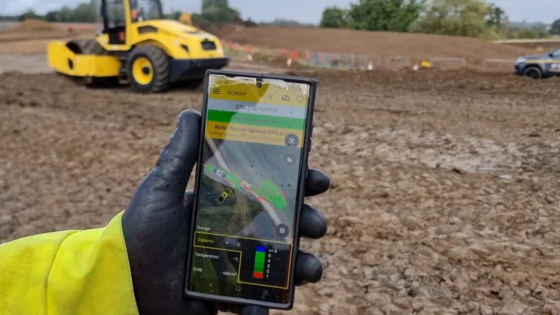
The project was also selected for an MMC theme trial of an enhanced compaction control to inform a future optimisation of earthworks specifications, as it has the potential to reduce plant use and fuel consumption.
The team has a compaction target of 95% maximum dry density, with the method specification requiring nine passes through. The team used equipment from compaction technology specialist Bomag, including Terrameter which measures ground compaction and the Bomap GPS system, which records and visualises all the data, to assess whether the compaction target could be achieved with less passes and therefore save carbon. One observation from the day, indicated by a Nuclear Density Gauge test, was that compaction appeared to be sufficient after four passes with the roller.
Another MMC trial involved the use of a 3D machine control at the Essex Embankments project in Wallasea. The technology allows operators of excavators and bulldozers to accurately and efficiently control the position, orientations and movement of the equipment based on a 3D design model.
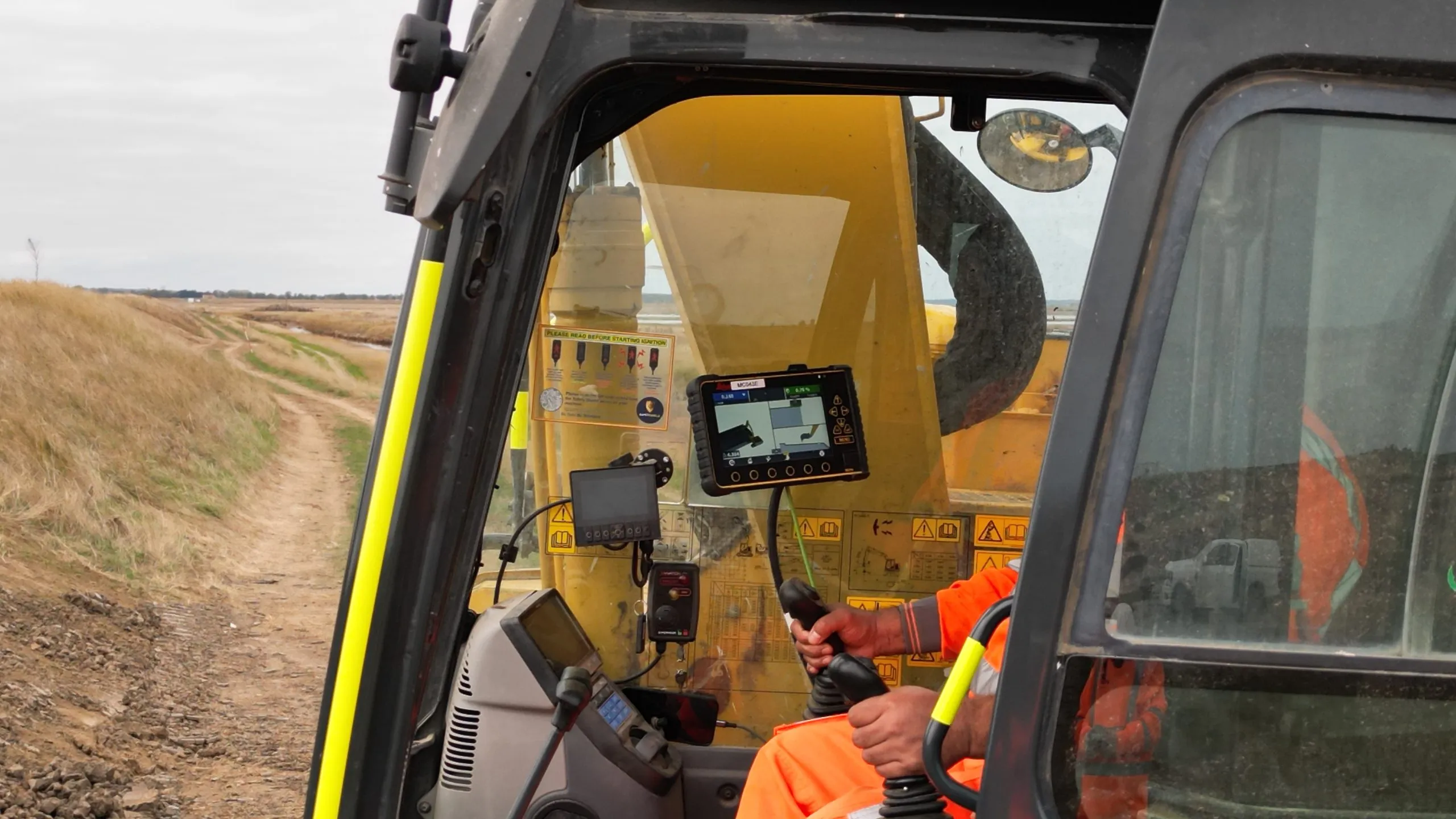
A 3D machine control trialled at the Essex Embankments project offered time savings of up to 70% for the execution of some tasks, reducing fuel consumption
The trial aimed to determine the cost and carbon savings in relation to programme reduction and fuel efficiencies from using 3D machine control technology, compared to the traditional method. It took into account the additional modelling that needed to be carried out to enable machine control to be deployed.
This technology is frequently used on large projects, and through the trial the Environment Agency wanted to assess whether it would be a value proposition for smaller jobs.
Manning comments: “The Essex Embankments Wallasea trial provided insights into how 3D Machine Control can substantially reduce machine working time and fuel consumption for activities where they are shaping earthworks to a design. Although the overall efficiency from the trial was around 25%, for the earth reprofiling (ramps), final trim (slopes) and topsoil shaping, the time savings were 60-70%.
“We also learnt about factors that can reduce the effectiveness of the technology, such as GPS signal connectivity and machine sensor issues, which have been further investigated to inform development of national guidance aiding wider deployment of the optimal techniques.”
“We are driving down our capital carbon, but we are also thinking about operational carbon,” Collins emphasises.
In terms of decarbonisation, our message is clear that we want to share knowledge with other people in the industry, because sometimes the reason we can’t bring a technology to market is because nobody else except from us is using it
With the Environment Agency maintaining long, linear flood defences, a solution to improve diagnostic monitoring is of vital importance. Collins says: “Advancing certain monitoring technology saves carbon in the ongoing maintenance of our assets. The idea is that long after the DTA is finished, these monitoring technologies will just be business as usual and asset maintenance will be lower carbon because we will have a better understanding of those assets as they age.”
Manning says the programme is also looking at circular economy approaches. “On the steel theme, they are looking at steel reuse or the reuse of sheet piles between projects, particularly when sheet piles get used quite a lot in a temporary case,” he says. He adds that on the MMC theme they are looking at bricks made from construction waste, having already identified an established supplier.
With 40 trials completed and more underway, the DTA team will have a lot of data on low-carbon solutions by next April, when the programme will finish. The DTA is on track to deliver savings of 55,000tCO2e through its scaled-up solutions by 2030.
As to why the programme will end in 2027, Manning explains: “The objective of trying to get things scaled up or ready to scale by 2027, is to put the building blocks for further decarbonisation and adoption at scale by 2030 so that the overall goal for that year will become more achievable.”
Apart from helping it achieve its interim targets while on its journey to net zero, the Environment Agency hopes that the DTA trials could help the wider industry decarbonise. For that reason, it has been sharing information about trials through presentations in conferences, as well as through its engagement with industry bodies and the Infrastructure Industry Innovation Partnership.
Collins says: “Obviously we have some things that are commercially sensitive that we legally can’t share. But in terms of decarbonisation, our message is clear that we want to share knowledge with other people in the industry, because sometimes the reason we can’t bring a technology to market is because nobody else except from us is using it.”
She concludes that even though the Environment Agency has a different asset base to rail, road and water companies, there are technologies tested through the DTA programme that can provide benefits to those sectors.
Like what you’ve read? To receive New Civil Engineer’s daily and weekly newsletters click here.
