
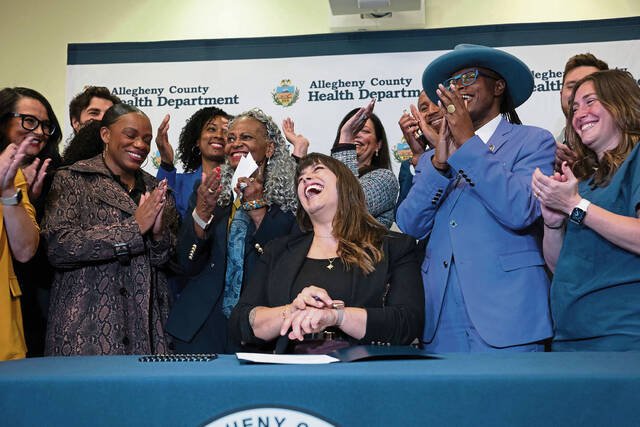
Allegheny County last month notched an unprecedented victory for family rights when it passed legislation requiring employers to provide paid parental leave.
The landmark bill made Allegheny the first county in the nation to enact such a policy in a state that didn’t require it.
But as supporters celebrate, fundamental question remain: How will a policy with no comparable model work and how will it be put into place?
The paid leave policy, signed by county Executive Sara Innamorato on Oct. 22, requires businesses with at least 15 employees to provide eligible workers with no less than 12 weeks of paid parental leave.
Employers have one year to prepare before the requirements take effect.
Yet it is unclear what resources the county will provide to businesses, how employers will navigate the requirements and what infrastructure will be established to oversee compliance.
Despite repeated requests from TribLive, county officials have offered little detail about how the policy will be implemented and enforced.
The policy on paper
Under the approved measure, full- and part-time employees must meet eligibility requirements of either six months of employment or 625 hours worked, depending on their employment status.
Workers who qualify for paid parental leave will receive their regular base pay, capped at $4,200 per week, while employers would be required to maintain their health insurance and provide job protection during leave.
Qualifying events include the birth of a child, stillbirth or fetal death, adoption of a child, and legal placement of a child such as foster care.
Under the legislation, employees can use the leave during the first 12 months following a qualifying event.
However, Pittsburgh civil litigation and employment lawyer Justin Harkins said the language does not specify whether leave must be completed within the 12 months or could extend beyond that period if it begins before the deadline.
“It was confusing to us about this 12-month deadline after the inciting event, whether that’s a hard cutoff date or that’s just where it needs to start,” Harkins said. “So there are a few things that we think will hopefully get ironed out before the implementation date.”
The legislation also expanded paid sick leave requirements.
Potential lawsuits
Since the Board of Health introduced a proposed paid parental leave in May, much of the discussion has drawn comparisons between the city’s and county’s paid sick leave policies.
In 2020, business groups argued that Pittsburgh’s Paid Sick Leave Act violated Pennsylvania’s Home Rule Charter, which bars municipalities from regulating private business duties and requirements.
The state Supreme Court ruled that the ordinance was a valid exercise of municipal authority related to disease prevention and public health, not an improper regulation of businesses.
Harkins and Margaret Grimm, who is also a civil litigation and employment lawyer, said they expect the county’s paid parental leave policy to face a legal challenge before it takes effect.
Harkins said the legislation is “a little ambiguous about implementation.” He said the implementation date could change if there is a legal challenge.
“(It is) likely there will be a request for a stay of implementation of the law, which could extend it by months or years, depending on how long it takes to go through the legal process,” Harkins said.
Grimm said there are several potential avenues businesses could take.
“It’s possible that a legal challenge could mount on whether or not this is a public health initiative or not,” Grimm said. “The business community is also discussing some of the potential challenges with affordability and financing, and what that could look like from self-insurance to private insurance policies, which are potentially emerging.”
Building on existing protections
In August 2025, Innamorato signed an executive order to create an “office of worker protections” to enforce labor and anti-discrimination laws.
The executive order tasked County Manager John Fournier “to study and recommend measures to expand organizing rights for workers not currently covered by the National Labor Relations Act or other federal labor statutes.”
Allegheny County spokeswoman Abigail Gardner, whose last day was Friday, told TribLive in October that the administration planned to use the county’s existing worker safety and protections departments to take on appeals and implementation efforts.
Additionally, Gardner said the health department and marketing and communications teams would put together educational materials.
Ronnie Das, spokesman for the health department, declined to comment last week on the timeline for when those materials would be available.
Innamorato was approached Thursday by a reporter with questions about implementation. She indicated county administration would respond, but officials provided minimal information.
In responses provided Friday, officials said they were conducting finalist interviews and expected to share more information soon about the office of worker protections and the department’s role in implementing paid parental leave and expanded paid sick leave.
They did not provide a specific timeline or details about the office’s responsibilities.
County administration said the manager’s office and the health department would provide additional information in the coming weeks.
“Often these new laws will get worked out over the course of months or years after they’re enacted, as employers start to run up against problems that weren’t predicted by the people who drafted the law,” Harkins said.
But not everyone wants to wait for answers.
Pressure from council
County Councilwoman Suzanne Filiaggi, R-Franklin Park, said she believes the county underestimated the complexity of the legislation and hasn’t developed a sufficient plan to administer it.
“It’s now a law. … The clock is ticking,” she said.
Filiaggi was one of four council members who opposed the policy when it came to a vote Oct. 20.
During her remarks at the meeting, Filiaggi stressed she was not against the science but rather the lack of clarity for businesses.
Other opposing members were Nick Futules, D-Verona; Aaron Adams, D-Duquesne; and Pat Catena, D-Carnegie.
In October, Councilman Paul Klein, who chairs council’s health committee, told TribLive that the administration needed to clarify expectations of how smaller businesses should proceed.
“We will have those conversations so that we can make the promise of this bill real and something that people can get their heads around and actually make it workable,” said Klein, D-Pittsburgh.
When the legislation passed, Council President Michelle Naccarati-Chapkis said she expected to see a continuation of refinements and a road map to a better path for implementation.
She stressed council did not see the final version of the proposal before the Board of Health’s final vote. Naccarati-Chapkis said council members should have been able to review the updated ordinance, vet and analyze the revised document, and ask additional questions about its applicability, implementation and enforcement.
“Words and their meaning matter and are significant when crafting a complex legal document. If you have developed a budget, monitored that budget, adjusted that budget, then you understand financial impacts and how to plan for something such as paid parental leave,” Naccarati-Chapkis said.
Since the bill was signed into law, Filiaggi said council has submitted seven pages of documents containing questions about the administration’s plan for implementing the policy as well as seeking clarity on some of its language.
As of Thursday, Filiaggi said, council had not received a response.
“I think we owe the at least 34,000 businesses in Allegheny County … we owe it to them to relieve their anxiety and give them a clear predictable road map,” she said.
