
While industry sources and experts don’t believe plans will face immediate disruption, long-term projects may face recalibration should the CEO be ousted.
Korea’s biggest technology companies — from chipmakers to platform operators — have built their AI ambitions around a powerful ally in Nvidia CEO Jensen Huang. But allegations of extramarital affairs that threaten his tenure have left Korean partners anxious about the future of major investments and technology deals forged through personal ties.
“Speed was Nvidia’s edge when I was in the business,” a former SK hynix executive said. “Its execution and feedback were said to be two to three times faster than AMD’s or Intel’s. I suspect Korean companies will see that pace slip once Huang leaves.”
The former executive warned that Huang’s potential removal could threaten the very culture that made Nvidia so formidable. “Nvidia’s extraordinary speed came from employees who pushed themselves to the limit out of respect for and confidence in Huang,” the former executive said.
“That confidence is beginning to crack. If he hangs up his black jacket, Nvidia risks losing the execution speed that has long set it apart.”
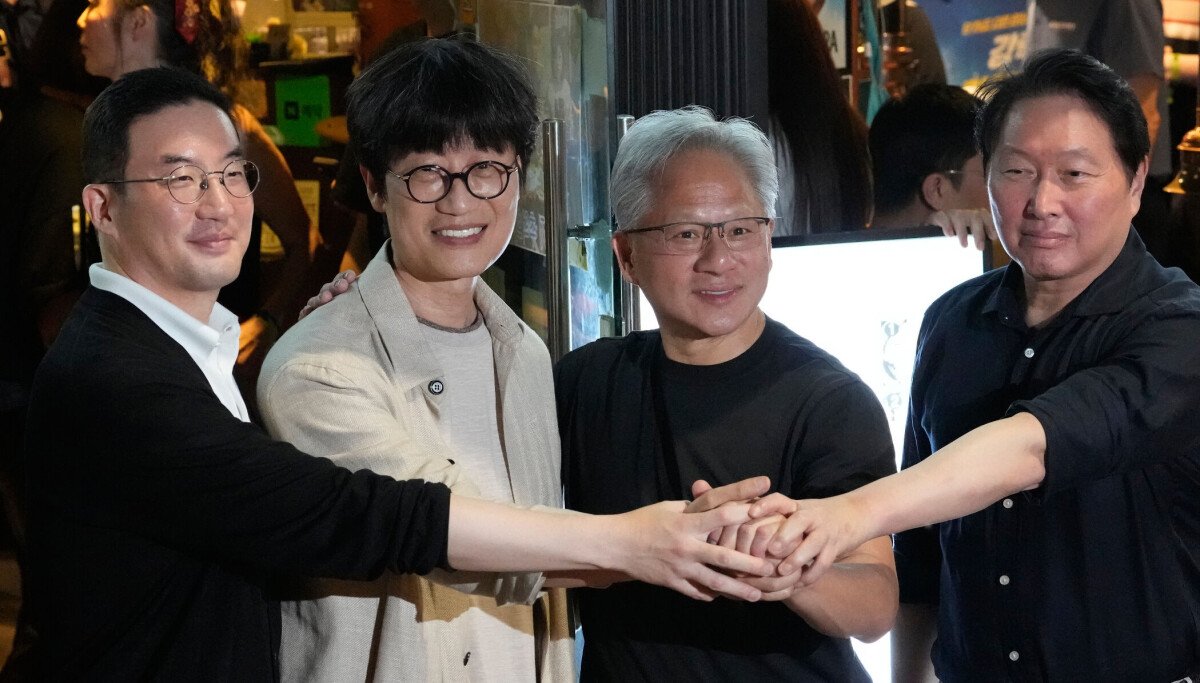
Huang has personally driven Nvidia’s partnerships with Korean conglomerates through direct talks with their top executives. After a high-profile gathering with Samsung Electronics Executive Chairman Lee Jae-yong and Hyundai Motor Group Executive Chair Euisun Chung in October last year, he went on to meet SK Group Chairman Chey Tae-won, LG Group Chairman Koo Kwang-mo and Doosan Group Chairman Park Jeong-won. Huang’s eldest daughter, Madison Huang, a senior director at Nvidia, has also served as a key liaison.
For Korean companies, the immediate concern is whether their ambitious ventures with Nvidia can stay on track.
Samsung and Hyundai are both developing AI factories that will each use 50,000 Nvidia GPUs. SK hynix is collaborating on next-generation high bandwidth memory (HBM), and Samsung Electro-Mechanics is jointly investing in AI chip packaging substrates.
Nvidia’s Korean partnerships also extend to LG and Doosan in robotics and energy and SK Telecom in AI cloud computing. The U.S. chipmaker has invested 1.34 trillion won ($1 billion) in Korea’s homegrown platform operator Naver.
Existing deals are unlikely to unravel overnight, but the future of longer-term partnerships remains uncertain, industry sources say.
“Personal ties between Korea’s corporate chiefs and the Huang family created a top-down channel that could make even seemingly impossible deals happen,” a business source said. “That level of influence and execution may no longer be possible.”
Another electronics industry source warned that the risks could extend to long-term supply agreements.
“If those contracts fall apart, manufacturers could be left with products made to customer specifications but nowhere to sell them,” the source said.
The crisis could also have geopolitical consequences if Washington responds by tightening semiconductor sanctions against Beijing.
“Stricter U.S. restrictions on technology exports to China would make it increasingly difficult for Samsung Electronics and SK hynix to equip their Chinese operations with cutting-edge machinery,” said Park Jae-geun, a professor at Hanyang University who specializes in semiconductor devices and processes. “That could delay factory upgrades, weaken production competitiveness and disrupt investment plans over the medium to long term.”
For memory chipmakers, the near-term outlook remains relatively insulated from Nvidia’s leadership turmoil. Demand from other Big Tech companies, including Google, Amazon and Microsoft, remains strong, while Nvidia’s own push to boost GPU production depends on a steady supply of HBM.
“AI semiconductor demand isn’t dictated by the fate of a single corporate leader, though prolonged management uncertainty could ripple through supply chains,” said Park Kun-soo, the executive vice chairman of the Korea Semiconductor Industry Association. “Short-term volatility and longer-term risks should be assessed separately.”
BY LEE YOUNG-KEUN [lee.soojung1@joongang.co.kr]
