
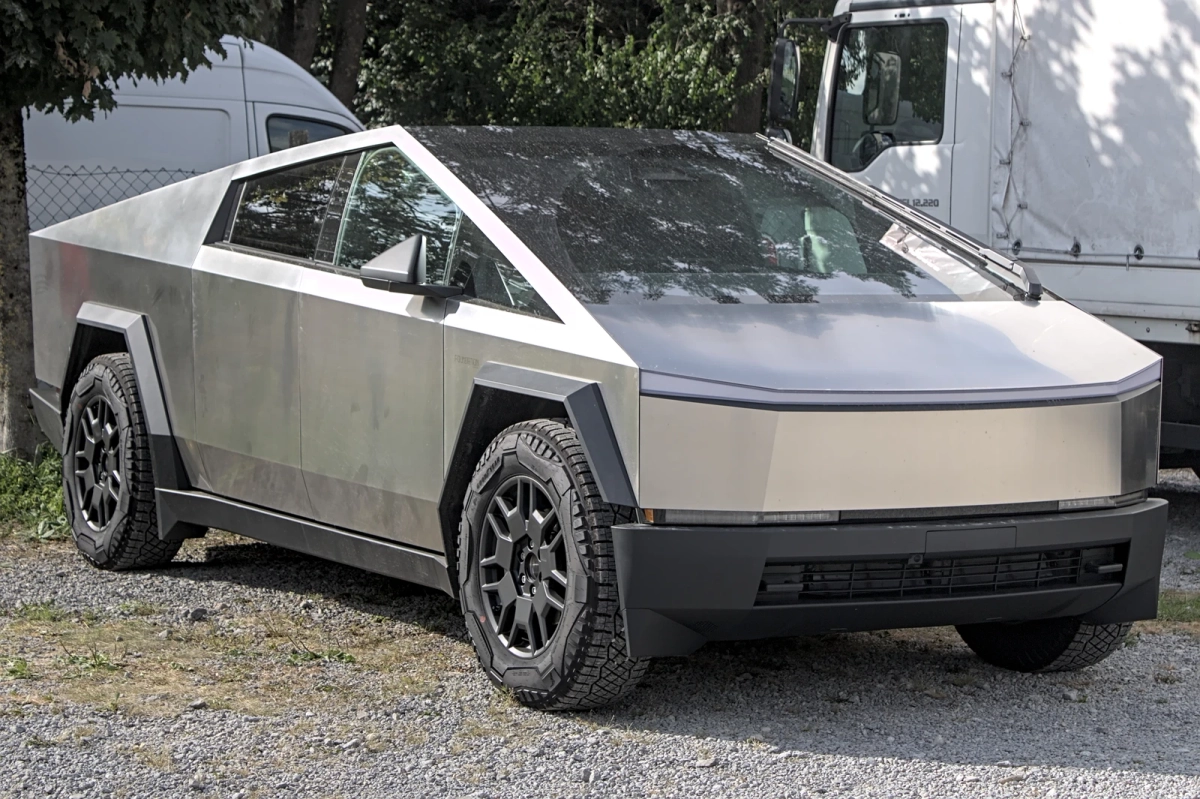
Tesla’s most controversial model is about to take its final bow. CEO Elon Musk said in a post on X that Tesla plans to phase out Cybertruck production at Giga Texas around mid-next year, shifting that capacity to the autonomous robotaxi Cybercab. That means the stainless-steel pickup will have had an actual sales run of only about three and a half years, from the start of deliveries in late 2023 to the end of production.
One day before the announcement, Tesla had just raised Cybertruck prices again, with the top-trim Cyberbeast priced at $102,490. Compared with the $39,900 starting price at its 2019 unveiling, the model’s entry price has nearly doubled.
A Rocky Debut, Controversy Throughout
Cybertruck’s troubles were planted on the day it was unveiled. On Nov. 21, 2019, Musk introduced the model at Tesla’s design studio in Hawthorne, California, and staged a shatterproof-window demonstration—throwing a metal ball at the glass—only for both windows to crack, with the video quickly spreading online. He later explained that a prior sledgehammer strike on the door had damaged the base of the glass, preventing the steel ball from bouncing off. Four years later, at the November 2023 delivery event, Tesla chief designer Franz von Holzhausen demonstrated again, throwing a baseball at the armored glass, which this time held intact.
The pickup, built from gleaming stainless steel with a design inspired by the dystopian aesthetic of “Blade Runner,” was once seen by analysts and brand experts as a chance for Tesla to rebuild its image at a time when price cuts were denting its reputation. Musk also claimed the vehicle would use the same ultra-hard cold-rolled stainless-steel alloy as SpaceX’s Starship rocket, though Reuters reported that the two actually use closely related but slightly different variants.
Reservation figures were once a source of excitement. On Nov. 23, 2019, Musk said Tesla had received 146,000 orders, and days later said reservations reached 250,000 within five days of the reveal, each backed by a refundable $100 deposit. But the refundable mechanism cast doubt on the real conversion value of those reservations, with some reservation holders listing their spots on eBay at prices ranging from $1,000 to $8,000.
Four Years of Delays and 11 Recalls
The road to mass production was equally bumpy. Musk initially promised production would begin by the end of 2021, but by August 2021 Tesla had quietly pushed the plan to 2022, disclosing it only through a note on the reservation page. The production plan was later pushed again to 2023, with the company blaming supply-chain shortages. In July 2023, the first Cybertruck rolled off the line at Giga Texas, which Tesla characterized as trial production; official deliveries began on Nov. 30 that year.
The upward trajectory of pricing is clear:
| Time | Starting Price (USD) |
|---|---|
| At 2019 unveiling | 39,900 |
| At late-2023 deliveries | 60,990 |
| February 2026 (dual-motor all-wheel-drive version) | 59,990 |
| March 2026 | 69,990 |
| August 2026 | 74,990 |
| Day before production-end announcement | 82,490 |
Note: The $59,990 price in February 2026 was a limited-time offer that Musk said at the time would last only 10 days. One day before the production-end announcement, the Premium trim was priced at $92,490 and the Cyberbeast trim at $102,490.
The quality record is similarly dense. According to National Highway Traffic Safety Administration data, Tesla has issued 11 recalls for the Cybertruck since its late-2023 launch, with some vehicles requiring physical repairs and the rest fixed through over-the-air software updates. The broadest came in January 2024, when a recall over warning-light font issues affected more than 2.19 million Tesla vehicles, spanning multiple models including the Cybertruck. In April 2024, 3,878 Cybertrucks were recalled because the accelerator pedal pad could come loose and become trapped by interior trim; in March 2025, another 46,096 were recalled because the roof light bar could delaminate and detach.
Capacity Shifts to Cybercab
According to Musk, the production-line space freed up by the Cybertruck will be used to expand Cybercab capacity. The move aligns with Tesla’s recent tilt of resources toward autonomous driving and robotaxi operations, and means the model that carried the mission of a brand-image experiment is ultimately giving way to the company’s judgment about its next growth engine.
From the cracked windows to the decision to end production, the Cybertruck never escaped the crack at the heart of its fate. For existing owners, the end of a model line usually means uncertainty over the duration of parts supply and software support; for stainless-steel and component suppliers in the supply chain, the contraction in related orders will gradually show up over the coming quarters. Tesla has not yet disclosed the specific scale of capacity adjustments or staffing arrangements involved in ending Cybertruck production.
