
Surveillance by small, cheap quadcopter drones has made substantial battlefield advances nearly impossible amid Russia’s ongoing war on Ukraine.
Armored vehicles are quickly spotted and destroyed with either drones or artillery. Soldiers on foot seldom fare any better. Negating the other side’s drone capabilities would be a tremendous advantage, but conventional air defense isn’t good enough.
Fortunately, the U.S. has developed a solution: 30mm chain guns — traditionally mounted on Apache attack helicopters — bolted to civilian pickup trucks and connected to a portable sensor called Mobile–Acquisition, Cueing and Effector, or M-ACE.
After detecting drones, the Northrup Grumman-made system calibrates programmable shells to detonate mid-air, meaning the system, which is cost-friendly compared to other solutions, can destroy quadcopters and dismantle swarms without hitting them directly.
Such an answer to some of the evolving drone challenges seems too good to be true, but its viability has been vetted in recent years.
Ukraine has already deployed M-ACE on the battlefield in small quantities, along with Australian “Slinger” systems, which use the same chain gun. Taiwan has also expressed interest in the system, iterations of which have recently been fielded by the U.S. Army and Marine Corps.
A key shortcoming with these systems, however, is driving nonmilitary vehicles in war zones. While the mounted gun may be able to stop drones, the vehicle’s crew would have effectively no protection from landmines, artillery or gunfire.
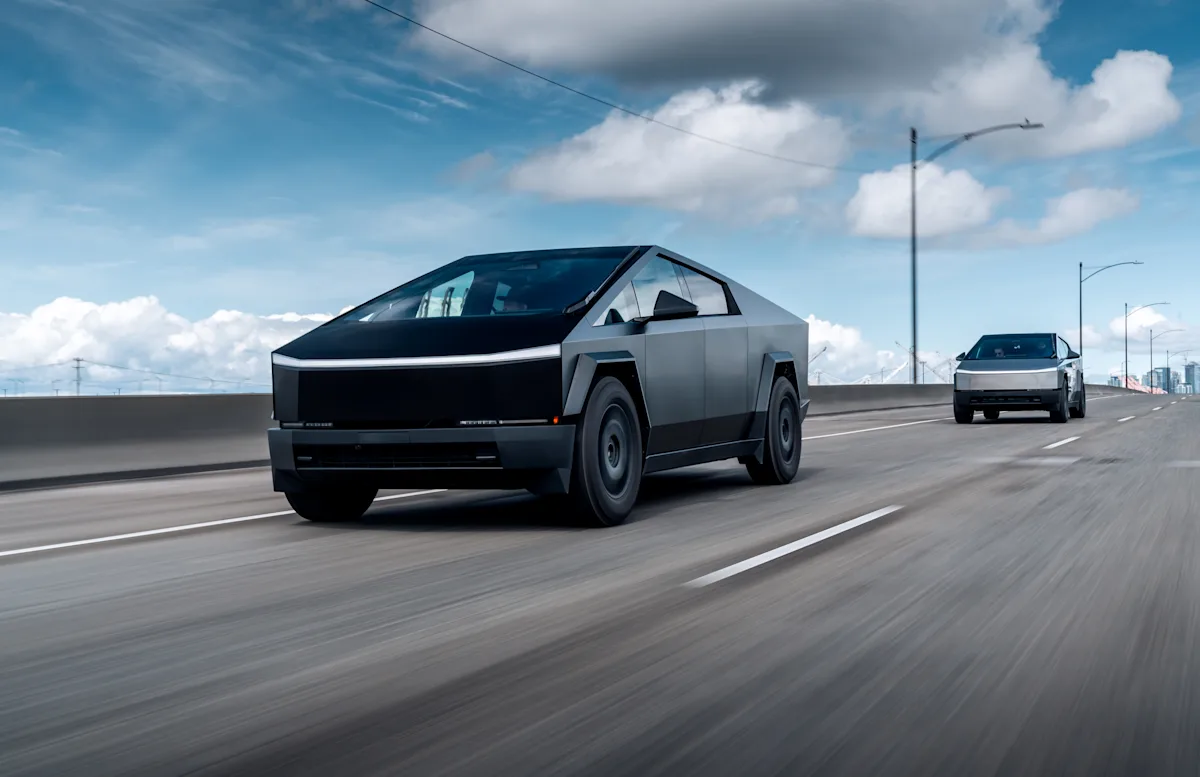
To make these counter-drone platforms truly effective, systems should be mounted on remotely operated vehicles. Enter the Tesla Cybertruck.
The Cybertruck’s usefulness for Ukraine cannot be unpacked without acknowledging its failure on the civilian market. Elon Musk promised hundreds of thousands of sales each year; Tesla fell short by 92% in 2025, barely selling 20,000 of the widely mocked pickups.
Consumers have a slew of reasons to avoid Cybertrucks. In addition to political controversy surrounding Tesla’s CEO, the truck’s design has been slammed for poor visibility, accelerator pedals that get stuck, warranties voided by car washes, dysfunctional windshield wipers and trunk doors that have gone viral for safety concerns.
Such issues, however, would be mostly irrelevant should the vehicle be used to aid the Ukrainian military.
Low demand, meanwhile, has left over 10,000 Cybertrucks sitting unsold in dealership lots. With Tesla modifying its “Gigafactory” in Austin to build a quarter-million units each year, Cybertrucks could, in theory, be delivered quickly to Ukraine — and in large quantities.
Availability isn’t the only factor that makes Tesla’s pickup a good choice. With systems like M-ACE limited by the vulnerability of crew members, Tesla could bypass the supervision requirement of the vehicle’s self-driving capability.
With remote operation, Cybertrucks on the battlefield would add a layer of safety other M-ACE-equipped pickups can’t provide. These vehicles are also easier to mass produce than any purpose-built unmanned ground vehicle rated to handle 30mm autocannons.
Today, two UGVs fit this role — the Estonian-made THeMIS and the U.S.-made Textron Ripsaw M5. Per-unit prices are not publicly available, but it’s safe to assume that these systems cost hundreds of thousands: THeMIS has sold for several million dollars, and the Ripsaw M5’s civilian variant has a starting price of $295,000.
If the Cybertruck is a viable substitute for these UGVs, an $80,000 price tag seems like a bargain. Beyond its availability and self-driving mode, the Cybertruck also offers the benefit of electrical power.
EVs have several logistical and functional advantages over fuel-powered trucks. The lack of moving parts and fuel requirements make them easier to maintain and cheaper to operate. They also create less noise and less heat, key for avoiding attention from Russian forces — especially those with thermal cameras.
A fleet of Cybertrucks equipped with chain guns and sensors to clear the skies of small drones could significantly affect the war and tilt certain battlefields in Ukraine’s favor.
Defanging enemy drones would, at worst, make the war effort more sustainable by reducing casualties and buying time for Europe to supplement Ukraine’s efforts.
More optimistically, these systems could give Ukraine’s ground forces more flexibility to move on drone-saturated front lines.
There’s no sign that an end to the war, or an improvement in Cybertruck sales, will come any time soon. Ukraine could be the best backup plan for Tesla’s misplaced investment.
Alex Lee is a recent graduate from Washington University in St. Louis, where he majored in political science and minored in writing.