
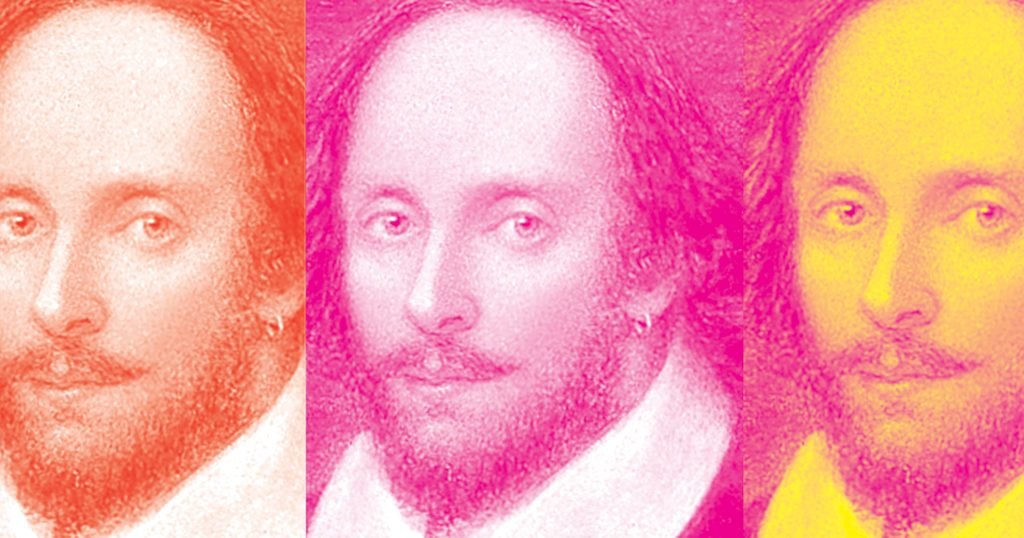
In eight years of writing monthly essays for Shakespeare & Beyond, I’ve described my ongoing subject as the intersection of William Shakespeare and popular culture, but recently I’ve been wondering how accurate that description is. Looking back at the articles I’ve written, I think the case can be made—in fact, it’s the case I’ve been making all this time—that Shakespeare not only informs popular culture, he is popular culture.
He was certainly popular culture in his day, and his theater—as the source of entertainment, news, and gossip where average folks rubbed both literal and metaphorical elbows with their supposed betters—was the equivalent of our modern internet. Shakespeare, opera, and symphonies were popular entertainments for all levels of society until about the 19th century, when dress codes, tiered ticket prices, and separate entrances for the wealthy and the working class began to enforce the notion that these art forms were elitist and highbrow, and audiences were expected to conform to a polite decorum far different from the rowdy madhouse of Shakespeare’s inn yards and playhouses. Shakespeare’s popular reputation might well have begun to change as early as 1623, seven years after his death, when the publication of the First Folio designated his “Plays” as the loftier “Works,” two words that seem interchangeable now but carried important value distinctions then.
I’ve written about how I yell “drink!” every time I hear Shakespeare referenced or quoted, and I end up yelling it a lot (especially when listening to Taylor Swift). Shakespeare’s themes, language, and characters are everywhere, providing inspiration, intellectual heft, artistic credibility, and source material for novels, parodies, musicals, sitcoms, and award-winning films. I’m chronicling less the intersection of Shakespeare and popular culture and more a Venn diagram that’s a single circle.
