
Epstein Survivors, Fashion Models Urge Federal and State Investigations into the Modeling Industry’s Role in Epstein Abuse
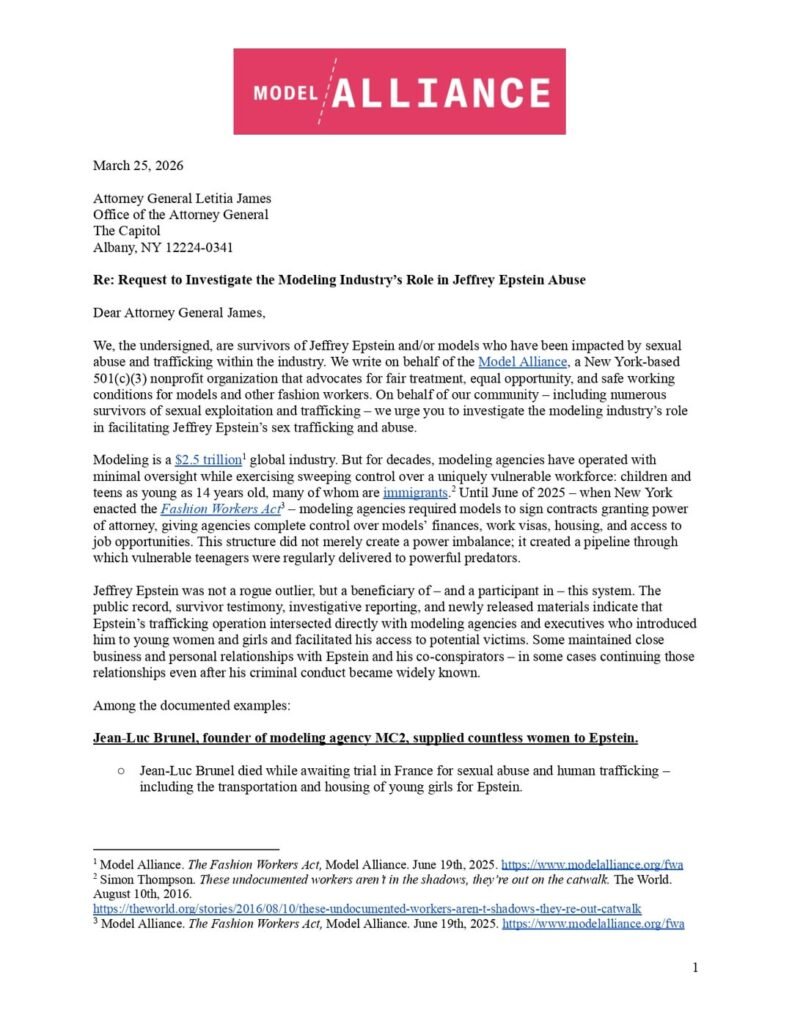

Letters – organized by New York-based Model Alliance – urge Attorney General Letitia James and bipartisan members of Congress Ro Khanna and Thomas Massie to investigate if and how modeling agencies served as pipeline for Epstein, other abusers
NEW YORK CITY, March 25, 2026 – The Model Alliance, a New York-based nonprofit organization that advocates for the fair treatment of fashion workers, today called for sweeping investigations into the modeling industry’s role in facilitating the sex trafficking operation of financier Jeffrey Epstein. The organization’s letters – signed by more than three dozen Epstein survivors and fashion models impacted by abuse within the industry – urge New York Attorney General Letitia James and bipartisan members of Congress Ro Khanna and Thomas Massie to examine if and how modeling agencies delivered young children and teens to Epstein and his fellow abusers.
“Modeling is a $2.5 trillion global industry,” the letter to Attorney General James reads. “But for decades, modeling agencies have operated with minimal oversight while exercising sweeping control over a uniquely vulnerable workforce: children and teens as young as 14 years old.”
“Jeffrey Epstein was not a rogue outlier, but a beneficiary of – and a participant in – this system,” the letter continues. “The public record, survivor testimony, investigative reporting, and newly released materials indicate that Epstein’s trafficking operation intersected directly with modeling agencies and executives who introduced him to young women and girls and facilitated his access to potential victims.”
The letters document examples of modeling executives and agents sending models to Epstein and his co-conspirators; recruitment schemes involving fake modeling opportunities designed to lure young women into the arms of predators; and long standing industry relationships between Epstein and figures in the modeling world. Taken together, these facts raise serious questions about if and how the modeling industry functioned as a recruitment and referral pipeline – sending aspiring teenage models to Jeffrey Epstein and other men with power, wealth, and well-documented histories of abuse.
The following statements were made following the letters publication:
"It’s not a coincidence that so many of Jeffrey Epstein’s victims were aspiring or working models,” said Sara Ziff, Executive Director of Model Alliance. “Despite the glamorous veneer, the modeling industry has long served as a pipeline that sends teens directly into the hands of abusers. As a survivor myself, I am proud and humbled to stand with this brave community of survivors in calling for an immediate and thorough investigation into the modeling industry’s role. Accountability must extend beyond individual abusers to the system that enabled them.”
“I’ve been on the front lines of this fight for decades, and it’s past time the justice system investigated not just individual predators of sexual abuse, but the modeling industry that fueled — and indeed enabled — their behavior,” Carré Otis, Board Member of Model Alliance. “I am grateful for the Model Alliance’s leadership on this issue, and look forward to a full investigation.”
“No one should have to risk their safety to pursue a career,” said Lara Blume McGee. “But for so many of us, the same people that controlled our access to opportunity also put us directly in harm’s way. Any real investigation must examine how that access was used, who benefited from it, and why so many young women were left unprotected.”
“For a long time, many of us thought we were alone in what we experienced,” said Lisa Phillips. “But as this letter makes clear, each of us was part of a broader pattern — one in which the modeling industry enabled abuse and, in some cases, facilitated sex trafficking. It’s past time for a full accounting of how this was allowed to happen, and for real accountability for the systems and people who made it possible.”
“I entered what I believed was a professional industry, but instead found myself in environments where exploitation was allowed to exist,” said Sharlene Rochard. “What happened to me reflects a broader systemic failure. I stand with Model Alliance and fellow survivors to advocate for accountability, stronger protections, and to ensure the next generation of young women is not placed in the same vulnerable positions.”
Model Alliance’s call for accountability comes on the heels of another major recent advocacy win by the organization: the passage of the New York Fashion Workers Act (FWA). Signed into law by Governor Kathy Hochul in December 2024, and in effect since June 2025, the FWA enacts the first-of-its-kind regulation of model management agencies and closes longstanding loopholes that have allowed abusive and exploitative practices to persist in the fashion industry.
To read the letter to the New York Attorney General, click HERE.
To read the letter to Members of Congress, click HERE.
https://www.modelalliance.org/letters
‐—————–‐——————————-
The Guardian interview: (Mar 29, 2026)
Modeling industry activist calls for inquiry into how agencies ‘facilitated Epstein’s abuse’
Excerpt:
A top modeling industry activist has called for business leaders to be hauled before lawmakers in Washington to investigate what role modeling agencies may have played in the Jeffrey Epstein sex-trafficking scandal.
Sara Ziff is the founder of the Model Alliance, a non-profit advocacy group calling for fair treatment, labor rights and safe working conditions for fashion industry workers.
“I’d like to see a proper investigation into how modeling agencies facilitated Epstein’s abuse,” she told the Guardian in an interview, adding that bringing the heads of the companies before the oversight committee is “totally appropriate”.
Ziff and more than 40 Epstein survivors have signed a letter sent to New York attorney general Letitia James, and congressmen Ro Khanna and Thomas Massie to ask for an inquiry into the issue. They say the number of people in the model business – agents, owners, scouts – whose names have come up in Epstein document releases and through witness testimony “point to more than a single predator operating in isolation”.
The letter describes a power structure in the fashion business that made model agencies “a pipeline through which vulnerable teenagers were regularly delivered to powerful predators” and describes Epstein as “not a rogue outlier, but a beneficiary of – and a participant in – this system”.
Citing public records, survivor testimony, investigative reporting, and entries in the US Department of Justice’s Epstein files releases, the letter states, “Epstein’s trafficking operation intersected directly with modeling agencies and executives who introduced him to young women and girls and facilitated his access to potential victims”.
Ro Khanna said in a statement:
“I will be taking this information to the oversight committee and will urge them to investigate this issue and subpoena individuals from the modeling industry who were involved in Epstein’s abuse. I am grateful to the survivors for speaking up and I will continue to fight for accountability. ”
‐—————–‐——————————-
The Daily Beast interview: (Apr 5, 2026)
We Know The Sick Secrets of Epstein's World (YouTube)
Joanna Coles speaks with models and activists Carré Otis and Stacey Williams as they rip the glamour off the fashion industry and expose a system they say functioned as a pipeline for exploitation, coercion, and trafficking—targeting teenage girls with promises of fame while trapping them in debt, silence, and fear.
From midnight “fittings” and retaliatory blacklisting to alleged links with powerful figures like Jeffrey Epstein and Donald Trump, the conversation traces how agencies, photographers, and insiders allegedly operated with impunity for decades.
Otis details being trafficked and abused as a minor, while Williams recounts the career cost of refusing advances—and the industry-wide normalization that kept it all hidden in plain sight.
Now, with legislative momentum, the Model Alliance pushing reforms, and lawmakers like Ro Khanna demanding oversight, the episode zeroes in on a single question: what happens when one of fashion’s most protected systems is finally forced into the light.