
‘Revolution’ or ‘chaos’: The massive stakes if a Republican becomes California governor
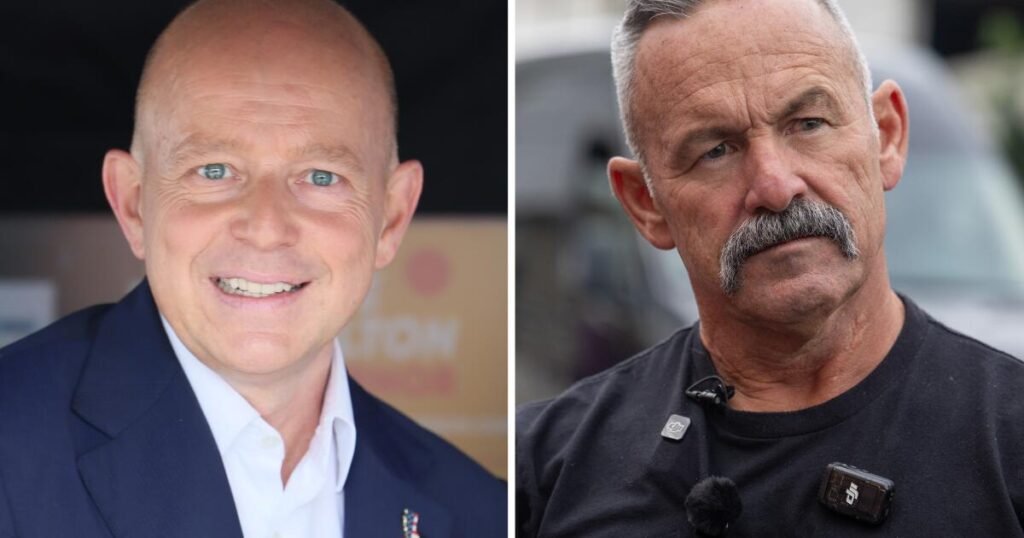
If conservative commentator Steve Hilton is elected California’s next governor, as President Trump wants, it would mark a “political revolution” for the liberal state, the candidate said.
The state’s Democrat-controlled Legislature, “after all their years of lecturing us about democracy,” would be forced to work with him “to enact the changes that Californians just voted for,” and he would be willing to work with them too, the Silicon Valley entrepreneur and former Fox News host said.
If firebrand Riverside County Sheriff Chad Bianco is elected governor, he will take a decidedly different approach, he said.
“You want to know how I’m gonna work with a Democrat Legislature? I’m not. I’m gonna get every single one of them unelected,” Bianco said. “Every single day, I’m gonna stand on the steps of the Capitol, and I’m gonna tell the California voting public about the idiots in Sacramento that are ruining their lives.”
For the first time in years, the state GOP is riding into its convention this weekend on a wave of optimism about the upcoming gubernatorial race.
According to recent polling, Hilton and Bianco both stand a chance of winning more votes in the June 2 primary than any of the many Democratic candidates, who have spread thin their party’s nearly 2-1 advantage in voter rolls. If the GOP candidates do that, they would advance to a head-to-head contest in November’s general election, and one would become the state’s first Republican governor since Arnold Schwarzenegger.
Much could change to prevent that scenario. More Democrats could drop out. Voters could coalesce around one or two of those left. Hilton, with Trump’s endorsement, could consolidate Republican support and push Bianco out of contention.
Still, the prospect of a Republican governing California, a stronghold of the anti-MAGA movement, has captivated political experts and spectators alike.

Gov. Gavin Newsom imposed a moratorium on the death penalty shortly after taking office, a policy the next governor could reverse. At San Quentin, an inmate is moved from his cell on death row.
(Robert Gauthier / Los Angeles Times)
Trump, in his recent endorsement, said he has “known and respected” Hilton for many years and would help him “turn it around” in California after an “absolutely horrendous job” by Gov. Gavin Newsom and other state Democrats.
“With Federal help, and a Great Governor, like Steve Hilton, California can be better than ever before!” Trump wrote.
Many Democrats predict the opposite: grandstanding and gridlock as either Hilton or Bianco’s MAGA-aligned agenda meets stiff resistance from powerful state Democrats repulsed by the president’s movement.
“If the new governor decided to go hard MAGA, they would face enormous pushback,” said state Sen. Ben Allen (D-Santa Monica), who considers it unlikely for both Republicans to advance.
“I don’t think there’s any question that the state would descend into chaos,” said Phil Angelides, a Democrat and former state treasurer who lost to Schwarzenegger in the 2006 gubernatorial race.
The limits of power
California governors hold substantial power.
They direct and appoint leaders to the state’s many executive agencies, boards and commissions, which oversee vast portfolios in vital areas, such as the environment, California’s university systems and the state parole board. They craft the state budget and have a line-item veto to eliminate legislative appropriations. They can make major unilateral decisions — such as welcoming federal troops into California cities — and command a bully pulpit to drive public opinion and policy, including through statewide ballot measures.

Demonstrators confront California National Guard troops and police outside a federal building during protests in Los Angeles in 2025 after the Trump administration sent in the National Guard. The Republican candidates for California governor said they would welcome similar orders by the Trump administration.
(David McNew / Getty Images)
California’s next governor would have the power to end Newsom’s moratorium on the death penalty, appoint state judges and grant state pardons. During emergencies the governor would be able to reshape state regulations, suspend laws and redirect funding, as Newsom did during the COVID-19 pandemic by banning price gouging, halting evictions and postponing the 2020 tax deadline.
But their power also has limits.
Many of the governor’s appointees are subject to state Senate confirmation. The Legislature can change and amend the governor’s proposed budget and pass a budget bill distinctly different from his proposal. Democrats, with their supermajority, can also override the governor’s vetoes.
The independently elected state attorney general can sue to defend state laws, regulations and residents, a power current officeholder Rob Bonta, a Democrat, has exercised more than 60 times to challenge the Trump administration. The California Supreme Court, which leans liberal, can rein in the executive branch if it determines it has violated the state Constitution or other statutes.
Trump has repeatedly pushed the limits of executive authority and benefited from having a Republican-controlled Congress and a conservative U.S. Supreme Court majority that holds an expansive view of executive power. Hilton or Bianco would face the opposite in California, where many legislators would refuse to acquiesce to a Republican governor, especially one almost certain to face a swift recall, political experts said.
Hilton or Bianco could “potentially build alliances” with Democrats on issues such as housing and affordability and drive change that way, said Kim Nalder, a political science professor and director of the Project for an Informed Electorate at Sacramento State. But “if the Democratic majority in the Legislature decides to dig in its heels, then they could oppose practically everything [the new governor] would do.”
Nalder said Hilton or Bianco could also “try to rule in a Trumpian way” by testing the boundaries of their authority. She expects Bianco would do so given his recent decision to “violate the norms of democracy” by seizing more than half a million 2025 ballots as part of an unusual local sheriff’s investigation into allegations of voter fraud that state and county officials say have no merit.
But he “wouldn’t have the public support or the hold on the other branches of government that Trump has,” she said, “so it would be much more difficult.”
Angelides said electing either Hilton or Bianco would put someone “deeply associated with the MAGA movement” atop a deeply blue state government in which many career employees hold opposing views, which would cause a cascade of disruptions.
“There’s no reason to believe it will be different than the chaos we’ve seen in the Trump administration: an evisceration of a number of state agencies, as well as the departure of a lot of talented people who will not stay and would not jeopardize their careers, their reputations, to work under a governor from the MAGA movement,” Angelides said.
State employees are protected by powerful unions with deep ties to Democratic leaders, which Hilton said he would sever.
A Bonta spokesperson said in a written statement that the attorney general “works in service of the people of California — not the Governor,” and would not hesitate to exercise his independent authority under the state Constitution.
“We hope to maintain a close working relationship with whomever California’s next Governor is, but our mission and our priorities will not change,” the spokesperson said. “Regardless of who is in that office, we will continue to enforce civil rights laws, investigate and prosecute complex crimes, protect public safety, stand up for consumers and the environment, and fulfill our duty to Californians.”
Senate President Pro Tempore Monique Limón (D-Goleta) also offered a diplomatic response, saying in a statement that “it is critical that whoever our next Governor may be helps advance the lives and goals of California and its communities.”
In their own words
Hilton and Bianco both said they would radically reshape state government, in part by dismantling regulations that are hampering development and making basic necessities — housing, food, gas, electricity — too expensive.
Hilton, a top advisor in British Prime Minister David Cameron’s coalition government more than a decade ago, would install agency leaders who would be hyper-focused on slashing costly regulations in order to “reduce the burden of cost and hassle on California families and businesses,” he said. “Elections have consequences, and so it would be irresponsible not to use maximum aggression to make the changes as quickly as possible.”

The top two Republican candidates running for California governor said they would have a much better relationship with President Trump than Democratic Gov. Gavin Newsom, who challenged the president’s policies in court and mocked him on social media.
(Mark Schiefelbein / Associated Press)
Bianco said “every single regulation in this state is leaving” if he wins, with California becoming far more business friendly. “The environmental activism, the environmental activism terrorists who are controlling state government, are going to be put in their place, which is outside where nobody hears from them.”
Both Hilton and Bianco also sharply criticized California Democrats for challenging Trump at every turn, a practice they would end.
“I would be wanting to work with the administration to help Californians,” Hilton said.
“Why would you ever push back on a president unless they were seriously trying to destroy your state?” Bianco said. “California is failing because of its own policies.”
Hilton said he expects Bonta to lose to his Republican running mate for attorney general, Michael Gates. Bianco said that if Bonta remains in office, he would completely “defund” the state Justice Department.
Hilton and Bianco also shared similar thoughts on Trump’s immigration crackdown and deployment of the National Guard to Minneapolis and Los Angeles, the latter without Newsom’s approval.
Hilton said that he “certainly would never want to see, in California, the scenes that we saw in Minneapolis, nor would I want to see repeated the scenes that we saw in our state last summer,” but that those clashes were “provoked and instigated by Democrat sanctuary policy,” which he would end.
California’s sanctuary policies largely bar local police and corrections officials from conducting or assisting federal authorities in immigration enforcement, which state leaders say is not their responsibility and could undermine community trust in local police.
Bianco said that Trump sent in troops because Newsom “was derelict in his duties to protect the people of California,” and that it is more important to address “failed Democrat policies for the last 20 years.”
“President Trump has done not one single thing to harm California in the last year,” he said.
Matt Lesenyie, an assistant professor of political science at Cal State Long Beach, said that if Hilton or Bianco becomes governor, Sacramento will see “a lot of gridlock and grandstanding, and that’s from both parties.”
But he also said he does not expect that to happen, because undecided voters are going to “figure it out” and coalesce behind a Democrat — even if at the last moment.
“That last slice of the electorate,” he said, “doesn’t wake up until the last two weeks.”
Times staff writer Katie King contributed to this report.