
You May Also Like

Jeff Bezos’ space company just notched a big reusability milestone — but also suffered a sizable setback.
Blue Origin’s huge New Glenn rocket launched into space for the third time ever Sunday morning (April 19) — but, in a first for the company, it soared into orbit powered by previously flown hardware. The mission, called NG-3, carried the massive payload BlueBird 7, a direct-to-cellphone internet satellite, to low Earth orbit (LEO), and flew atop the same first-stage booster core that launched NG-2, but with new engines.

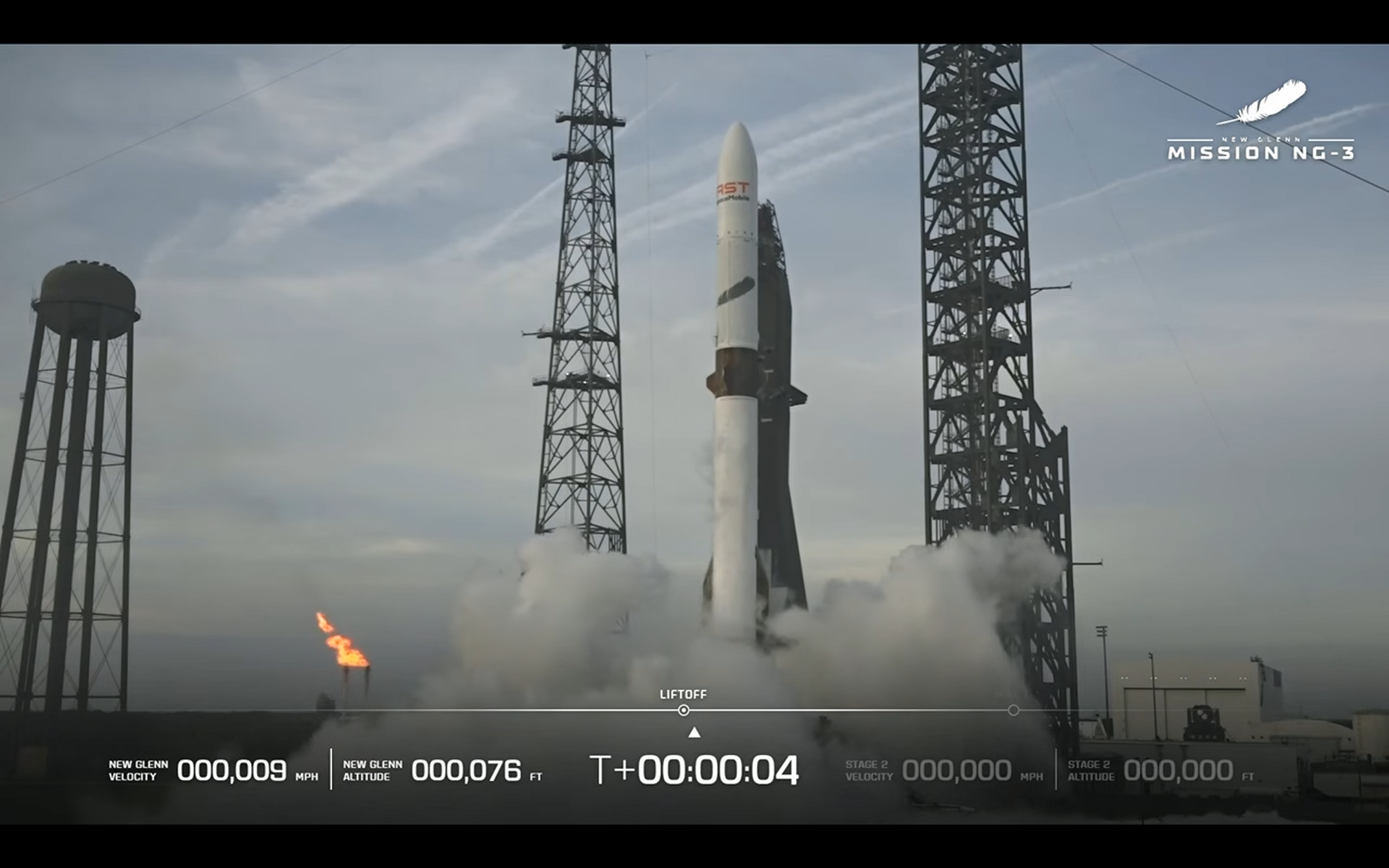
Liftoff for NG-3 occurred at 7:25 a.m. EDT (1125 GMT) from Blue Origin’s Launch Complex 36 pad at Cape Canaveral Space Force Station in Florida. Blue Origin had hoped to launch the flight at 6:45 a.m. EDT (1045 GMT), at the start of a two-hour window, but paused the countdown at T-3 minutes, 57 seconds for a bit due to an undisclosed reason. The clock resumed with a new launch time a just after 7 a.m. EDT.
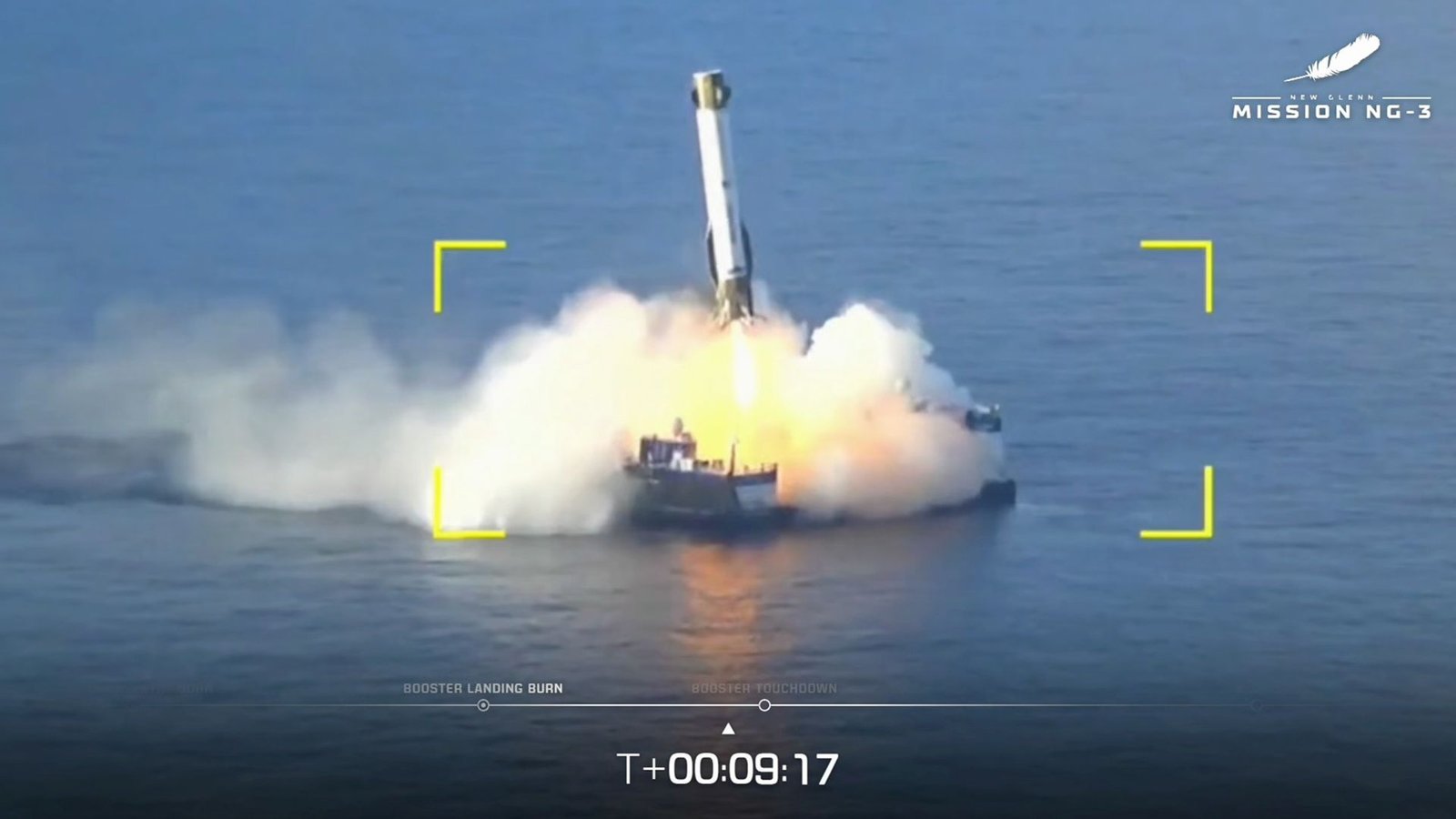
New Glenn’s first stage shut off its engines and separated from the upper part of the rocket about 3.5 minutes into flight, landing back on Blue Origin’s droneship “Jacklyn” in the Atlantic Ocean around six minutes later.
Blue Origin workers across the country cheered loudly as the booster returned to Earth, chanting GS-1 (the technical name of the booster, which Blue Origin calls “Never Tell Me The Odds”) during landing.
Jordan Charles, vice president of New Glenn for Blue Origin, said during launch commentary that engineers refurbished the thermal protection system along the base of the rocket so it could better handle the heat of reentry.
“That gets pretty hot as you’re coming in during our reentry process,” Charles said. “So we want to definitely see and correlate a bit better our thermal environments as we’re flying this particular mission.”
Image 1 of 3

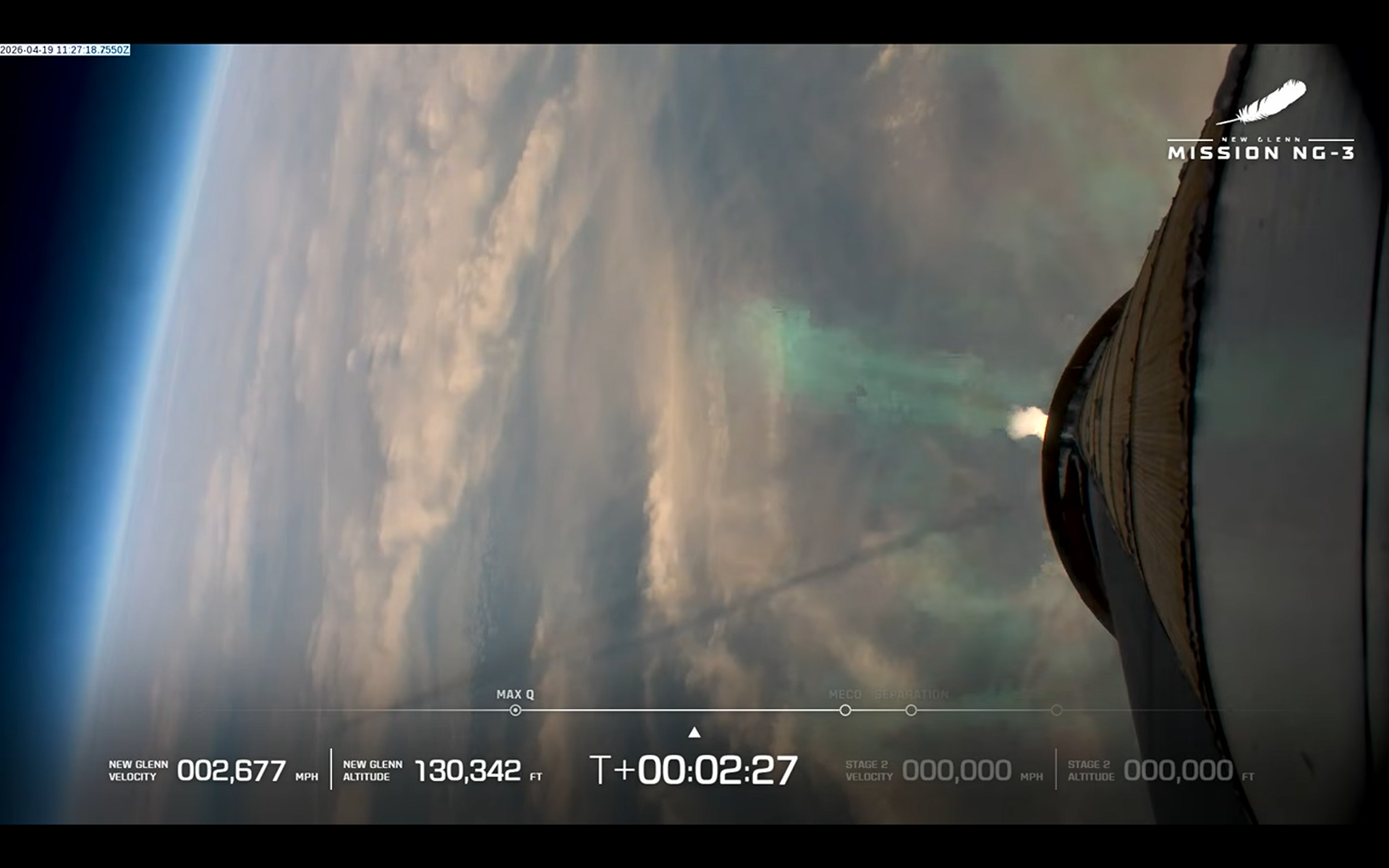
Blue Origin also made guidance system upgrades to the booster for today’s flight.
“We made a few tweaks with respect to how the rocket actually reenters, and then on the inside of the rocket, just making sure all of our systems continue to work as we as we expect that they will,” Charles said.
The first reuse of a New Glenn first stage, even if its engines are new, is a significant step toward the company’s ultimate vision for the rocket, whose first stages are designed to fly at least 25 times apiece.
Of the two New Glenn missions to date, only NG-2 successfully landed its first stage aboard the Jacklyn droneship. That mission launched NASA’s ESCAPADE probes on a mission to Mars in November 2025. New Glenn debuted in January 2025, on a mission that reached orbit successfully but did not pull off a first-stage landing.

A hefty payload
The main goal of Sunday’s New Glenn rocket launch was not to demonstrate reusability, but to launch a massive satellite into orbit.
BlueBird 7 was supposed to be the second “Block 2” satellite in the internet constellation of Texas-based company AST SpaceMobile. Its predecessor, BlueBird 6, launched on an Indian LVM3 rocket last December. BlueBird 6 is one of the largest satellites in space, with an antenna that spans 2,400 square feet (223 square meters). BlueBird 7 has the same dimensions.
BlueBirds 1-5, the “Block 1” version, while sizable in their own right, pale in comparison; their antennas cover a more modest 693 square feet (64.4 m) apiece.

Bluebird 7 was scheduled to be deployed into orbit from New Glenn’s upper stage about 1 hour and 15 minutes after liftoff. But about 2 hours after liftoff, Blue Origin reported that something appeared to go wrong.
“We have confirmed payload separation. AST SpaceMobile has confirmed the satellite has powered on,” Blue Origin wrote in a social media update. “The payload was placed into an off-nominal orbit. We are currently assessing and will update when we have more detailed information.”
A little later on Sunday, AST SpaceMobile provided its own update, and the news was not good.
“While the satellite separated from the launch vehicle and powered on, the altitude is too low to sustain operations with its on-board thruster technology and will [be] de-orbited,” the company said in a statement. “The cost of the satellite is expected to be recovered under the company’s insurance policy.”
This third launch of New Glenn was a major milestone for Blue Origin, which has designed the rocket’s first stage to be fully reusable. Such a capability would allow the company to compete with SpaceX’s Falcon 9, Falcon Heavy and Starship rockets, the only orbital-capable boosters to date with proven reusability.
New Glenn stands 322 feet (98 meters) tall — about the same size as the NASA Space Launch System (SLS) rocket that launched the Artemis 2 mission around the moon, and nearly 100 feet (30 m) taller than the 230-foot (70-m) Falcon 9.
New Glenn’s first stage is powered by seven BE-4 engines, which burn a fuel mixture of liquid oxygen and liquid methane, known as methalox — the same fuel used by the 33 SpaceX-built Raptor engines that power Starship’s Super Heavy booster. And right now, both launch vehicles need to prove themselves.
Endurance has successfully completed thermal vacuum chamber (TVAC) testing! We’re now preparing for our lunar lander’s return to Florida. pic.twitter.com/MGABuZPXYPApril 9, 2026
Blue Origin is relying on New Glenn to launch the company’s Blue Moon lander, one of two commercial vehicles NASA selected to land astronauts on the moon as part of the agency’s Artemis program.
SpaceX had been NASA’s first choice for a crewed lunar lander, with Starship slated to put astronauts on the moon on the Artemis 3 mission. But delays in the development of both companies’ spacecraft and a recent shakeup of Artemis architecture has put Blue Moon back in the spotlight.
During Sunday’s launch, Blue Origin officials said its Mark 1 Blue Moon lander, an uncrewed version of the lander, will launch to the moon by the end of this summer. The lander recently completed environmental testing at NASA’s Johnson Space Center in Houston. It is now back at Blue Origin’s Rocket Park facility in Cape Canaveral for final work.
The problem New Glenn experienced on today’s launch could complicate that timeline, however.
Artemis 3 will no longer go to the moon. NASA now wants astronauts aboard its Orion spacecraft to practice rendezvous and docking maneuvers in Earth orbit with either or both of the lunar landers, and has indicated a willingness to fly with whichever is ready once it’s time to launch — hopefully, in mid-2027.
Both landers have a list of qualifications and technology demonstrations to complete before NASA certifies either to support astronauts aboard, such as on-orbit cryogenic fuel transfer and uncrewed lunar landings, but each is making progress.
SpaceX is currently performing prelaunch tests on the Version 3 of its Super Heavy booster and Starship upper stage, which are expected to lift off on the vehicle’s 12th test flight in the coming weeks. Meanwhile, the Mark 1 (Mk1) Blue Moon vehicle recently completed a stint inside the massive vacuum chamber at NASA’s Johnson Space Center in Houston and was later shipped to the Kennedy Space Center, in Florida, for further testing.
Editor’s note: This story was updated on April 19 to include details of the successful launch and landing of Blue Origin’s NG-3, as well as the off-nominal orbit of its BlueBird 7 payload. It was updated again at 4:10 p.m. ET on April 19 with the news that BlueBird 7 will be deorbited.
