
Now Reading: Bellevue sees rise in traumatic e-biker crash cases
- 01
Bellevue sees rise in traumatic e-biker crash cases

Bellevue sees rise in traumatic e-biker crash cases
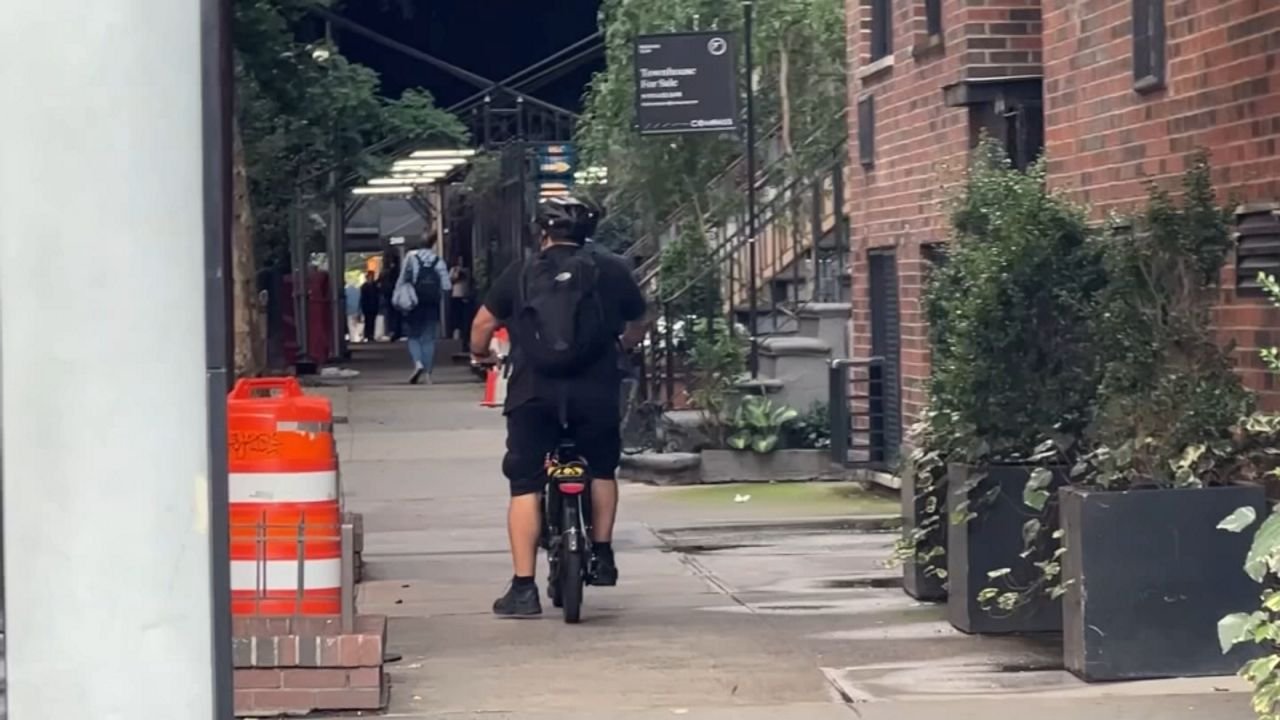
More than half of all trauma cases at Bellevue Hospital Center are the result of e-bike and e-scooter crashes.
Brittany Allyn, a social media content creator, was recording her exit from an Uber when a man on an e-bike hit the car door.
“A guy on an e-bike hit off the door on the Tesla, and then that driver fell off his bike and flew into another biker, and that biker happened to be around like an 80-year-old woman, and she fell off and hurt herself,” she said.
Many people have stories of crashes or near-misses.
“Bikers follow the rules most of the time. E-bikes and e-scooters, like 10%. They’re going back and forth,” Andy Winfrey of NYC Bike said.
It’s not just delivery workers. The need to get around faster is the name of the New York game.
And sometimes with CitiBike, all someone can grab is an e-bike.
“As a New Yorker, [who is] always trying to get as fast as possible from point A to point B, which is maybe something I should work on, I like these. I feel like the normal bikes also probably could use like an update,” Ash Grewal, an e-bike user, said.
With the growth of shared and personal micromobility devices and the rise in food delivery apps, the use of electronic devices has increased 35-fold in the U.S. since 2010.
Emergency rooms may bear the most extreme brunt of the trend.
“It was becoming more and more frequent that we were being called to the emergency room with another trauma, you know, person fell off an e-scooter, person fell off an e-bike, pedestrian hit by a bike. And it was just becoming like every night,” Dr. Hannah Weiss, a chief neurosurgery resident for NYU Langone Health/Bellevue Hospital, said.
Weiss began tracking the cases, eventually publishing the results.
Of the more than 900 patients treated at Bellevue Hospital Center, a third suffered traumatic brain injuries, and nearly 30% needed intensive care. The share of all trauma cases involving e-scooters and e-bikes went from less than 10% in 2018 to more than half by 2023.
“This is becoming a real burden on trauma centers in cities like New York and beyond,” Weiss said. “These are not just scrapes and bruises. These are major injuries. They’re complex. They’re requiring different subspecialties to get involved, and often surgery or hospital admission.”
One in five patients came into the ER intoxicated with more severe brain injuries.
Only one in three of the patients was wearing a helmet at the time of their accident.
“It’s one of the clearest, most modifiable risk factors that we found in the study. And people with helmets had significantly lower rates of traumatic brain injury,” Weiss said. “If you had a helmet on, it was protective.”
Of all the patients hurt in a micromobility crash, pedestrians experienced brain injuries at nearly twice the rate of riders.
“And these are often older individuals who were completely unprotected. No helmet. You know, didn’t see them coming and were hit by a bike or a scooter,” Weiss said.
Allyn and others say maybe it’s time to make some new rules of the road.
“Truly, you cannot afford to be on your phone. If you’re getting near a curb,” she said. “Look every which way because even though you’re following the rules, other people aren’t.”
“There has to be some kind of licensing or something. I know that there’s tricky,” Winfrey said. “But they have to do, I don’t know, another lane for those kinds of vehicles.”