By Thomas Kennedy
This article was originally published by Truthout
After using $1 billion to brutalize immigrants, Alligator Alcatraz has been emptied. Its victims still need justice.
Immigration and Customs Enforcement (ICE), along with the Department of Homeland Security (DHS), announced last week that all persons detained at the Alligator Alcatraz immigration jail were transferred to other facilities, and that the site’s giant tents and cages had been emptied.
The reason given to the public was the risk posed by Florida’s hurricane season, with the agency offering this statement: “As we enter hurricane season, ICE and the state of Florida have moved illegal aliens from the soft-sided facility. For the safety of the illegal alien detainees, we transferred them to other facilities.”
That didn’t seem to be a concern when the makeshift immigration jail opened last June, just as the 2025 hurricane season began. A July 2025 press conference attended by President Donald Trump, Gov. Ron DeSantis, then-DHS Secretary Kristi Noem, and Florida Attorney General James Uthmeier was disrupted by heavy thunderstorms that caused parts of the facility to flood, a pattern that would become routine during its yearlong operation. The possibility of a hurricane striking the Everglades site was, in fact, of such little concern that officials from the Florida Division of Emergency Management (FDEM), which administers Alligator Alcatraz, delayed the release of the facility’s hurricane preparedness and evacuation procedures until pressured by members of Congress. When it was finally made public, the 33-page draft document was so heavily redacted that entire pages were blacked out, leaving lawmakers with more questions than answers.
FDEM Director Kevin Guthrie responded to worries about a hurricane impacting an immigration jail comprising industrial tents and cages in the middle of the Florida Everglades by stating that the facility could “withstand category winds of up to category 2,” and that beyond that, “we will have to do an evacuation.”
So what changed between last year’s hurricane season and this year’s? The political context, for one. Who can forget unelected Florida Attorney General James Uthmeier boasting that migrants detained at the facility would find “not much waiting for them other than alligators and pythons. Nowhere to go, nowhere to hide.” Floridian voters were far less enthusiastic about the spectacle of a detention camp marketed around the threat of predators. Subsequent polling found the facility deeply unpopular, with only 35 percent approving and 51 percent disapproving. Those are troubling numbers for Republicans heading into what is already shaping up to be a challenging midterm election cycle.
On top of rhetoric that seemed constructed to disgust anyone except the most extreme anti-immigration hardliners, financial malfeasance generated controversy almost as soon as Alligator Alcatraz opened. To finance the tent-based immigration jail, state officials diverted nearly $1 billion from Florida’s Emergency Preparedness and Response Fund, a reserve traditionally intended for disaster preparedness and response. In one particularly striking example of inexplicable wasteful spending, a portable sanitation company called Doodie Calls received a staggering $219.1 million in state contracts. At a time when Florida is grappling with ongoing drought conditions, destructive wildfires, and the onset of hurricane season, those resources could have been used to strengthen emergency response capabilities and protect communities. Instead, taxpayers are footing the bill for an immigration jail whose infrastructure consists of cages within tent structures at a cost exceeding $1 million per day.
Much of this money did not go to the facility’s operating costs, however. Records show that Florida emergency officials spent $405 million in taxpayer dollars in six months on supposed immigration enforcement, with expenditures covering private jet flights, catering, meals at 55 restaurants, and bar tabs in the Tallahassee area, which is nowhere near Alligator Alcatraz. One private jet firm received $479,000 in taxpayer money, and nearly $30,000 were spent on rental cars. This continued misuse of public funds eventually led the Florida legislature to place some guardrails on the state’s emergency fund, curtailing DeSantis’s ability to tap into it for immigration detention purposes, specifically in relation to Alligator Alcatraz. Financing an unpopular immigration jail by continuing to raid Florida’s public funds meant for emergency response during hurricane season ultimately proved to be politically unfeasible.
The DeSantis administration has maintained since the opening of Alligator Alcatraz that all costs would eventually be covered by the federal government, but this reimbursement has largely not materialized. The Trump administration has so far paid Florida $58 million from FEMA funds, using a grant that can only cover operational costs and excludes modifications or construction related to the makeshift immigration jail. The federal reimbursement, which would still be paid for by U.S. taxpayers if it ever happens in full, would cover only $608 million of the costs incurred so far, leaving Florida taxpayers to pay the rest of the nearly billion dollars spent. But the harm can’t be measured in dollars alone.
Since its inception, the immigration jail has shocked the public’s conscience following reports of abuses and horrific conditions. Immigrants imprisoned at Alligator Alcatraz described overflowing toilets leaking into sleeping areas, inadequate access to showers, constant 24-hour lighting, insect infestations, unsafe food and water, and degrading treatment that no human being should endure. Some were forced to scoop human waste from clogged toilets with their bare hands because there was not enough water pressure to flush. Reports documented ongoing routine shackling, physical abuse by guards, and prolonged solitary confinement
In what Amnesty International deemed a form of torture, detainees were placed by guards in a 2-by-2 foot cage-like structure, left restrained on the ground while exposed to the sun and elements for hours without sufficient water or food. Justo Betancourt, a Cuban man who spent more than six months at Alligator Alcatraz, lost about 50 pounds while there. His wrists and ankles were bruised from the shackles he was forced to wear, and he suffered a stroke due to his deteriorating health. The U.S. government attempted to deport him to Mexico through the third-country agreement between the two states, but he was returned after the Mexican government found his health to be in too poor of a condition.
The story of a family I met during the early days of Alligator Alcatraz exemplifies just how traumatic the site was for those whose lives intersected with it. Yaneisy Fernandez didn’t hear from her son, Michael Borrego, for days after he was taken into custody, until she received a call from inside Alligator Alcatraz. Up until that point, all that she had heard of Alligator Alcatraz was the news coverage highlighting comments from state officials like Uthmeier. Borrego underwent emergency surgery for stage 4 hemorrhoids at Miami’s Kendall Hospital after bleeding profusely while in Alligator Alcatraz. While recovering at the makeshift immigration jail he was shackled to a bed and denied his prescribed post-surgical antibiotics. The heat contributed to his wound becoming infected with pus. Despite being Cuban, Borrego would eventually be deported to Mexico, where he was finally able to reunite with his young daughter, who suffered from anxiety attacks during the period in which she was separated from her father.
The severe medical neglect that Borrego suffered while detained was compounded by authorities denying him in-person access to his lawyer, leading him to become a plaintiff in a federal class-action civil rights lawsuit challenging the lack of legal counsel access and inhumane conditions at Alligator Alcatraz. The constitutional violations detailed in the 38-page complaint include forcing those detained to use monitored, recorded collect calls capped at five minutes, violating attorney-client confidentiality. A federal judge eventually ordered the state to provide unmonitored phones for legal calls, to which the DeSantis administration responded by arguing it would be too costly for Florida taxpayers, despite the nearly $1 billion already spent to set up and run the facility. The estimated cost of unmonitored phone access would be about $180,025, plus an additional maintenance cost of $6,283. Adding insult to injury, the state of Florida has spent more than three times that amount paying a private law firm to fight against the expansion of phone access.
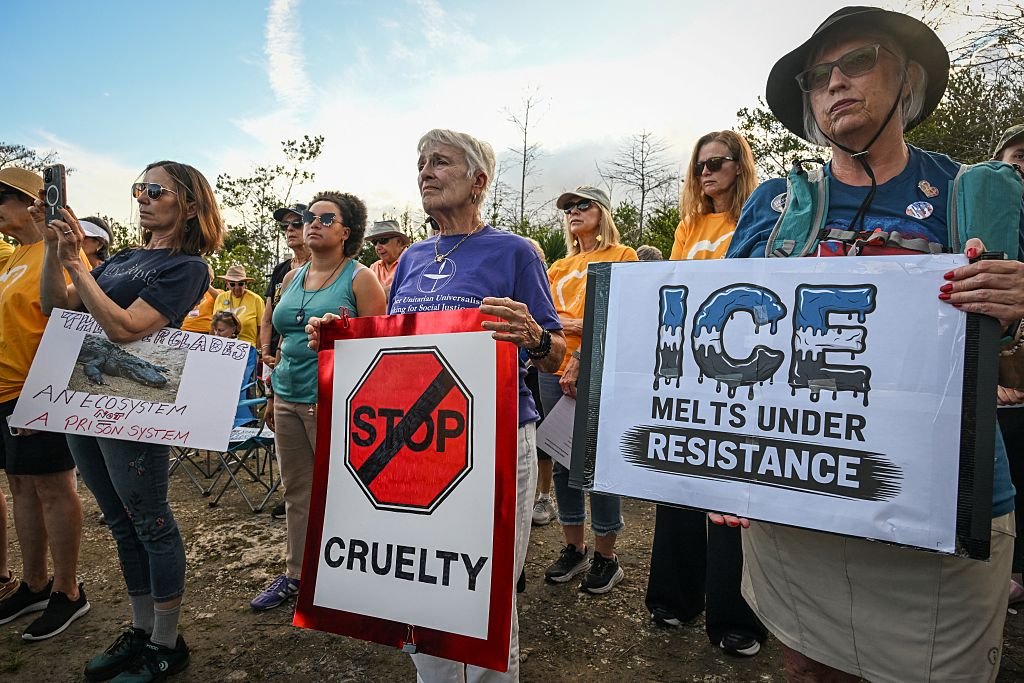
Standing outside of Alligator Alcatraz at a weekly vigil held every Sunday since the makeshift immigration jail opened, Robert Hilliard, a 101-year-old World War II veteran who was awarded the Purple Heart, warned the crowd about growing fascism in the United States. “Forgive me, I’m going to use the f-word,” said Hilliard, who took time that Father’s Day Sunday to brave the hot Everglades summer sun. “We have a fascist government that allows innocent people to be put in detention camps and incarcerated.” He went on to note that, despite the U.S. government claiming they were going after so-called criminals in their witch-hunt against immigrants, 71 percent of those detained by ICE have no criminal convictions.
Alligator Alcatraz now sits empty, and although DHS has not confirmed its closure, the vendors hired to do work inside the site were notified to begin “full demobilization” of the facility. Taxpayers continue to foot the bill, with $603 million of Florida’s $1 billion in immigration detention contracts still unpaid. DeSantis and other officials who touted this facility as a new model for immigration detention have instead created a billion-dollar human rights fiasco. Their experiment in Florida was a truly dangerous one. In Alligator Alcatraz, they attempted to set up a state-run immigration jail, which effectively functioned as an extrajudicial black site, almost fully divorced from federal authority. Most of the people who were detained at Alligator Alcatraz will simply be transferred to other immigration jails, while their families continue to endure uncertainty, separation, and hardship. Floridians also deserve answers about the nearly $1 billion in taxpayer funds funneled to private vendors through no-bid state contracts. Through this detention camp, corporations and contractors will have pocketed millions in profits, while immigrant families are left to bear the human cost and rebuild their lives in the aftermath.
This article was originally published by Truthout and is licensed under Creative Commons (CC BY-NC-ND 4.0). Please maintain all links and credits in accordance with our republishing guidelines.