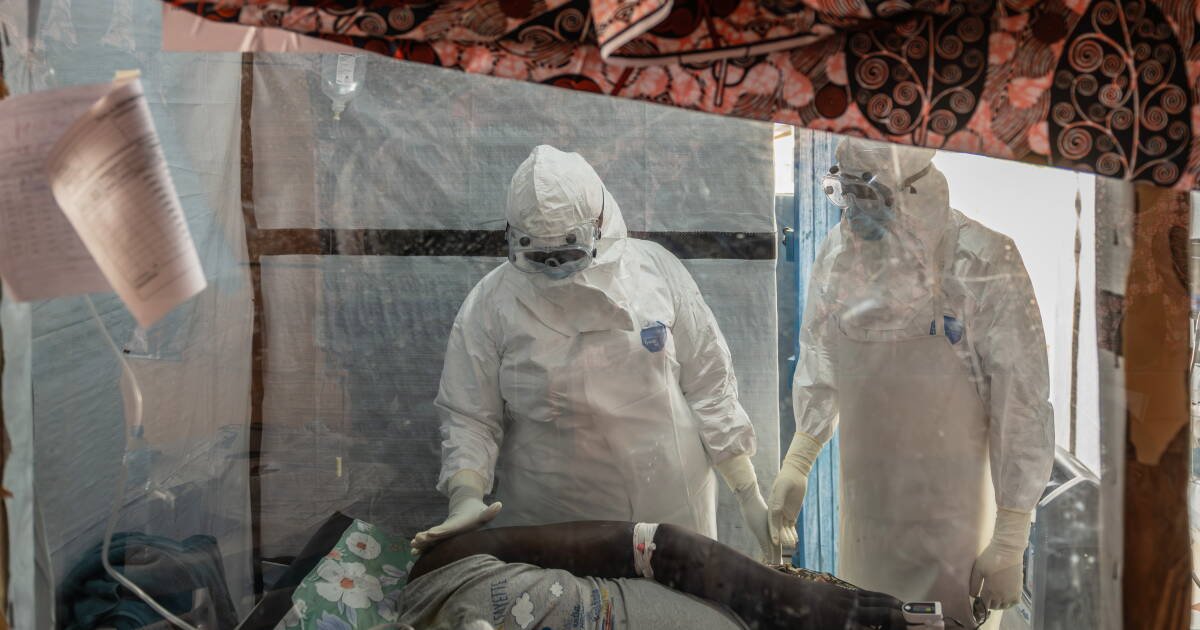
It’s been about a month since the World Health Organization declared the Ebola outbreak in the Democratic Republic of the Congo and Uganda a public health emergency of international concern. In the days since, the virus has been responsible for more than 200 deaths and more than 1,000 infections. Experts with the U.S. Centers for Disease Control and Prevention project the outbreak could spread to rival the worst on record.
The outbreak comes as the Trump administration has withdrawn the United States from the World Health Organization, dissolved U.S. Agency for International Development (USAID) and implemented some of the strictest travel restrictions over the outbreak.
Dr. Nahid Bhadelia, an infectious disease physician and the founding director of Boston University’s Center on Emerging Infectious Diseases, joined GBH’s All Things Considered host Arun Rath to discuss the outbreak. What follows is a lightly edited transcript of their conversation.
Arun Rath: So the first time you and I spoke, 11 years ago, we were talking about the Ebola outbreak in Sierra Leone. Can you tell us how this current outbreak compares?
Dr. Nahid Bhadelia: The West African Ebola virus disease outbreak in 2014 to 2016 was the biggest Ebola outbreak in history, with over 25,000 — nearly 30,000 — infections, 11,000 deaths. And the biggest concern had been that by the time we detected that virus, it was already in three countries in West Africa: in Sierra Leone, in Guinea, and in Liberia. The index case was in December 2013 and the identification was March 2014. That lag is kind of what allowed the outbreak to become so big, the epidemic to be what it was.
What echoes here for me with the Democratic Republic of the Congo is similar startings, where there was a significant delay by the time this outbreak was identified as a specific species of Ebola called Bundibugyo. It had already made it into multiple provinces, including a couple of urban centers. And the question then is: Why was this delayed?
The other things that kind of speak to the similarities between the two are the operational difficulties in terms of operating, particularly in DRC, because of ongoing conflict, because of distrust. Even though it is a country that has had significant experience — this is their 17th Ebola outbreak — something seems different about this.

Aurélie Marrier d’Unienville
AP
The idea that this might become bigger is at the forefront of many of our minds, and potentially be at least the biggest outbreak in DRC of Ebola, if not the biggest outbreak ever.
Rath: One of my questions was going to be about lessons learned from the last time. And it sounds like one lesson not learned involved early detection?
Bhadelia: Well, the interesting thing is DRC has been very good, even particularly recently. They’ve had incredible capacity at INRB, which is their national laboratory, in detecting Ebola outbreaks in the past. And so something seems to have changed leading up to this particular outbreak.
One of the difficulties is that this particular species, the Bundibugyo species, is one that we’ve only had two other outbreaks with. And the early testing in this outbreak, even though there was testing for Ebola, it was not for Bundibugyo — for this particular species. The provincial labs that would’ve picked up the early cases tested negative for the more common Ebola Zaire species. That was part of the delay. So, even though there was surveillance, it seemed to have fallen flat in this particular instance because of the species.
But the second thing that concerns me and many others is that DRC has been facing a lot of other challenges, particularly in the setting of USAID programs being dismantled in the country. They used to support a lot of other infectious diseases’ supports, such as measles and cholera.
All those cases have gone up. So, think about it this way: If Ebola is the signal, and the noise is all the other endemic diseases, we’ve been recording — at our center — just an increase in incidence of all those other diseases. That may have made it harder to pick up the signal from the noise.
Rath: You’re in perhaps a better position to answer this than anybody. How does the United States approach and response now compare with 11, 12 years ago?
Bhadelia: I will start with the good thing first, if there can be such a thing.
There has been — now — monetary commitment to this response. We can start backwards, now — post the event having happened.
Where this country’s fallen flat is that our withdrawal with the USAID programs in the region has not just led to increases in other endemic diseases that I mentioned. Studies show that it has led to an increase in conflict in the area — which also, of course, makes it harder to do any kind of public health response. So those investments have sort of made the area more vulnerable, and that has been part of the U.S. policy that has led to this.
The other thing that has happened is: We used to have a lot more relationships with people on the ground, with USAID programs. There are some CDC folks still on the ground, but having those connections are important for two reasons.
One, they are important because they served as a way for us to get early signals, were something to happen in that area. And when we pulled out, we don’t have those eyes on the ground, those relationships.
The second reason it matters is — because in this area, in particular — trust is a currency just like money is. And if you only show up for the diseases you care about, prior outbreaks in DRC have shown that communities distrust you. And in some ways, our pullout and our stance to only now be in the response when it’s a disease that we care about, I think, has left us back-footed.
Rath: I want to get your take on the, the stringent travel restrictions. First, the plan to treat exposed U.S. citizens in Kenya. That’s a move that generated backlash in that country. What do you think of that policy?
Bhadelia: Yeah, it’s a policy that doesn’t make sense to me, Arun. As someone who was a responder in West Africa, I took care of Ebola patients there.
[I try to imagine] if I had been told then that I would not have the guarantee to be able to come back and take advantage of these incredible investments we’ve made now. I mean, in the last so many years since the West Africa outbreak, the U.S. has spent over $1 billion in setting up these biocontainment care units at Emory and Nebraska and New York City and other places. They provide incredible care and have staff that do this, and have been doing this for a long time in terms of training and as well as experience.
So if you tell me as a responder that my choices are now not that, but instead a field hospital that’s been set up in an ad hoc manner? I would be a lot more hesitant to deploy. That’s one of the things I worry about. It would maybe make fewer people want to help.
Or, worse, people who are there and helping, if they have an exposure, they may be less likely to want to declare their exposures. Because they’re worried they would be kept in Kenya rather than being allowed to come back here.
Then there’s, of course, the center itself. I don’t think you can create the same quality of care that you can in a well-established hospital that can provide ICU-level care in a field hospital in Kenya that’s been set up over a matter of weeks. There is no way.
And it doesn’t make sense from either an infectious diseases public health perspective — or otherwise — to not just bring those people home to begin with. After someone’s exposed, they are not infectious. Even if they have a high-risk exposure, there is a few days during which it takes for the disease to have an incubation period to go to being symptomatic. It is easier to transport people back in that period rather than trying to come up with a plan to transport them once they get sick.
It’s more dangerous for everyone involved. It’s worse for the patient.
Rath: The U.S. has now placed restrictions on people coming in from DRC, from Uganda and from South Sudan. These are for non-U.S. citizens, but it doesn’t matter if you’re a green card holder. If you’re coming in from one of those places in the past three weeks, you’re prohibited from entering the U.S. What’s your take on that?
Bhadelia: Historically, what’s been shown is that blunt travel bans don’t really help because passports don’t decide who gets infected. And instead, I think the type of approach that we had in West Africa — where we tracked who was coming from the area and placed them under observation — allows you to more closely track people once they’re here. And be able to put them under quarantine if you need them, or observation, or under fever watch. I think it’s a bit more both humane, but also more scientifically based.
“Historically, what’s been shown is that blunt travel bans don’t really help because passports don’t decide who gets infected.”
Dr. Nahid Bhadelia, founding director of Boston University’s Center on Emerging Infectious Diseases
The other thing that’s happened is that it’s not just the U.S. Our stance being so strict around travel restrictions has led some other countries actually putting travel restrictions into place, such as Uganda and Rwanda, which are neighbors of DRC. Which is all fine and good. You can step back and say, “They don’t want to see the outbreak spread.”
But what’s happened is that those kinds of travel bans then put stops to commercial shipping, resources coming in — human beings coming in to help, human beings going out after they’ve helped. That makes transport in and out of the region much more difficult, to get aid and help in the places where they’re needed.
Rath: I got to say, it’s always comforting talking with a doctor like you because, while Ebola is terrifying, knowing that we have experts who understand it this well is very reassuring. With all of that reassurance, should we be concerned at all about the outbreak reaching the U.S.?
Bhadelia: I think if you look at the West Africa experience — I just told you, earlier in this conversation, how big that was. And during that period of time when we were tracking all the travelers, only one traveler ended up coming to the U.S. who was actually Ebola positive, who was sporadically just coming in. And that was because that person was within the period of time before the travel measures had been put into place to detect folks.
That experience tells you that, what you might see, is actually a lot of suspect cases. People coming from the area who may have symptoms that are nonspecific, which could be Ebola, and that creates a lot of anxiety.
But someone truly being Ebola positive coming to the U.S. is less likely. The reason why is because of where this is happening, in terms of geographic location and remote accessibility. But also when people are truly sick with Ebola, they can’t really travel. The idea that someone could make such a long journey makes it much, much less likely.
So I wouldn’t worry. I don’t think we’re at risk, specifically, to see more Ebola cases. What could happen is that, if this outbreak continues to grow in the region, that could lead to regional insecurity. And that could come back as a potential sort of a more geopolitical and other threat to us here in the U.S. as well.
Plus also, Arun, it’s just the right thing to do is to help stop this. Because when we talk about 20,000 infections and 11,000 deaths, I mean, I think you gotta not think in numbers. You have to think in families. You have to think about communities. And we don’t want to see that happen in DRC, particularly after what happened in West Africa.