
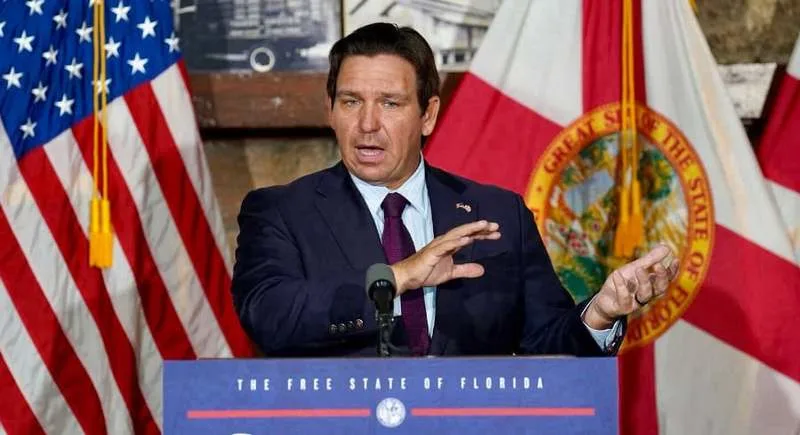
Florida Governor Ron DeSantis moved swiftly on Wednesday to recommend that two Islamic organizations, various foreign drug cartels, and an anti-fascism movement be officially designated as terrorist organizations, executing new powers granted to him on the first day a sweeping anti-terrorism law took effect.
The legislation, known as HB 1471, became effective on July 1 following its passage during the 2026 Florida legislative session. Under its provisions, DeSantis announced his intent to apply the terrorist label to the Council on American-Islamic Relations (CAIR), the Muslim Brotherhood, and antifa.
To become official, the designations must be approved by the three Republican members of the Florida Cabinet: Attorney General James Uthmeier, Chief Financial Officer Blaise Ingoglia, and Agriculture Commissioner Wilton Simpson. All three officials face elections this coming November. DeSantis stated that he expects an “emergency call” to be arranged quickly with the Cabinet to finalize the decision.
“We’ve got to draw a very strong line in the sand here,” DeSantis said during an announcement at the Attorney General’s Tampa Office of Statewide Prosecution. “We’ve seen this creep throughout the country over many, many years.”

Florida Gov. Ron DeSantis (X)
The law serves as statutory backing for a December executive order issued by DeSantis that targeted CAIR and the Muslim Brotherhood. In March, U.S. District Judge Mark Walker issued a preliminary injunction against that executive order, ruling that it violated CAIR’s rights by threatening individuals who provided the nonprofit with material support.
CAIR and civil rights advocates have confirmed they will challenge the new law in court. In a statement, CAIR argued that the statute “dramatically expands Florida’s authority to both label and punish groups.”
“DeSantis is seeking to unilaterally silence a leading American civil rights nonprofit and punish those who support it,” said Scott McCoy, deputy legal director of the Southern Poverty Law Center, speaking on behalf of CAIR.
According to a press release from the governor’s office, the law is designed to identify and “combat terrorist organizations operating in Florida.” The release did not provide a definition for antifa, though DeSantis remarked that the movement “practically lives in Portland.”
The governor’s list also includes more than 90 groups already classified as foreign terrorist organizations by the U.S. federal government. Among them are the Venezuelan gang Tren de Aragua, the Mexico-based Sinaloa and Gulf drug cartels, and Iran’s Islamic Revolutionary Guard Corps (IRGC).
DeSantis emphasized that the recommendations were based on organizational behavior rather than ideology.
“Even though I don’t like Antifa’s ideas, I mean, they’re militant leftists,” DeSantis said. “It’s their actions and what they’re involved with that’s very destructive. And the same with Tren de Aragua, same with (the Islamic Revolutionary Guard Corps), obviously they’re a revolutionary military Islamic organization, but they’re also the leading fermenter of terrorism worldwide.”
The law establishes multiple avenues for enforcement and penalties. It permits the state’s Chief of Domestic Security—a role currently held by Florida Department of Law Enforcement Commissioner Mark Glass—to designate domestic or foreign terrorist groups. Furthermore, it prohibits Florida courts from enforcing provisions of foreign or religious laws, specifically citing Islamic Sharia law.
On education, the statute mandates that public universities and colleges expel any student who “promotes” a designated terrorist organization. The law defines “promotion” as actions that can be “reasonably interpreted” as an actual threat of violence, disrupt the learning environment, infringe on the rights of others, or provide material support or recruitment for the group.
Additionally, public higher education institutions are banned from using state or federal funds to support campus activities or programs that promote these organizations. Private K-12 schools affiliated with designated groups will also be barred from receiving state scholarship program funds.
The legislation passed through Florida’s Republican-controlled Legislature with an 80-25 vote in the House and a 25-11 vote in the Senate. During legislative debates, Democratic lawmakers raised concerns regarding due process, pointing to a companion bill (HB 1473) that exempts the documents and records showing how a “terrorist” designation is reached from public disclosure. Opponents also expressed concern that individuals, particularly college students, could face severe administrative penalties for alleged association with a group without a criminal conviction.
READ: 30-Year Prison Term For Florida Man Who Filmed Abuse Of Minors In The Philippines
Please make a small donation to the Tampa Free Press to help sustain independent journalism. Your contribution enables us to continue delivering high-quality, local, and national news coverage.
Sign up: Subscribe to our free newsletter for a curated selection of top stories delivered straight to your inbox.
DeSantis Names CAIR And Antifa In Day-One Terrorist Blacklist Under New Florida Law
Leave a Reply