

Now Reading: H5 bird flu strain detected in Australian seabird for first time
- 01
H5 bird flu strain detected in Australian seabird for first time

H5 bird flu strain detected in Australian seabird for first time
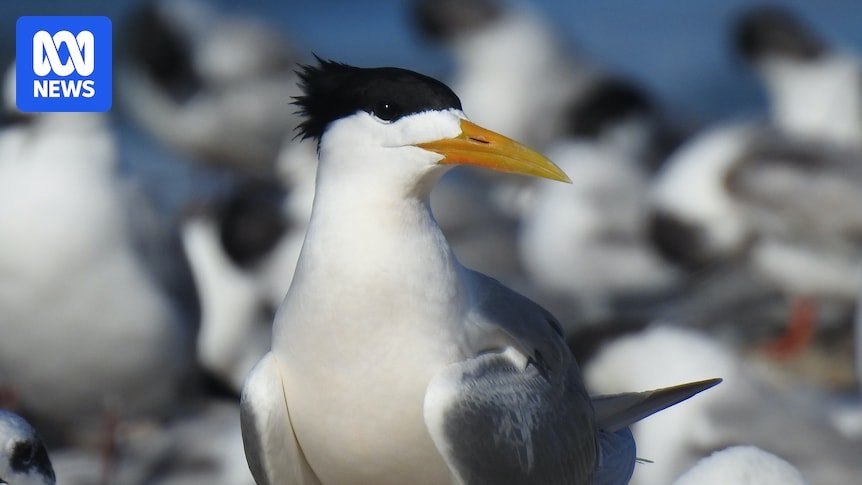
The H5 strain of bird flu has been detected in an Australian seabird for the first time, with authorities also carrying out testing on a fur seal found in New South Wales.
The detection of the virus in a native bird represents what the federal government described as a “concerning development”, because previous confirmed cases have involved migratory birds from the sub-Antarctic region.
Agriculture Minister Julie Collins said CSIRO lab testing had confirmed the deadly strain in a greater crested tern found in Robe in South Australia’s Limestone Coast.
There have also been two further confirmed cases in South Australia and one in Western Australia, bringing the total number of detections to 12.
The NSW government today confirmed it was conducting tests, for bird flu, on a fur seal found on the Central Coast on Thursday.
Ms Collins said there was still no evidence of mass mortality among wildlife and no evidence of any spread to agricultural settings.

Julie Collins says further work is being carried out. (ABC News)
The minister said SA authorities were “implementing enhanced surveillance in the area where this bird was found”, and that further investigation was being conducted to determine how the bird contracted the virus.
“Our scientists are undertaking further work to establish the potential pathway that resulted in the Australian seabird’s infection,”
she said.
“[They will] seek to determine whether this particular tern has caught off these migratory birds, if it’s the same sort of sequence or not.
“What we do know is that this is a coastal seabird that has an overlapping coastal range with migratory seabirds that have previously tested positive for H5.
“While this is a concerning development, it is not unexpected and is another sign that our strong biosecurity system is working.”
The greater crested tern was found by a member of the public a few days ago, and was reported to the Emergency Animal Disease Hotline.
The bird was sent to the CSIRO, which confirmed the case of H5 bird flu, the minister said.
She said no other dead birds were found nearby.
In a statement, a spokesperson for the NSW government said test results to determine the cause of the death of a fur seal on the Central Coast were “still pending”.
“A young fur seal found unwell at Blue Bay … died on Thursday, and, as a precaution, samples have been collected and submitted for H5 avian influenza testing in line with established protocols,” the spokesperson said.
South Australia’s two previous confirmed cases of H5 bird flu have been on Yorke Peninsula and Kangaroo Island.
Department of Primary Industries and Regions SA (PIRSA) chief veterinary officer Skye Fruean said the sea lion population on the latter was potentially exposed.
“We’ve already done a huge amount of preparatory work to build the resilience of Australian sea lion populations, including at Seal Bay, so that will remain a focus,” she said.
“The risk to those sea lions in particular doesn’t particularly change from that detection. We knew that we might find this anywhere along the coast.”
Surveillance working well, SA vet says
Dr Fruean said the spread from migratory to native birds was a concern.
“We don’t know for sure how this bird has contracted H5 bird flu but we can make some fairly safe assumptions based on what we know about the virus,” she said.
Lab testing has confirmed the deadly strain in a greater crested tern found in Robe, SA, the federal government says. (ABC Goldfields & Esperance: Tara de Landgrafft)
“We know that the migratory seabirds have been visiting our shores from the Antarctic regions and some of them have been bringing H5 bird flu with them.
“These seabirds such as the greater crested tern do have the opportunity to come into contact or interact with those migratory birds, either out at sea when they’re feeding on fish, or onshore.“
She said she was confident that surveillance of sick or dead birds “was working well”.
“It’s a particularly nasty strain of bird flu,” Dr Fruean said.
“It does spread fairly easily bird to bird but it does require quite close contact, so quite similar to how seasonal influenza spreads between people.”
Dr Fruean says it’s possible the tern became sick after coming into contact with migratory birds offshore. (ABC News)
Friends of Shorebirds SE public officer Maureen Christie said greater crested terns bred on islands off Robe and Beachport and could also be seen along the rest of the coastline.
They also ventured into coastal lakes and the Coorong, she said.
“We’ve been saying for several years now that it’s not if, it’s when, but it’s rather devastating when it’s actually here,” she said through tears.
She said she was “exceedingly worried” there were no signs on local beaches about what to do if you find a sick bird, like there was for the algal bloom and the outbreak of abalone viral ganglioneuritis in the South East in 2024 and 2025.
“We still haven’t go anything on our beaches,” she said.
Robe Mayor Lisa Ruffell said it was important to keep the detection in perspective.
“I can’t say this enough: it’s only one bird at the moment,” she said.
“Everybody is concerned it’s going to go further.
“[But] we are hoping that it is just one instance and this is the end of it.”
Ecologist and ornithologist David Paton said the coming weeks would be a vital learning opportunity in the fight against bird flu.
“The more we learn over the next month or so about the way in which the disease is being transferred to other species, the better,” Dr Paton said.
SA Primary Industries Minister Clare Scriven encouraged members of the public to continue to contact the Emergency Animal Disease Hotline.