
Now Reading: Southern California rent inflation falls to 5-year low – Orange County Register
- 01
Southern California rent inflation falls to 5-year low – Orange County Register

Southern California rent inflation falls to 5-year low – Orange County Register
Good news, tenants: Southern California rent inflation is running at its slowest pace since 2021, according to the Consumer Price Index.
That’s what my trusty spreadsheet found by peeking at the rent tracker within the nation’s key inflation gauge for three Southern California metropolitan areas.
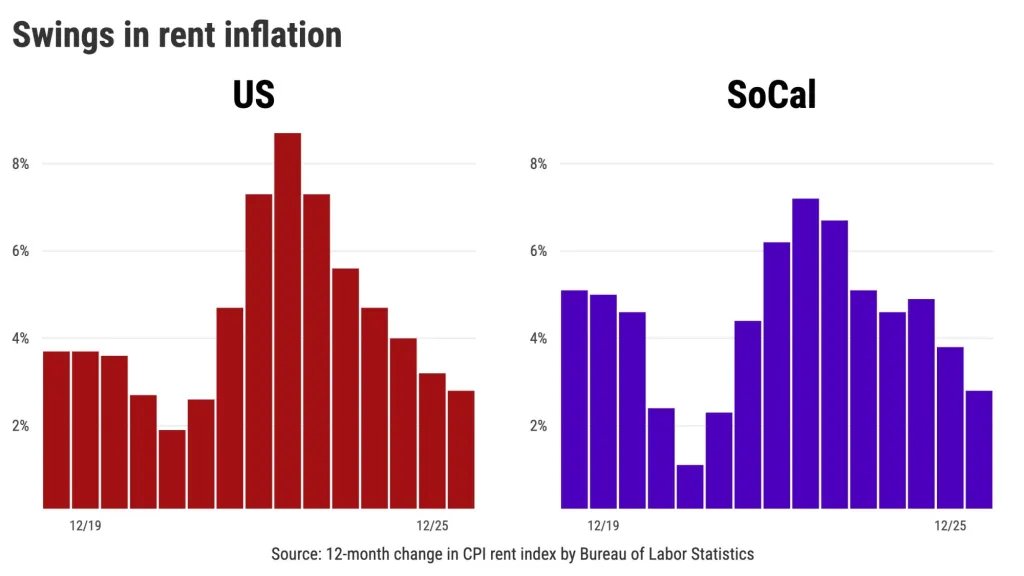
Southern California renters paid 2.8% more in the first half of 2026 compared with the previous year, according to a population-weighted average of the three metro CPI results. That’s the smallest rent inflation rate for a half-year period since the last six months of 2021, a time when the economy was sorting out the swiftly changing pandemic business climate.
Now the CPI measures rent swings differently than other yardsticks. It surveys tenants across all living arrangements, including occupants of large apartment complexes and renters with smaller landlords. And the survey asks renters how much they’re currently paying for rent and utilities, while many other rent indexes concentrate on the cost of newly signed leases.
No matter the math, Southern California rent hikes are cooling. Why? Landlords are scrambling to keep their units full.
A wobbly economy and a stagnant population have chilled demand. Meanwhile, modest new construction heats competition for tenants and puts downward pressure on what’s charged.
Consider that rent inflation started 2026 well below the 4.9% jump seen in 2025’s first half and the 4.4% average hike since 2019.
Aside from the improvement, the CPI also shows Southern California rents are up 39% since 2018. It could be worse, however: Local homebuyers face house payments up 86% in the same period.
Who can afford this? Well, the typical Southern California wage rose 40% since 2018, according to a federal employee cost index.
Nationwide, too
The typical American tenant is enjoying a similar rent-hike chill.
The nationwide CPI shows rents rising 2.8% a year in the first half. That was the smallest half-year gain since the second half of 2021.
It’s also down from the 4% pace of 2025 and a 4.4% average since 2019.
These rent hikes mean American tenants are paying 39% more than in 2018. That’s meek pain vs. what U.S. homebuyers face: House payments are up 99% in the same period.
Meanwhile, U.S. wages are up 33% in eight years.
Locally speaking
The metro area comprising Los Angeles and Orange counties had the region’s highest rent inflation to start 2026: Up 3.1% in the first half of the year vs. 4.7% a year earlier and a 4% average since 2019. Rents are up 35% since 2018.
San Diego County‘s rent inflation cooled rapidly: a 2.3% gain in the first half was down from 5.5% a year earlier and the 4.9% average since 2019. Rents are up 44% since 2018.
And in the Inland Empire, rent inflation also dropped sharply: up 1.7% in the first half, down from 4.9% a year earlier and the average of 5.6% since 2019. Rents are up 51% since 2018.
Jonathan Lansner is the business columnist for the Southern California News Group. He can be reached at jlansner@scng.com
- Try Jonathan Lansner’s Substack collection of economic trends. CLICK HERE!