
As Washington prepares to ask for a major disaster declaration from the same federal government that just months ago wanted to abolish the Federal Emergency Management Agency, former employees say sweeping cuts have already diminished FEMA’s ability to respond.
FEMA employees in Western Washington who were “DOGE’d” this year by the Trump administration worry that even if a major disaster declaration is granted, unlocking resources for individuals and nonprofits, relief tasks will fall upon an understaffed and under-resourced agency.
For flood victims already disenchanted by their FEMA experience after flooding in 2021, some are relying on community support while waiting with bated breath for possible federal aid. Others are avoiding damage documentation in expectation of disappointment again.
Nearly 2,450 employees are estimated to have left FEMA since the second Trump administration began, ushering in cuts mandated by the Department of Government Efficiency (DOGE). FEMA’s presence in Western Washington wasn’t spared from the Trump administration’s deep cuts, according to former employees of the agency in the region.
Due to the cuts, the country is unable to simultaneously respond to multiple disasters, according to a report by the Government Accountability Office, a governmental oversight body. FEMA’s Region 10 office in Bothell oversees Washington, Alaska, Oregon and Idaho.

The cuts made to FEMA’s presence in Western Washington, including Region 10, in the last year are significant, former employees Mitch Paine and Matt Glazewski told Cascadia Daily News.
“There’s absolutely no way that they have anywhere near the number of staffing that they had a year ago to be able to handle federal disaster declarations,” Glazewski said.
In the last year, the Trump administration eliminated many regional employees in probationary periods, including high performers who recently received promotions, according to a current Region 10 employee who requested anonymity.
FEMA, which is funded by Congress and overseen by the Department of Homeland Security, declined to say how many regional positions were cut in the last year.
“Workforce adjustments have not affected FEMA’s ability to support disaster response or recovery efforts in Washington or elsewhere,” a FEMA spokesperson said in a written response to questions.
However, just as 2026 began, DHS began executing another round of dozens of cuts to FEMA’s emergency disaster response “CORE” employees, according to CNN, which reported that regional offices are mostly composed of the type of positions that were cut.
The current Region 10 employee told CDN that they weren’t aware of any regional CORE employees who had their contracts canceled in the last week. Region 10 CORE employees’ contracts were recently temporarily extended by only 180 days, following new DHS guidance issued in 2025, according to the employee.
With CORE contracts potentially in question, the current employee said much of the FEMA staff is left in the dark regarding their own future and the agency’s.
Fear is widespread throughout the agency, Paine said, adding that employees who remain are scared to speak up after the Trump administration has repeatedly fired employees who speak out.
FEMA employees signed a petition stating that the cuts put the nation at risk of repeating mistakes made during Hurricane Katrina in 2005. Federal officials suspended those employees, twice.
FEMA’s Region 10 team helps communities with permitting and regulation, which ties into the availability of flood insurance. “That team is down to very few people, so there is very little assistance out there for communities,” said Paine, who worked for FEMA for five years until May.
The mapping team, which includes engineers and staff who produce flood maps and help communities assess landslide risk and study aftermath, is down multiple staff members, Paine said.
“They lost a lot of engineers,” he said. “It means less regional support.”
FEMA’s mitigation team, which helped with some of the preparation and planning work that set Mount Vernon up to build its flood wall that prevailed amid record-breaking Skagit River levels, has taken a hit, too.

Paine, who worked in mitigation for FEMA in Washington, both for Region 10 and the agency’s national headquarters, said it seems like the Trump administration is lumping in mitigation work with “funding climate change.”
“Mitigation isn’t about climate or equity, it’s about reducing future damage costs,” Paine said.
With assistance from the nonprofit Whatcom Long Term Recovery Group, FEMA dollars and mitigation efforts helped Whatcom residents elevate their homes following the floods of November 2021. However, Paine and U.S. Rep. Rick Larsen, an Everett Democrat, worry the administration’s deprioritization of mitigation is putting communities at risk.
“This administration has been clear that they want to narrow FEMA’s focus strictly to immediate response, and maybe help with a little bit of long-term recovery, but not really help at all with states or communities to build the infrastructure necessary to lessen the impact of a disaster if it comes,” Larsen said.
The administration’s operation of FEMA lacks a vision beyond decreasing the government’s role in helping communities deal with disasters, Larsen said. FEMA’s denial of Washington’s request for federal disaster relief following last year’s bomb cyclone, in which the agency said aid “is not warranted,” is consistent with the Trump administration’s approach, Larsen said.
“When we don’t have FEMA staff that can support communities in finding ways to recover so people get to a better place than before, [that] makes us less prepared for the next flood,” Paine told CDN. “The fact that Whatcom and Skagit County had a flood four years ago, and they’re facing one already again, adds emphasis; we can’t just put stuff back to how it was before because this will happen again.”
An uncertain future
While the Trump administration approved Washington’s most recent emergency declaration, the state is still holding out for a major disaster declaration, which some leaders are skeptical will come in a politically fraught climate. When asked on Dec. 11 what the recovery plan would entail if the federal government didn’t help, Gov. Bob Ferguson said the granting of emergency aid from the federal government “does seem to be on an increasingly partisan bent.”

Ferguson isn’t alone. Colorado Democrats, including the governor, said Trump was playing “political games” after the state’s request for emergency recovery funds was denied in December.
Plus, after the Trump Administration canceled FEMA’s Building Resilient Infrastructure and Communities (BRIC) program, a hospital just across the border in Oregon is desperately fundraising to finish the construction of a tsunami shelter after FEMA pulled $14 million in awarded funding for the project. Washington, along with 20 other states, sued to restore the FEMA grants, saying in its filing that it’s unsure if two levee projects in the state can be completed without the nearly $100 million FEMA originally granted.
Had the BRIC program not been canceled, Paine said the program would’ve been ideal for recovering communities like Sumas in need of home elevation and drainage improvement.
Agreeing with the governor, Rep. Larsen said he wouldn’t be surprised if the Trump administration chose not to support Washington’s long-term recovery. Washington’s potential for a major disaster declaration did, however, possibly receive a boost when U.S. Health Secretary Robert F. Kennedy Jr. announced a public health emergency declaration over the state’s flooding.
The potential politicization of FEMA aid isn’t so easily identifiable, according to Glazewski, who says there are instances — such as Trump’s denial of aid to North Carolina after Hurricane Helene ravaged Trump-supporting counties — that surprised him.
“It does appear that there is some sort of political piece associated with it, but it’s also not rational because it doesn’t feel as if there’s really a clear way to say why something was or wasn’t (denied),” Glazewski said. “It seems feeling-based, not based on the scale of the disaster or the need.”

Unbeknownst to his supervisor, Glazewski, who lives in Bellingham and worked for the federal government for nearly two decades, including about six years with FEMA, was “DOGE’d” this March. The email thanked him for his service. Many others in the region were also abruptly fired this year, he said, adding that this shrunk the bench of regionally deployable FEMA employees.
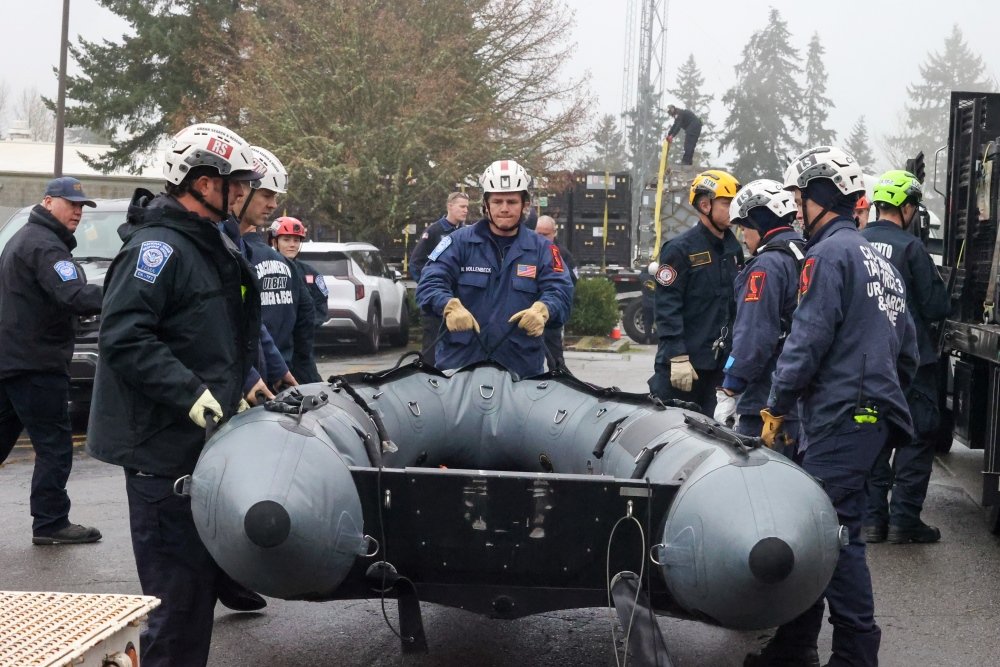
Since Washington was granted a disaster declaration, out-of-state FEMA personnel, including three FEMA search-and-rescue teams, were welcomed in Washington. Out-of-state FEMA employees are likely working overtime, exhausted and burn out quicker, Glazewski said, adding that “it’s not a great situation for anyone.”
Plus, Paine said, non-local support staff don’t necessarily know the peculiarities or realities of Washington communities.
“Not having a strong regional team just kind of limits our ability to have effective FEMA support,” Paine said.
More than 150 regional FEMA employees were deployed in Washington as of Dec. 23 following Trump’s Dec. 12 emergency declaration, according to the agency. More federal resources could be deployed if the state receives a major disaster declaration.
Owen Racer is a Report for America corps member who covers health care and public health in Whatcom and Skagit counties. Reach him at owenracer@cascadiadaily.com; 360-922-3090 ext. 101. Learn more and donate at cascadiadaily.com/rfa.