
You May Also Like
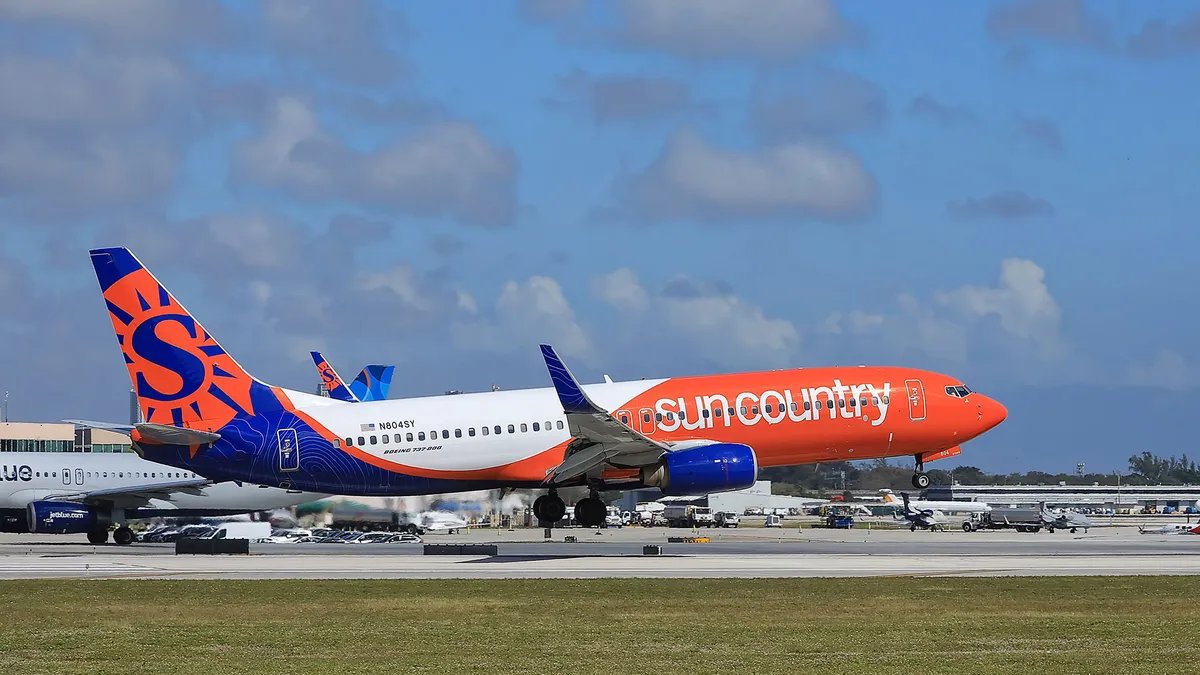
The proposed merger between ultralow-cost carriers Allegiant and Sun Country is a logical arrangement that is likely to boost surviving brand Allegiant, according to analysts.
While it could be just the first consolidation of U.S. discount carriers this year, the small size of the two airlines and their niche business models means that the tie-up won’t have a substantial impact on the U.S. airline industry.
“We don’t view this as all that meaningful, but it’s nice to have,” wrote investment analyst James Kirby of J.P. Morgan after the $1.5 billion deal was announced on Jan. 11. “We’ve long been fans of consolidation, believing it should limit the industry’s capital consumption and diminish its longer-term growth trajectory.”
Combined, Allegiant and Sun Country account for 2.5% of U.S. domestic seat share, according to Cirium data compiled by Raymond James investment analyst Savi Syth.
Kirby said the Allegiant-Sun Country combination does not change the dynamics that have enabled legacy carriers to achieve better financial results than most discount competitors since the pandemic. Those factors have included outsize demand growth for premium seats, a narrowing of the cost advantage that discount airlines have historically enjoyed over legacy competitors and the growing importance of large loyalty programs.
One way, though, that the merger deal resonates is that it reduces the number of potential buyers of cash-strapped Spirit Airlines, which is in its second Chapter 11 bankruptcy restructuring since late 2024. Frontier is presumed to be Spirit’s most likely buyer.
Complementary route networks
The Sun Country-Allegiant deal must still be approved by antitrust regulators, but analysts view that as likely to happen due to the merger’s small scale and to the lack of competitive overlap in their networks.
Though both airlines have a focus on warm-weather destinations, Sun Country is heavily focused on flying out of Minneapolis, while Allegiant serves travelers much more widely, with a focus on small and midsize cities and on secondary airports in larger markets.
Of the carriers’ combined 656 routes, they compete only on Appleton, Wis.-Fort Myers, Fla., wrote Deutsche Bank investment analyst Michael Linenberg.
Besides the complementary route networks, analysts are bullish about Allegiant becoming an international carrier with the addition of Sun Country’s 18 routes to destinations in Canada, Mexico, Central America and the Caribbean.
Allegiant also said that adding Sun Country’s 45 Boeing 737 passenger aircraft to its mixed fleet of 121 Boeing 737s and Airbus A320-series planes would enable it to add frequencies on existing routes and connect the dots between the Sun Country and Allegiant networks.
In addition, Allegiant would acquire Sun Country’s sizable charter and cargo operations, a hedge against the seasonality that is endemic to leisure flying, Syth noted.
Analysts and both airlines said an integration process will be simplified by their similar operational strategy of aggressively scaling their flying depending on seasonality and days of the week. Each airline achieves that operating flexibility by utilizing aircraft significantly less on average than other airlines. The strategy has been a key reason why both carriers have achieved consistent profitability in a post-pandemic environment that has sent other U.S. discount airlines reeling.
Differences in distribution
Under the merger agreement, Allegiant would pay $18.89 per Sun Country share. Allegiant CEO Greg Anderson would head the combined company. The carriers are hoping to close the deal in the second half of this year, though they would operate separately until attaining a single operating certificate from the FAA.
One area in which the airlines’ operating strategies diverge is distribution. Sun Country sells through GDSs, but Allegiant does not. Allegiant said it isn’t ready to say how it would handle that difference.
“Integration planning will take place over time with representatives from both organizations,” the airline said.
Bloomberg Intelligence aviation industry analyst Francois Duflot said that both Allegiant and Sun Country use Amadeus’ Navitaire digital platform for reservation management. He said that Amadeus could be influential in persuading Allegiant to adopt third-party distribution, utilizing enhanced merchandising capabilities.
“It can be something worth trying for Allegiant, not necessarily at full scale,” he said.
