
You May Also Like


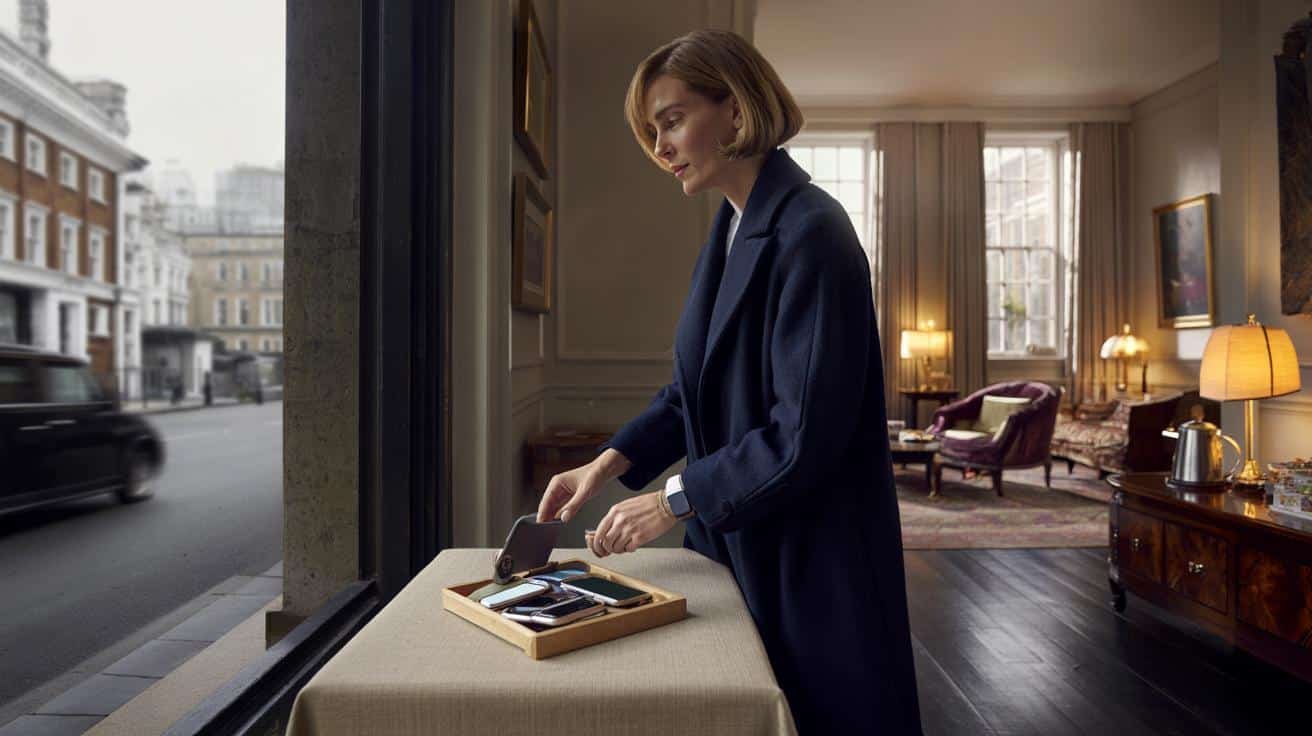
On a grey Tuesday in Marylebone, a woman in a navy cashmere coat steps into a townhouse and hands over her phone like it’s a weapon. No locker code, no charging station with numbers. Just a wooden tray on a linen-covered table, already sprinkled with iPhones and Apple Watches like fallen medals.
Inside, there are no screens. No soft blue glow leaking from anyone’s palm. Just the hiss of a kettle, the rustle of newspapers, a faint piano looped so quietly you have to lean in to hear it.
The woman looks around, disoriented at first, then oddly lighter. Her shoulders drop. You can almost see the notifications leave her body.
Welcome to London’s latest status symbol: the life you can’t post about.
When being unreachable became the new VIP
Walk down any upscale London street right now and you’ll notice something strange. Not the cars, not the clothes, not the inevitable tiny dogs. Watch the hands. The new flex in Kensington and Notting Hill isn’t the newest phone model. It’s people who don’t seem to be holding one at all.
They’re not distracted, not scanning for signal, not half-listening to you while checking Slack. They’re just… there. Fully present, fully boring-looking, and quietly broadcasting the loudest message of all: “My time is too valuable to be constantly reached.”
A private members’ club in Mayfair now offers “tech-free tiers” of membership, starting at £4,000 a year. Members must deposit their devices at reception and sign a pledge: no phones, no laptops, no smartwatches in the lounge or at the bar. The waiting list is three months.
One boutique hotel in Hampstead reports that its “digital detox suite” is booked out every weekend for the next six weeks. Guests pay extra for the privilege of a room with no TV, no Wi-Fi password, and curtains that take actual effort to pull shut. The minibar? Still there. The broadband? “Accidentally” disconnected.
On paper, it sounds ridiculous. Paying more to get less. Buying silence in a city where silence doesn’t come naturally. But in a world where every ping is a tiny demand, the ability to disappear is starting to look like the ultimate luxury good.
London’s old status symbols were visible: the handbag, the watch, the corner table. The new one is invisible. It’s the empty calendar block that stays empty. It’s the unanswered email that doesn’t spark guilt.
People with serious money don’t want the newest app. They want the right to say no to all of them.
The rituals of opting out (without moving to a cottage in Wales)
The people chasing this new luxury aren’t all fleeing to the countryside. Most of them are still here, crammed onto the Central line and queuing at Pret. They’re just quietly building pockets of tech-free space into their days like contraband.
One hedge fund partner in Belgravia has a rule: no phone between his front gate and his kitchen table. The device stays in the hallway drawer beside the spare keys and takeaway menus. Only after dinner does he check what the outside world has been screaming about. His kids call it “Dad’s time tunnel.” His PA calls it “mildly terrifying”.
A PR director I met in Shoreditch started something she calls “Analog Fridays”. Every Friday after 5 p.m., she switches to a £25 burner dumbphone, the kind you’d expect to see in a 2003 nightclub. Only close friends and family have the number.
She still goes out, still meets clients at Soho House, still takes the Tube. But there’s no email, no Instagram, no Slack icon glowering at her. She told me her first Analog Friday felt like standing under a hot shower after years of dry shampoo. Now her boss is trying it too.
There’s a logic to all this that goes beyond trend-chasing. When everyone and everything is “always on”, attention itself becomes scarce. Whoever can protect theirs, wins.
That’s why the most in-demand yoga classes in Chelsea are the ones that explicitly ban phones in the studio, not just on silent. It’s why restaurants in Mayfair are quietly testing “no-photo” sections, pitched as “privacy zones” for those who’d rather actually eat their food than stage it.
Plain truth: the richest people in the room aren’t trying to be more productive, they’re trying to feel less hunted.
How Londoners are drawing the line without sounding like jerks
There’s a quiet art to stepping back from tech in a city that runs on Slack threads and WhatsApp groups. The ones who pull it off don’t announce they’re “going off-grid” like a manifesto. They set small, slightly odd rules that other people can live with.
One lawyer in the City uses a handwritten “office hours” card taped to his home office door: 7–8.30 p.m., absolutely no calls. Friends know they won’t hear back until after that window. Clients don’t even realise there’s a line, they just sense he doesn’t respond at lightning speed at night. Expectations reset without a fight.
The biggest mistake people make when they try to reclaim their time is going all-out overnight. Twenty unread messages becomes 2,000 in days. Guilt builds, then the whole thing collapses and the phone wins again. We’ve all been there, that moment when the tiny red badge feels bigger than your whole life.
*Let’s be honest: nobody really does this every single day.* Even the most disciplined “digital minimalist” in Knightsbridge cracks and doom-scrolls Twitter at 1 a.m. some nights. The difference is, they treat the slip as a blip, not a personality flaw.
At a tiny tech-free café in Hackney, I asked the owner what people actually say when they hand over their phones at the door. She laughed and said most of them whisper, like they’re confessing something.
“People say, ‘Please don’t let me have this back unless it’s an emergency,’” she told me. “They’re half joking, half begging. I think they just want someone to give them permission to stop.”
- Start with one tech-free room – bedroom, kitchen, or bathroom. Treat it like a no-smoking zone for Wi-Fi.
- Create a visible “off” ritual – a tray by the door, a basket on the shelf, a drawer that physically shuts on your phone.
- Tell one person your rule
- Choose one recurring slot per week that’s non-negotiable: Sunday morning, Tuesday dinners, your commute home.
- Aim for “less frantic”, not “perfect monk mode”
When silence becomes the most expensive thing in the city
There’s something slightly absurd about the fact you can now pay hundreds of pounds for a “digital detox retreat” in the same city where libraries are still free. Yet the pull is real. People aren’t buying candles and breathwork. They’re buying distance from the feed.
London has always been a place where trends arrive dressed as necessity. Right now, the necessity is mental space. The old luxury was having everything: every app, every notification, every update. The new one is having the ability to walk away from it without your life collapsing.
This shift raises awkward questions. Who gets to be unavailable without losing their job? Who can skip a WhatsApp reply and not be called rude? Who can afford to turn their phone off on a Tuesday afternoon and just… walk by the river?
The next wave of status in the city might not be about who has the most. It might be about who has the courage to have just enough, then stop. And that’s a kind of wealth that doesn’t always show up in your bank account, but in the way your shoulders drop when you step into a room with no signal at all.
| Key point | Detail | Value for the reader |
|---|---|---|
| Tech-free time is a new status symbol | High earners in London pay for clubs, hotels and cafés that ban or limit devices | Helps you see your own attention as something worth protecting |
| Small rituals work better than radical detoxes | Analog Fridays, no-phone rooms, visible “off” trays | Offers realistic ways to reclaim focus without quitting your job |
| Boundaries change other people’s expectations | Clear rules around response times and availability | Makes it easier to say no without constant explanations or guilt |
FAQ:
- Is this tech-free trend only for the very rich?Not at all. The high-end clubs and retreats get the headlines, but the core idea – choosing when you’re reachable – is free. You can copy the same boundaries at home, on the bus, in the park.
- Won’t switching off hurt my career?It depends how you do it. Sudden disappearances scare people. Clear, consistent rules around response times usually earn respect, especially if your actual work stays solid.
- How long should a “digital detox” last to feel a difference?For many Londoners who’ve tried it, even two tech-free hours in the evening feels like taking off tight shoes. A full day once a week starts to change your baseline stress.
- What if my friends think I’m being dramatic?Blame the rule, not your personality. Say, “I’m trying this no-phone-after-9 thing, I’ll reply in the morning.” Most people secretly want the same permission.
- Do I have to give up social media completely?No. This trend isn’t about purity, it’s about control. Keeping Instagram, but only using it at set times, is far closer to how most “offline chic” Londoners actually live.
