
You May Also Like

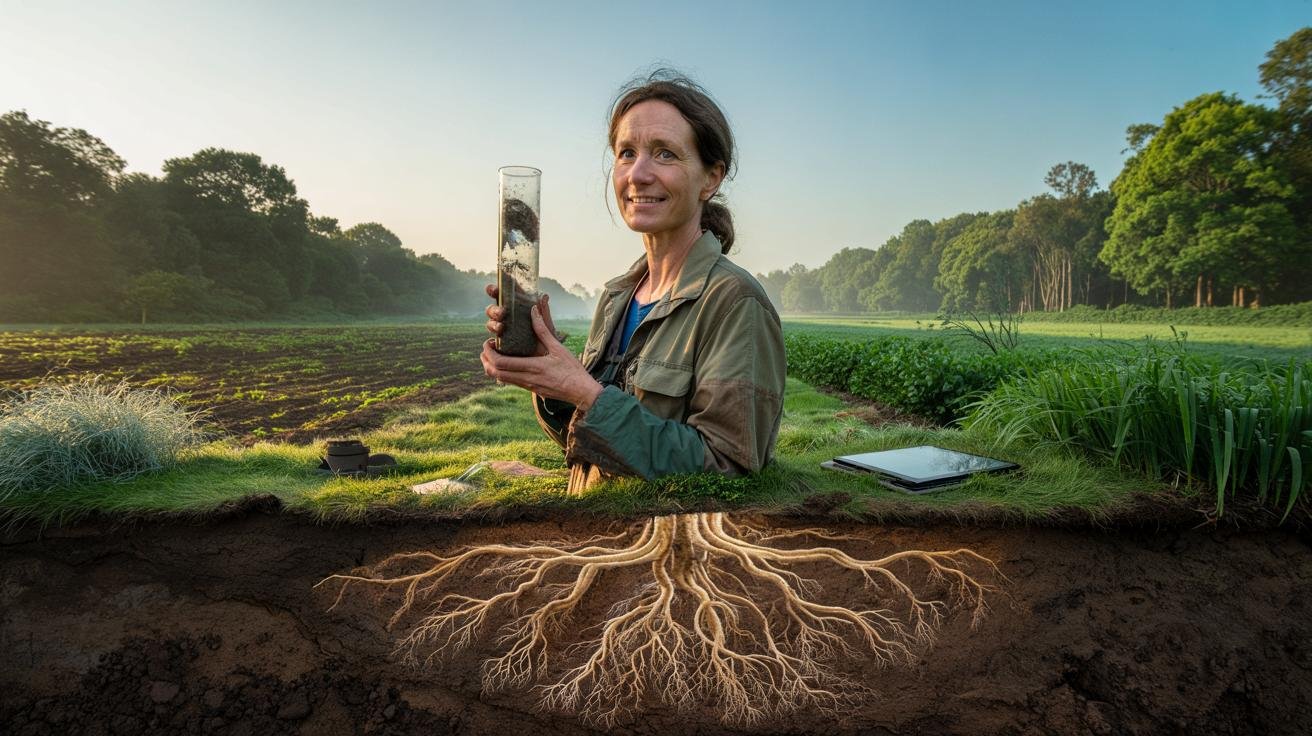
Far below the forests and fields we see every day, a hidden living network quietly shapes the fate of the climate.
Most conversations on global warming focus on smokestacks, cars and melting ice, yet a huge part of the story lies underground. The 2026 Tyler Prize for Environmental Achievement, often dubbed the “Nobel of the environment”, has just gone to a scientist who built her career on revealing that unseen half of the planet.
The Nobel of the environment goes underground
The Tyler Prize, created in 1973 and hosted by the University of Southern California, honours researchers who change how humanity understands and protects the planet. Past laureates include primatologist Jane Goodall and climate scientist Michael Mann, figures widely associated with conservation and climate action.
The 2026 laureate is American biologist Toby Kiers, a specialist in fungi and plant evolution. For nearly three decades, she has focused on a topic once considered niche: the partnerships between plants and fungi in the soil. Her work blends lab experiments, global field expeditions and new technology to reveal how these underground networks influence climate and biodiversity.
Kiers’ research shows that fungal networks are not just background biology; they are active players in regulating carbon on a planetary scale.
Alongside her scientific work, Kiers has also become a public advocate for what she calls “the invisible biodiversity beneath our feet”, arguing that any serious climate plan must take soils and fungi into account.
Fungal highways beneath our feet
Under forests, grasslands and farm fields, plant roots are wrapped in fine filaments of fungi. These are mycorrhizal fungi, forming partnerships with nearly 90% of land plants. The fungi trade nutrients and water for sugars produced by plants through photosynthesis.
These links do not stop at a single tree or crop. They often form vast networks, connecting different plants, even across species. Water, nitrogen, phosphorus and other compounds can move through these fungal “highways”.
Scientists sometimes call this vast underground mesh the “wood wide web”, a living infrastructure that quietly supports entire ecosystems.
By studying how resources move within these networks, Kiers and colleagues have shown that fungi do not distribute goods randomly. They behave more like market players, directing nutrients where they gain the best return in plant sugars. This work brought ideas from economics into ecology, reshaping how researchers think about cooperation in nature.
A hidden climate regulator
Beyond feeding plants, mycorrhizal fungi handle colossal amounts of carbon. Plants send part of the carbon they pull from the air into their roots, then into fungal partners. Recent estimates suggest these fungal networks lock away around 13 billion tonnes of carbon dioxide each year in soils across the planet.
Some of that carbon becomes part of stable soil structures that can persist for decades or centuries. Disturbing these networks through intensive ploughing, deforestation or soil degradation risks releasing stored carbon back into the atmosphere.
Kiers’ work has helped highlight this risk. By mapping fungal networks and quantifying how much carbon they move and store, her team provides data that land managers and policymakers can use when designing climate strategies.
From obscure niche to global policy conversations
For years, mycorrhizal fungi received far less attention than forests, oceans or ice sheets in climate debates. Kiers has worked to change that, co-founding initiatives to map fungal diversity globally and pushing for fungal conservation in international forums.
Her research projects often combine satellite data, soil sampling and genetic sequencing. This approach allows teams to build maps of underground fungal communities much as botanists map forests or coral reefs.
- In tropical forests, her group tracks how logging affects fungal diversity and carbon storage.
- In agricultural regions, they test farming practices that protect or restore fungal networks.
- In drylands, they study fungi that help plants survive drought, offering clues for climate adaptation.
By placing fungi on climate maps, Kiers argues they should also appear in climate budgets and land-use plans.
Why the Tyler Prize jury took notice
The Tyler Prize jury tends to reward research with both scientific depth and real-world impact. Kiers fits that profile. She has produced influential academic work on how cooperation evolves between species, while also feeding her findings into debates on agriculture, reforestation and biodiversity loss.
Her studies touch on questions that sit at the heart of climate policy: How much carbon can land systems store? What farming methods cut emissions without sacrificing yields? How do we protect biodiversity that people rarely see, yet depend on every day?
| Aspect of Kiers’ work | Climate relevance |
|---|---|
| Carbon flow through fungal networks | Refines estimates of land-based carbon sinks |
| Impact of farming on soil fungi | Guides low-emission, soil-friendly agriculture |
| Global mapping of mycorrhizal diversity | Identifies hotspots needing protection or restoration |
From lab to field: real-world impacts
Kiers’ work influences agriculture as much as conservation policy. Many modern farming systems, with heavy fertiliser use and deep tilling, disrupt fungal networks. That can leave crops more dependent on chemical inputs and reduce the soil’s capacity to hold carbon and water.
Her findings support a set of practices often grouped under “regenerative agriculture”. These include reduced tillage, more diverse crop rotations, cover crops and lower reliance on synthetic fertilisers. Such measures help fungal communities establish and maintain the exchanges that keep soils fertile.
Some farmers are now working with soil ecologists to monitor fungal health alongside yield. Trials show that fields with richer mycorrhizal networks can sometimes maintain production with less fertiliser, cutting costs and emissions at the same time.
Healthy fungal networks can act as a form of green infrastructure, supporting both climate goals and food security.
Risks if the underground alliance breaks
There is a growing concern that ignoring underground ecosystems could backfire on climate policy. Large-scale tree planting, for example, can fall short if new forests lack appropriate fungal partners or are planted on degraded soils where networks are broken.
Intensive land conversion can turn soils from carbon sinks into sources. When deep ploughing, drainage or repeated pesticide use strip out fungi and other soil life, organic matter breaks down faster and more carbon escapes into the atmosphere.
Kiers’ research helps quantify these tipping points. It suggests that protecting existing soil networks may be as valuable, in climate terms, as planting new trees or building renewable energy infrastructure.
Making sense of the science: key terms and scenarios
Several technical terms around this work now appear in policy documents and climate models. A few are worth unpacking:
- Mycorrhiza: A mutualistic association between a fungus and plant roots, where the fungus supplies nutrients and water, while the plant provides sugars.
- Soil carbon sink: The capacity of soil to store carbon for long periods, rather than releasing it as carbon dioxide.
- Regenerative agriculture: Farming practices aimed at rebuilding soil health, biodiversity and carbon storage while still producing food.
Climate modellers are starting to run scenarios that include changes in mycorrhizal networks. For instance, if 10–20% of current farmland adopted practices that enhance fungal communities, modelled outcomes show measurable additional carbon storage in soils over coming decades.
On the other hand, scenarios with expanding intensive agriculture and continued deforestation show shrinking fungal diversity and weakened carbon sinks. Those pathways make it harder to keep global warming below 1.5–2°C, even with rapid cuts in fossil fuel use.
What this means for everyday choices
While fungal ecology sounds remote from daily life, it intersects with food, forests and climate policies that affect everyone. Support for soil-friendly farming, pressure to reduce deforestation, and attention to how land is managed locally all influence underground ecosystems.
Kiers’ recognition with the Tyler Prize signals that debates on climate and biodiversity are broadening. The story is no longer just about emissions from power plants or cars, but also about the quiet, cellular negotiations happening between roots and fungi beneath our feet.
