
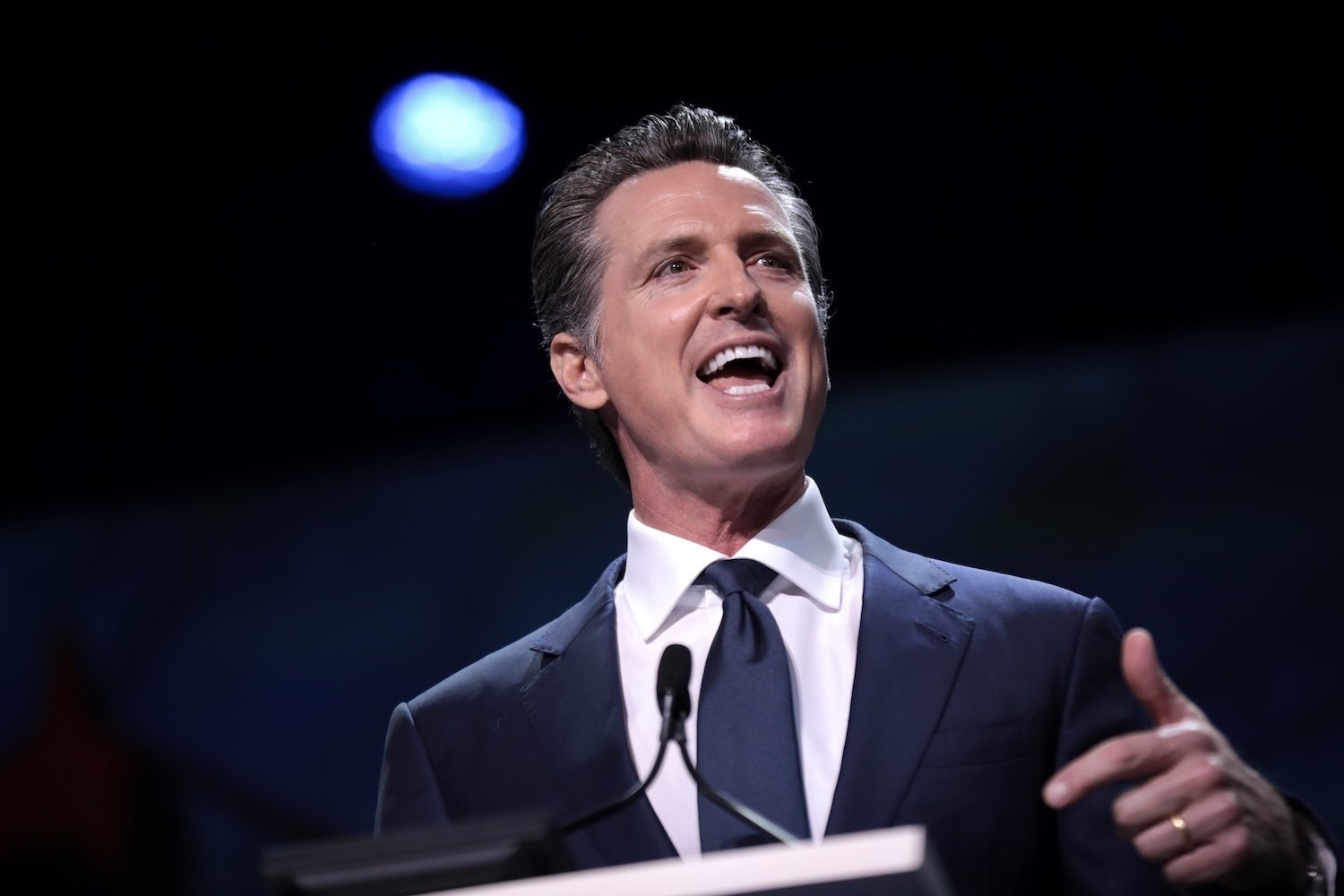


Gov. Gavin Newsom speaks to attendees at the 2019 California Democratic Party State Convention in San Francisco. As he prepares for a potential 2028 presidential run, homelessness remains a critical issue in California politics. “Our state investments have launched critical programs for local communities. Together, we’re breaking cycles of homelessness that took decades to create — and we’re doing it with urgency, compassion, and accountability,” Newsom said in his January 2026 announcement.
California Gov. Gavin Newsom announced that California has experienced a 9% decline in unsheltered homelessness, the largest drop in 15 years.
The figure is based on preliminary annual point-in-time statewide data from the U.S. Department of Housing and Urban Development (HUD), which measures unsheltered homelessness on a single night and has been criticized for undercounting specific populations.
Newsom’s announcement comes as he is increasingly viewed as a national political figure and a potential presidential contender, according to the Washington Post. With his second and final term as California governor set to end in 2027, Newsom has taken on a more prominent role in national politics, raising his profile ahead of the 2028 presidential election.
“In California, we’re proving there is a solution. The strategies we’ve put in place are working, and they’re turning this crisis around — but we’re not done. We won’t stop until everyone has a safe, stable place to call home,” Newsom said in his announcement.
After Newsom touted the preliminary data as evidence of progress, some local officials cautioned that statewide figures do not always reflect conditions in day-to-day life.
“At moments when new data is released, budgets are being debated, or major investments have been made, there’s a natural incentive to highlight indicators that suggest movement in the right direction,” said Greer Stone, the vice mayor of Palo Alto. “The state’s progress, or lack thereof, on the unhoused issue is an issue the governor knows will be a weak point for him in the election, so my guess is he is trying to highlight any progress on this issue, even if that progress has been slow and insufficient.”
Additionally, Stone noted that political timing often shapes how progress is communicated to the public, especially as elected leaders balance policy goals with public perceptions of them.
“Leaders operate in an environment where public confidence matters, and messaging often coincides with legislative cycles, budget negotiations, or broader political narratives,” Stone said.
But for many Californians, the debate extends beyond political timing to what they see in their own communities.
Anshul Desai has lived in San Francisco since 2017 and has seen noticeable shifts in homelessness levels over time.
“It was only since the pandemic that homelessness erupted and got pretty bad, but by the back half of 2023 and early 2024, it seemed like the streets were back to where they were pre-pandemic,” Desai said.

Some younger Californians say their view of Newsom extends beyond the homelessness crisis, shaped instead by his wider policy positions on key social issues.
Alina Robinson, a Carlmont High School student eligible to vote in the 2028 primary election, highlighted how these broader stances shape her view of the governor.
“I’m pretty pleased with the way he’s been dealing with things like clean energy policies and his support of LGBTQ+ rights,” Robinson said. “I think it’s really important to the people of California to make sure that we have a government that represents us, at least to some capacity.”
Still, for many, the real test of progress lies not in headlines or statistics but in what they experience in their own neighborhoods.
“Progress should be measured not just by counts, but by factors that impact people’s lives, such as whether people are staying housed, whether systems are working better, and whether communities are seeing sustained change,” Stone said.
