
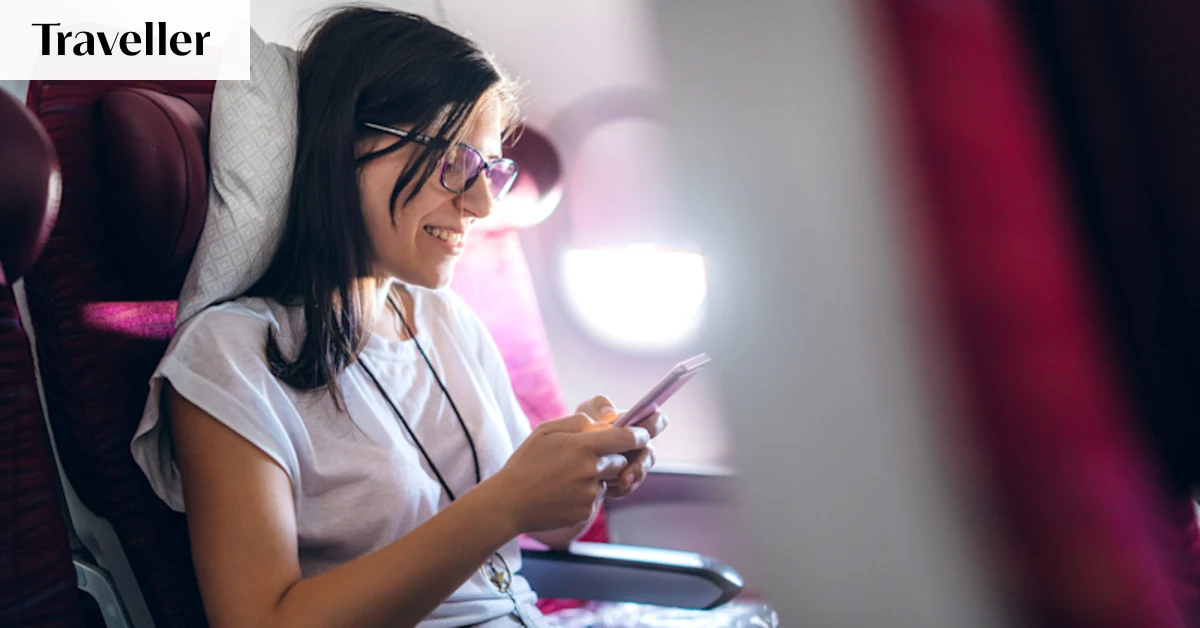
If an airline offers onboard Wi-Fi, you will know about it. You will know about it before you even book, given the way this message is usually trumpeted.
Onboard Wi-Fi! Free messaging! High-speed internet in the air!
This is the exciting future, where you’re never offline, you’re never unreachable, you’re always connected. This is a luxury, airlines tell you. The people in the expensive seats get access for free. Those in the cheaper seats can shell out a few more bucks for the privilege. But all will be connected.
And so you take to the skies and your phone buzzes with messages while you’re halfway through Mission Impossible II. You can respond to emails from your work colleagues from 40,000 feet above the Pacific Ocean. You can post photos of your inflight meal while you’re somewhere over Pakistan.
This is marketed as a luxury but is it, really? Because surely the idea of being disconnected from the world for 14 hours is far less frightening than always being connected. Never being allowed to disconnect.
Sign up for the Traveller newsletter
The latest travel news, tips and inspiration delivered to your inbox. Sign up now.
I listened, recently, to a presentation by Colin Nagy, an American journalist and brand strategist who was out in Australia talking about travel trends for Luxury Escapes.
Nagy is tapped into the ultra-luxury sector of travel, the world inhabited by Emirati billionaires and Russian oligarchs and non-disgraced royalty, and he says that, to those people, being constantly connected isn’t luxury any more. Quite the opposite.
“There’s a certain type of persona,” Nagy said, “for whom disconnection or not being reachable all the time is its own social signal. I think I’m starting to see this as a bit of a flex for people that are not at the beck and call of WhatsApp all the time.
“I was talking to an Emirati billionaire the other day and he said that luxury for [him] is to disappear for a very long lunch and not tell anyone [he] did, because, like, things will happen for [him] in the background. So it’s a bit of a quiet flex.”
Oh, great. So the billionaire set have wised up to the fact that being connected all the time actually sucks, while the rest of us are still taught to crave that ability to feel their phone ping with requests to join a Teams meeting at 40,000 feet.
You would have realised, even while reading a little higher up in this story, that all isn’t as it appears. Getting work emails while you’re above the Pacific? Checking your likes and comments in the middle of Mission Impossible?
This is not the stuff dreams are made of. It’s awful. And yet there’s an expectation, when people back home know of this constant connection, that you will always be there. You’re on a business trip? You should be on email. You’ve left your loved ones for a week? Answer some damned messages.
It wasn’t so long ago that going travelling just cut you off from everything. Never mind answering emails from seat 41D, there was no such thing as email.
If you wanted to get in touch with someone from back home you would either have to buy an international phone card and figure out the bizarre dialling system, or send a letter. Decide on a good post restante address, a place you’re likely to be in a month or so, and you might even be able to receive the reply.
Technology is a thing that creeps up on you, each increment touted as an advance, a way to make your life better. And in many respects, it does make your life better – when was the last time you cashed a traveller’s cheque? – so much so that you forget that a few of these advancements make life noticeably worse.
It’s no surprise to find that the uber-rich are treating tapping out of the world as the ultimate luxury. It’s because they can do it. Because they can get away with it. And who wants to be contactable 24 hours a day while they’re supposed to be on holiday?
The rest of us can dip our toes into this style of luxury. For a while now there have been tour companies and hotels offering “digital detox” experiences, taking you to places where you either can’t access Wi-Fi, or you’re told you’re not allowed to.
That seems like a good idea when you’re booking, but remember the scene in the most recent season of The White Lotus, where the well-off Ratliff family are asked to surrender their devices on arrival at their Thai hotel. The look of horror on their faces, as the reality of this situation dawns on them, is something we have probably all felt on a smaller scale. There’s an addiction to connection that is hard to break.
But that really is luxury. It’s also, as Colin Nagy says, a flex. It’s saying, I’m important enough that there is no one I serve, no one to whom I have to answer for the next day or week or month. I’m out.
A lot of us can’t do that. We’re not Emirati billionaires and we do have colleagues who need answers and we do have loved ones who can’t all just come on the trip with us. We require some sort of ongoing connection with the world.
Though, we could probably stand to spend 14 hours in the air with no Instagram.
 Ben Groundwater is a Sydney-based travel writer, columnist, broadcaster, author and occasional tour guide with more than 25 years’ experience in media, and a lifetime of experience traversing the globe. He specialises in food and wine – writing about it, as well as consuming it – and at any given moment in time Ben is probably thinking about either ramen in Tokyo, pintxos in San Sebastian, or carbonara in Rome. Follow him on Instagram @bengroundwaterConnect via email.
From our partners