We want our stories to be shared as widely as possible — for free.
Please view The 74’s republishing terms.
A look back at the history of PBS and PBS Kids, and a glimpse into efforts to protect the organization, which has served generations of learners.

This story first appeared at The 74, a nonprofit news site covering education. Sign up for free newsletters from The 74 to get more like this in your inbox.
For more than 50 years, PBS has been a trusted, educational source for millions of Americans — especially children.
Formed in 1969 by the Corporation for Public Broadcasting (CPB), a nonprofit authorized by Congress in the Public Broadcasting Act of 1967, PBS has been a staple for American families for decades.
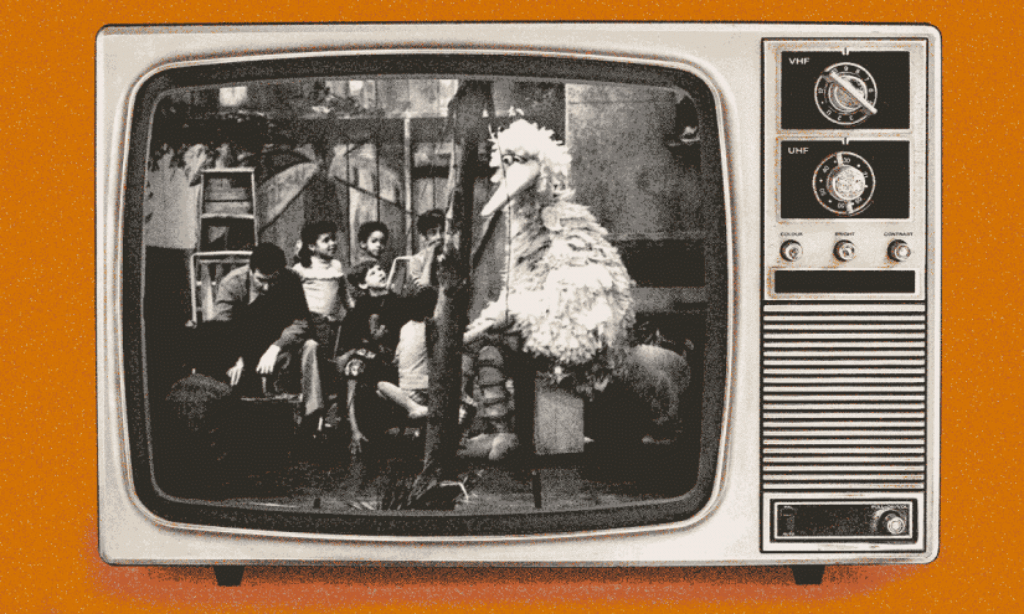
From its earliest days airing Mister Rogers’ Neighborhood and Sesame Street to iconic shows from the 70s, 80s and 90s like Electric Company, Reading Rainbow and Bill Nye the Science Guy, PBS programming has taught children to understand and express their emotions, and helped them build foundational literacy, math and science skills. And since 1999, PBS Kids has brought beloved characters like Daniel Tiger and Arthur into American homes and classrooms through shows and digital games.
Today, PBS, along with NPR and 1,500 other local public radio and television stations funded by CPB faces an uncertain future after Trump signed a bill cutting significant federal funds earmarked for the Corporation.
This isn’t the first time public broadcasting has been under threat. In the 1990s, former Speaker of the House of Representatives, Newt Gingrich, led efforts to defund public broadcasting. In 1969, Fred Rogers testified before Congress to protect $20 million in federal funding for the newly formed Corporation for Public Broadcasting, which the Nixon administration proposed cutting in half.
“I’m constantly concerned about what our children are seeing, and for 15 years I have tried, in this country and Canada, to present what I feel is a meaningful expression of care,” Rogers told then-Senator John O. Pastore. Rogers contrasted his approach with the animated “bombardment” and gun violence he saw on other networks.
“… If we in public television can only make it clear that feelings are mentionable and manageable, we will have done a great service for mental health.”
Fred Rogers, testifying before congress in 1969
Underscoring the importance of programs appealing to social emotional learning and mental health, Rogers won Pastore over. “Looks like you just earned the $20 million dollars,” Pastore concluded.
Over the years, PBS has remained a trusted media source among Americans, especially for its children’s programming. As of 2024, more than 130 million people watch PBS via traditional television; nearly 60% of all U.S. television households watch PBS over the course of a year; and PBS Kids reaches 15.5 million monthly users and 345 million monthly streams across PBS KIDS’ digital platforms.
Here’s a visual history of the milestones and iconic moments from the organization that has served generations of learners — as well as a glimpse into efforts to protect it over the years:
1969
Fred Rogers testified before the U.S. Senate Subcommittee on Communications to oppose proposed cuts to federal funding for public broadcasting.
Sesame Street airs its first episode in November 1969.
1970
The photos below capture behind-the-scenes moments from the first season of Sesame Street.


1971

1973

1986

90s and Early 2000s


2005


2008


2009
Sesame Street turns 40.

2011

2012

2013

2017


2025
The fight to fund continues.


!function(f,b,e,v,n,t,s){if(f.fbq)return;n=f.fbq=function(){n.callMethod?
n.callMethod.apply(n,arguments):n.queue.push(arguments)};if(!f._fbq)f._fbq=n;
n.push=n;n.loaded=!0;n.version=’2.0′;n.queue=[];t=b.createElement(e);t.async=!0;
t.src=v;s=b.getElementsByTagName(e)[0];s.parentNode.insertBefore(t,s)}(window,
document,’script’,’https://connect.facebook.net/en_US/fbevents.js’);
fbq(‘init’, ‘626037510879173’); // 626037510879173
fbq(‘track’, ‘PageView’);