
“How do you protect your community?”
By Katherine Nettles
In the time since it was formed in 2023, the Gunnison Valley’s Karuna Project has taken dozens of people, Crested Butte residents included, to far flung places around the world seeking more than just high-altitude adventure or flashy athletic accomplishments; they focus on philanthropic work to connect with other cultures and offer mutual benefit to one another.
Karuna’s founders, Nicole Blaser and Seth Quigg have made lives and careers out of outdoor leadership education. They combined forces to form the Karuna Project in 2023 aiming to bring people together all over the world, guide them through new and thrilling experiences and participate in community development that builds character and respect for other cultures.
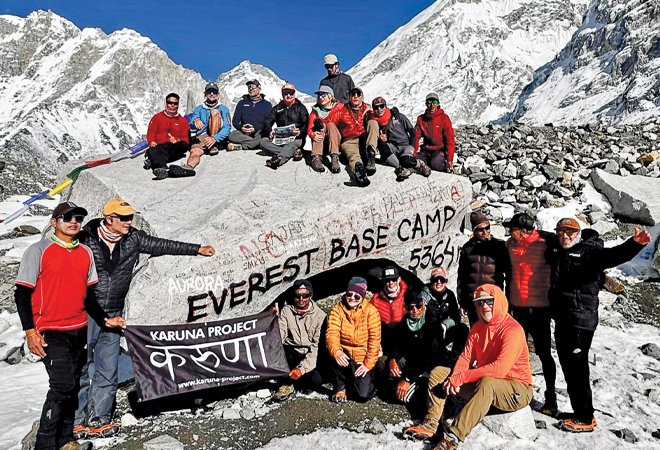
Karuna means ‘compassion’ in Sanskrit, explains Quigg, who in October led a group with the Karuna Project to the famed Three Pass Loop in the Khumba (Everest) region of Nepal and worked on sustainable tourism initiatives in what is becoming a sister city there, the village of Kakani north of Kathmandu.
Blaser and Quigg have learned a great deal about clients and logistics over the past 20 years, and decided to break the mold of traditional, more consumptive approaches to form more authentic connections with the places they now visit.
Quigg guided people on river expeditions, mountain expeditions, worked with NOLS, an international expeditions company out of Australia and even started his own commercial rafting company in the Grand Canyon which expanded to include Chile, Vietnam, New Zealand, Norway and other places. “But it was very much mass tourism: clients in, clients out. My personal ethos is that if I’m taking people out of the U.S. to do something I want to provide a cultural immersion experience because there’s so much magic and learning that can happen when you bring two different cultures together.”
Quigg started working that thread into his trips, installing solar energy, building schools and a medical clinic in Nepal. “We’ve done a lot of work through tourism,” he says.
Similarly, in Tanzania Quigg’s previous company partnered with a supermodel from the east African country Eretria to raise $20,000 and provide solar lights to a community—and then took the group to climb Mt. Kilimanjaro. “It’s an adventure tourism that brings people together. That’s where the magic lies for me, the human interaction and the connection.”
Quigg ended up fortuitously selling his shares of the previous guiding company about two weeks before COVID struck, and began working with major international humanitarian organizations to provide people access to clean energy.
“So that got me asking, how are humans showing up for each other on the planet? And I met some incredible mentors but at the same time I had a long list of past guests from the last 20 years. Some were asking about going back to the Himalaya.”
A long-time wilderness guide herself with extensive experience instructing, climbing, practicing snow science and wilderness medicine, Blaser had been Quigg’s supervisor during his time with NOLS in 2007, and they had stayed in touch through the years and their own adventures. They reunited in Crested Butte and did the Grand Traverse together, and Blaser was completing a law degree in environmental law and policy.
The pair sat down and asked themselves what was most important about the trips they had guided, all over the world. “We landed on connection: to yourself, to each other, to the community you visit,” says Quigg. They began brainstorming ideas, and the Karuna Project was born.
“I have a similar background to Seth doing outdoor education and leadership, and my skillset really lends itself more to structure. So, I handle finances, accounting, I try to think through the client needs, logistics, paperwork, itineraries, packing, etc.,” says Blaser. “Seth’s personality is well suited for networking and getting people amped. It was kind of a perfect fit.”
Karuna’s first trip was to Nepal in 2023.
“We talked about how to drive social change. A lot of people go on these international trips and then that’s it—they go home, and what’s the point, right? I think people want to broaden their experiences as humans. And think it’s our responsibility to do something with the people and places we visit, to show them that their culture is valid. A lot of people in Nepal feel they are failed attempts at being Western. We emphasize the positives for different cultures around the planet.”
They ran a second trip to Nepal in 2024 and then this year they completed an expedition on the Zanskar River in India.
Nine locals from the Gunnison Valley joined the latest trip to Kakani, with a range of travel experience among them. “We talk about sustainable tourism development with the people who live there,” says Quigg. “We talk about what it means to be alive, and these people [in Kakani] are living as they have for 1,000 years. They are farmers, there is a little bit of development. But they want tourism. This time we brought 15 recycle bins to place around the village. A local woman pays people to collect the plastic bags they use and make them into toiletry bags and laptop cases,” he says.
Karuna Project purchases these items and sells them in the Gunnison Valley, creating a circular economy that connects Nepalese artisans with Colorado consumers.
“We want to make sure it’s a symbiotic relationship because in a lot of historical relationships it’s all one sided, asking only ‘how are our guests going to benefit?’ We are trying to empower the locals, to say hey, your culture is just as valid as ours. Maybe more,” says Quigg.
Local connections
“In our culture, a lot of people have the newest skis or bikes, etc.,” says Quigg. “Yet a lot of them might be suffering from anxiety, loneliness, being sucked into this technology surrounding us. Our culture is very individualistic. We see that here in Crested Butte, where one person moves here alone to make their own way without family, and create their own life.
“And they have none of those things [in Kakani] but they have spiritual aspects, community, social connection, simplicity,” continues Quigg. “It’s almost new world versus old world. What can we learn from the old world that can support us moving forward? How do we create a positive exchange?”
Quigg and Blaser are looking to partner Karuna Project with local nonprofits to run donor or fundraising trips, inspired by attendees on their last trip raising funds for local nonprofits such as Living Journeys.
They are also interested in evolving into a 501(c)(3) with different branches for an import/export business with profit shares going back to the village, and one for mutual service expeditions.
“We believe the future world benefits when communities like ours in the Gunnison Valley connects across borders in a spirit of reciprocity,” said Blaser.
Quigg describes parallels in protecting a place’s identity as tourism brings the rest of the world in. “How do you protect your community? How do you not get bought out?”
He says they are considering a visitor center/museum that gives guests insight about how to assimilate into a culture without bringing their outside influences, desires and expectations into it.
Quigg says he worries that things change unsustainably otherwise.
“That’s how the world is becoming more globalized. Then you add tech and what we’re looking at is the loss of culture throughout the world. It could all be one phone culture. And this is a great parallel for our valley—how do we protect it without things having to change drastically?”
Blaser also works full-time for another outdoor education company called Positive Adventures, taking inner city kids from places like LA to Yosemite and Joshua Tree.
“It’s pretty cool because a lot of these kids have never camped, or experienced nature this way before,” she says.
Blaser says her focus on youth and the future also offers overlap with Karuna.
“I just learn a lot about what’s new and upcoming in the world with our industry. We cover interesting things, even like what it’s like to work with a younger generation. They work and think differently than we did.”
Blaser says she gets insight into how relevant Karuna is for the world, as some demographics now look for a softer outdoor or travel experience without the inherent challenges or discomfort. “The world is changing so much. It’s helpful to understand what many, many companies out there are encountering and what we know is good for the population, easing people into the idea of leaving their comfort zone and how powerful that experience can be,” she says. “We live in such a time when we as human beings need to be building bridges with each other in spite of the many differences there are, whether through travel or education. Step out of your comfort zone, meet new people and connect through differences.”
In 2026, Karuna has three trips planned: a trip to Tanzania is scheduled for July, a Nepal trip is scheduled for October/November and one in Northeastern India will take place in December to coincide with a tribal Hornbill Festival.
More information about Karuna Project and upcoming adventures for a cause can be found at www.karuna-project.com.