
In Antarctica, one of our planet’s last great wildernesses, a remarkable comeback is taking place.
In the very same waters of the Southern Ocean where whalers slaughtered more than 2 million whales during the 20th century, pushing a number of species to the brink of extinction, populations are recovering. Humpback whales have been the fastest to bounce back since commercial whaling was banned in 1986, and populations are nearly at pre-whaling levels. Blue whales, the world’s largest animal, have been slower.
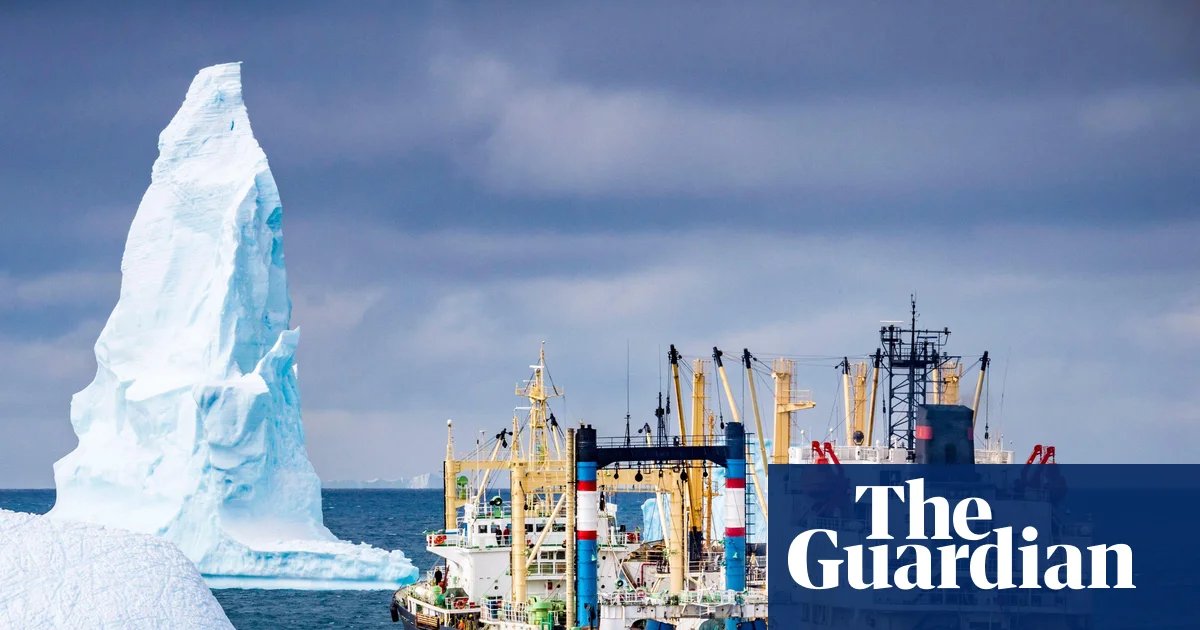
Last week, I spoke to two independent researchers undertaking a scientific survey near the South Orkney islands. They recorded seeing multiple groups of more than 100 whales, in “remarkable and breathtaking scenes” reminiscent of those described by the first polar explorers. But in the very midst of this comeback a new threat has emerged that is once more pitting whales against humans: industrial trawlers fishing alongside whales for Antarctic krill – the foundation of the Antarctic ecosystem and the main food source for most large Antarctic species.
More on Antarctic whale recovery and the growing krill fishery, after this week’s headlines.
Essential reads
In focus
In February, Sea Shepherd, a nonprofit conservation organisation once known for its aggressive direct-action tactics against whaling, was once more sailing the Southern Ocean. Swapping direct action for a quest for data, it hosted scientists aboard its 55-metre (180-ft) vessel, the Allankay. Using line-transect surveys, along with drone-based and acoustic measurements, the scientists recorded whales as well as the presence of krill trawlers, a growing Antarctic fishing industry that conservationists fear could threaten whale recovery.
Speaking to me from the Allankay during a blizzard, Dr Matt Savoca, of Stanford University’s Hopkins Marine Station, says the waters around the South Orkney islands “might have the highest density of whales anywhere on the planet”. His goal, he says, was twofold. First, to test that theory, and second, to answer a simple question: is Antarctic krill fishing sustainable?
“We have got these whales feeding and the krill industry extracting krill and the question is: is this sustainable or is it having an effect on the recovering whale population?” he asks.
A similar question was posed by David Attenborough in his film Ocean last year, over images of krill trawlers fishing close to feeding whales. It was also, to an extent, explored in my piece this month about a row over a “blue tick” sustainability label potentially being awarded to the world’s largest krill harvester. We have also written about the crustacean’s importance to the Antarctic ecosystem.
Concern over krill fishing has been growing since the Commission for the Conservation of Antarctic Marine Living Resources (CCAMLR), a body set up to protect the Antarctic region from overexploitation, hit a diplomatic stalemate. In 2024, China and Russia, two nations in the CCAMLR, blocked the renewal of a key international conservation agreement that restricts krill fishing in ecologically sensitive areas of the Southern Ocean. In 2025, the commission once again failed to reach consensus on conservation measures. This raised concerns over the depletion of the local krill population, the main food source for whales, penguins and seals, in key feeding grounds. The political deadlock also comes amid some scientists’ increasing fears that accelerating climate changes in the region are placing krill populations under threat.
The good news, according to Savoca, in terms of whale recovery in Antarctica, is the sheer number of sightings of so-called super aggregations of 100-plus feeding whales in the water, with two such sightings sometimes reported in the same day.
“It is incredible that every day at the South Orkneys with decent weather (far from a given), we could more or less guarantee seeing a group of 100-plus whales” says Savoca. “The fact that groups this size are common here is what’s most remarkable. It’s breathtaking to see blows stretch from horizon to horizon, just as the first explorers to the region described over a century ago”.
These numbers, says fellow researcher Ted Cheeseman, who co-founded and directs Happy Whale, an NGO led by citizen science, are “really exciting”. Nothing similar, he says, has been seen in the area since extraordinary footage of 1,000 whales was captured by the Scottish scientist Conor Ryan in 2022 – believed to be the largest aggregation of whales ever recorded.
Cheeseman and Savoca have, however, witnessed first-hand how close the krill trawlers, which can have weigh up to 3,000 metric tonnes, get to feeding whales, putting them in direct competition.
“Penguins and whales and quite a population of seals are eating this krill,” says Cheeseman. “Whales were always the largest predator here,” he says, “but now they have a predator, the krill trawlers, which are up to 100 times the size of a humpback. And these larger predators are taking the nutrients out of the system.”
Whales, he says, do not just eat krill, they also recycle the nutrients that krill provide back into the Antarctic’s fragile ecosystem. The industrial krill trawlers, which grind up the krill for use in dietary and pet supplements, and feed for fish farms, remove the nutrients from the ocean altogether, he says.
“When a whale eats krill, it poops out krill,” says Cheeseman. “There’s a nutrient recycling happening. If you take out more predators, you would imagine you get more prey. But when you take out whales, the krill reduces.”
Cheeseman and Savoca propose that, in the absence of a diplomatic agreement through CCAMLR to protect krill, there should be a 30km (19-mile) “buffer zone” where krill fishing is banned around the South Orkney island where the whales feed. “Krill fishers have, to their credit, agreed voluntary buffers of 30km around penguin colonies,” says Cheeseman. Savoca adds: “There is an incredible opportunity for conservation through collaboration. The NGOs, scientists, and the fishing industry can come together and succeed where CCAMLR has failed.”
Read more: