
California AG dishes on Trump’s climate war
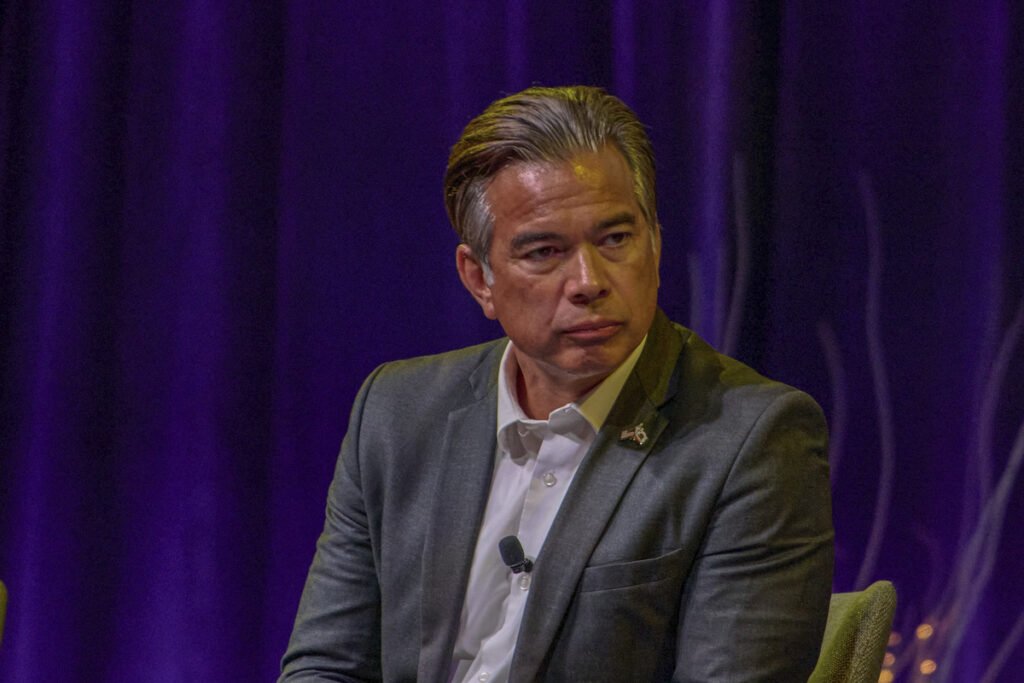
Rob Bonta isn’t backing down. The California attorney general is co-leading a coalition of blue states suing the Trump administration for rolling back the linchpin of U.S. climate regulation.
But while some environmentalists argue the repeal of the EPA endangerment finding could inadvertently give states more latitude to curb greenhouse gases, Bonta isn’t buying it.
“We’re really focused on just striking down the repeal of the endangerment finding,” the California Democrat said in a recent interview. “It is very important that the federal government play a role, as required by the Clean Air Act, and that they not retreat from their role or abdicate their role.”
The endangerment finding concluded that carbon dioxide pollution endangers human health and welfare, providing the scientific basis for EPA to regulate six greenhouse gases. The finding was issued in the wake of a 2007 Supreme Court case, Massachusetts vs EPA, which directed the federal government to regulate climate pollution.
EPA repealed the finding in February at the direction of President Donald Trump, who has waged a broader assault on U.S. climate policy and states’ efforts to address global warming.
Even as they oppose repeal, some environmentalists suggest revocation could weaken industry’s argument that federal law bars lawsuits filed against oil and gas companies by cities and states — including California — that seek compensation for climate change. A recent law journal article written by Ann Carlson, a prominent California environmental attorney and former Biden administration official, argues the endangerment finding’s repeal carries a “potential silver lining” because it opens the door for states to regulate greenhouse gases independent of EPA.
But Bonta says, “There’s a lot at stake here, including for California. Even if state and local jurisdictions can act, many, many won’t.”
Bonta has been one of the leading players in Democratic-led efforts to hit back at Trump, taking the administration to court over efforts to block electric vehicle charging stations and scrap environmetal and climate justice grants.
He’s sued the Trump administration more than 60 times since Trump returned to office and says he’s won 80 percent of the cases. He spoke with POLITICO’s E&E News recently about the endangerment finding lawsuit that he and 23 other attorneys general, along with several major cities and counties filed last month against the administration.
What do you think of the argument in some quarters that repealing the endangerment finding and leaving EPA out of the picture, when it comes to regulating emissions, would give an opening to states like California?
California still has some of the most aggressive climate action statutes and requirements in the nation and the world, but we share one environment. Climate change harms to our environment. They do not know state boundaries or national boundaries, and the federal government not doing more means that California will suffer more.
Even though we’re doing a lot as a state, the federal government not doing its part hurts California. It means more greenhouse gas emissions. It means more carbon pollution, more smog, more toxic chemicals in the air. It means more floods, heat waves and wildfires and increased costs for Californians in the form of utility bills, insurance premiums and health care costs. So we’re really focused on what’s right in front of us, which is making sure that the federal government follows its requirements under the Clean Air Act.
The lawsuit challenging the repeal of the endangerment finding includes a number of parties beyond the usual states that have been involved in litigation against the administration, including places like the Virgin Islands and various cities. What was the thinking behind that?
The large coalition shows the universal, global and national impact of this decision and also the belief that it is untethered from the facts and that is blatantly unlawful in violation of Massachusetts v. EPA and the Clean Air Act, as well as the Administrative Procedures Act.
It shows how broad the harm is that can be visited by this unlawful action, should it take effect, and also the belief in the merits of the case. We have Harris County, Texas, we have the Virgin Islands, we have local jurisdictions as well. It’s a really important group of folks who banded together to speak out against this unlawful action that can really harm the people in our jurisdictions and frankly, across the country and across the world.
The coalition’s initial petition in the U.S. Court of Appeals for the District of Columbia Circuit — the primary venue for national Clean Air Act lawsuits — was pretty limited, can you share some more details about the arguments you will be bringing to court?
We [will] basically say that the EPA decision is not in compliance with the Clean Air Act and with Massachusetts v. EPA.
We argue that they misinterpret the major questions doctrine. They have a futility argument that we believe is wrong on the science and the law. (EPA has argued “the futility” of regulating greenhouse gas emissions given the global nature of the phenomenon would support repeal “even if there were an adequate legal basis to retain the endangerment finding.”)
We’re going to be broadly arguing that this rescission of the endangerment finding violates the Administrative Procedures Act and the Clean Air Act and that the rationale behind it does not survive scrutiny.
Will the lawsuit raise the Climate Working Group — a group of climate contrarians handpicked by Energy Secretary Chris Wright to help with the repeal? The group’s findings were not cited in EPA’s final rule, amid criticism of its work.
The Climate Working Group is part of the story. So I do expect them to be part of the argument. It shows the willingness of the administration to band together this group of climate deniers, to try to create the perception of some actual, real science being done. And they were so widely disparaged and criticized by different organizations, including environmental groups and scientific groups and the press, that they didn’t rely on them in the end.
Where that left [EPA] at the end is they weren’t relying on any science or facts. So either they only have junk science from the Climate Working Group, or they have no science to rely on. You’re supposed to make decisions under the Administrative Procedures Act that are reasonable and supported by facts. I think the Climate Working Group and the lack of scientific evidence makes their position very clearly arbitrary and capricious.
Is there a risk that the case could end up at the Supreme Court and the conservative majority on the court could use it to repeal Massachusetts v. EPA?
I think the federal administration, not just in the rescission of the endangerment finding case, thinks the U.S. Supreme Court is a good forum for them. They have had some success in what we call the emergency docket, or the shadow docket, but even there, they’ve lost really important cases like the National Guard case, the tariffs case. I think they’ll lose birthright citizenship.
I’m sure the federal government wants to get in front of the U.S. Supreme Court. They think that the court now has some different justices than it did back in 2007 when Massachusetts v. EPA was decided. But the U.S. Supreme Court is an institution, its precedent carries forward throughout the life of the institution, not based on who are the justices that are currently constituting that court.
Massachusetts v. EPA is less than 20 years old. I realize that this U.S. Supreme Court is capable of overruling past precedent of the court, but they really should just be affirming recent precedent.
This interview has been edited for length and clarity.