Fab 5 Freddy discusses his ‘Fly’ new memoir
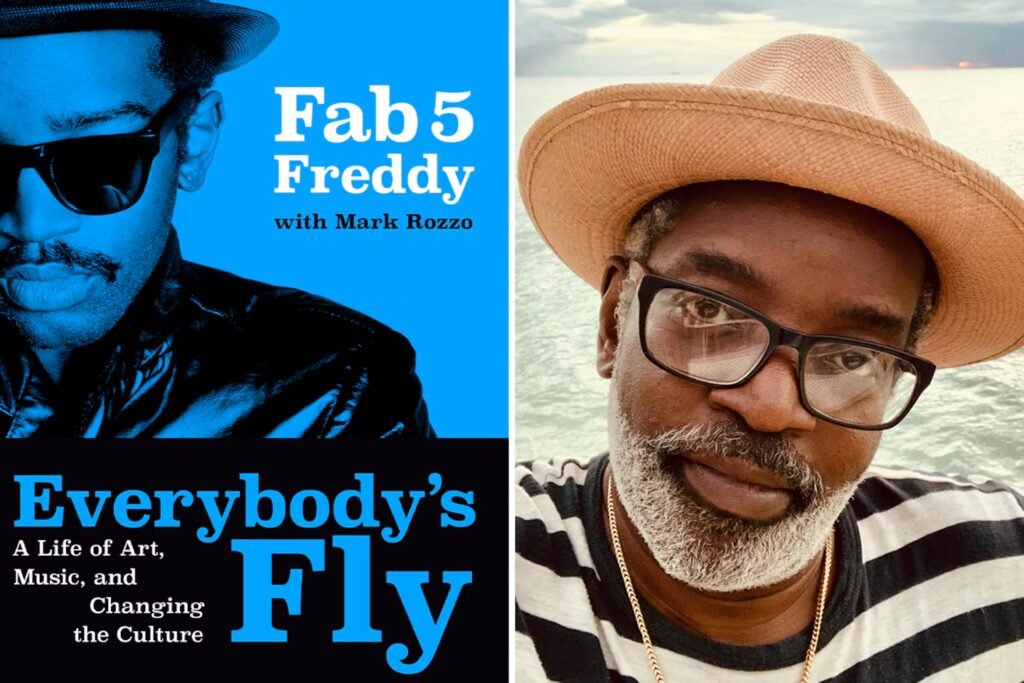
Freddy helped bring these seemingly disparate characters and scenes together. “I’m the king of synthesis,” he told Susan Orlean when she profiled him for a New Yorker story in 1991, in which Orlean called him “the coolest person in New York at the moment.”
Now 66, Freddy still looks fly in a zip-up blue sweater and close-cropped white beard. Sitting before a wall full of vintage jazz photographs in a recent video interview, he explained what makes him most proud.
“I found a way to do things that were not the traditional way, and that’s really a part of hip-hop culture,” he said. “My approach was, ‘Let’s figure out a way to make this happen and a way to get in,’ if you will. That’s the way I thought as a person with no art school training and no connection to a lot of these things, and that’s hopefully a blueprint and inspiration to other people that don’t come from traditional backgrounds.”
Reading “Everybody’s Fly,” which takes its name from that hit Blondie record (Freddy remains good friends with band leaders Debbie Harry and Chris Stein), you’re struck by the author’s remarkable instinct for connecting the cultural dots of the late 20th century. The book also asks you to reflect on what it was like to get in on the ground floor of hip-hop, decades before it became a global commercial force.
Freddy grew up in Brooklyn in the ‘60s and ‘70s, raised by parents who appreciated the Black Power movement. His father was good friends with the legendary jazz drummer and activist Max Roach, who could often be found hanging around the Brathwaite home. His folks also encouraged Freddy’s passion for the arts; he often carried home armloads of art books from the New York Public Library. (He even returned some of them.) He knew who Andy Warhol was long before they met, and knew about movements in modern art as he ran the streets with Krylon spray paint cans, tagging walls and subway cars with his friend and fellow graffiti artist, Lee Quiñones.
In the ‘70s, Freddy was a regular at the mobile parties in New York that gave rise to DJ legends like Grandmaster Flash (who’s also shouted out on “Rapture”: “Flash is fast, Flash is cool”). By the time hip-hop bubbled up into mass awareness, Freddy had already been immersed in the culture for years.
“I couldn’t have foreseen that it would get this big,” Freddy said. “People were poor at another level, buildings bombed out in the Bronx . . . People were breakdancing in the rubble and rapping about, ‘Hey, man, I’m here.’ It’s amazing. They’re not trying to go platinum or do all these gratuitous things. Writing the book took me right back to where the thing really began.”
It was a heady time. In 1979, Freddy and Quiñones showed their work at Galleria La Medusa in Rome, bringing American graffiti to the European art world. In 1982, they starred in the film “Wild Style,” the story of a graffiti artist (Quiñones) commissioned to paint a backdrop for a big hip-hop concert. (As Freddy writes, the movie didn’t just increase awareness of hip-hop culture, it also paid concrete personal dividends: “With the extra 300 bucks a week — that was the deciding factor for me — I could finally afford my own apartment”).
By the time MTV came calling in 1987, looking to jump on the hip-hop train and belatedly respond to the (accurate) criticism that their programming skewed extremely white, Freddy was a hip-hop mover and shaker. As the first host of “Yo! MTV Raps,” he took pride in visiting featured artists on their home turfs. He traveled to Houston to hang with Geto Boys, and Los Angeles to spend time with N.W.A. (Travel plans didn’t always work out: When Freddy interviewed Roxbury’s Ed O.G., they filmed in New York).
Freddy has stayed active in movies, including everything from 1991’s “New Jack City” (on which he was also a producer) and one of the most memorable scenes in “Rachel Getting Married.” He also directs: His 2019 documentary “Grass is Greener” provided a platform to explore one of his favorite causes, cannabis advocacy.
In the book, Freddy describes hanging out with Blondie’s members and laying down some basics of the hip-hop scene for them: “There are fly guys and fly girls. This cat Flash is the fastest DJ, and that really means something.”
Flash is fast. And Freddy’s still fly.
EVERYBODY’S FLY: A Life of Art, Music, and Changing the Culture
By Fab 5 Freddy (with Mark Rozzo)
Viking, 336 pages, $32
Chris Vognar can be reached at chris.vognar@globe.com. Follow him on Instagram at @chrisvognar and on Bluesky at chrisvognar.bsky.social.