
Fate of private Japanese moon lander unclear after ispace landing attempt

The second moon-landing try may not have been the charm for ispace.
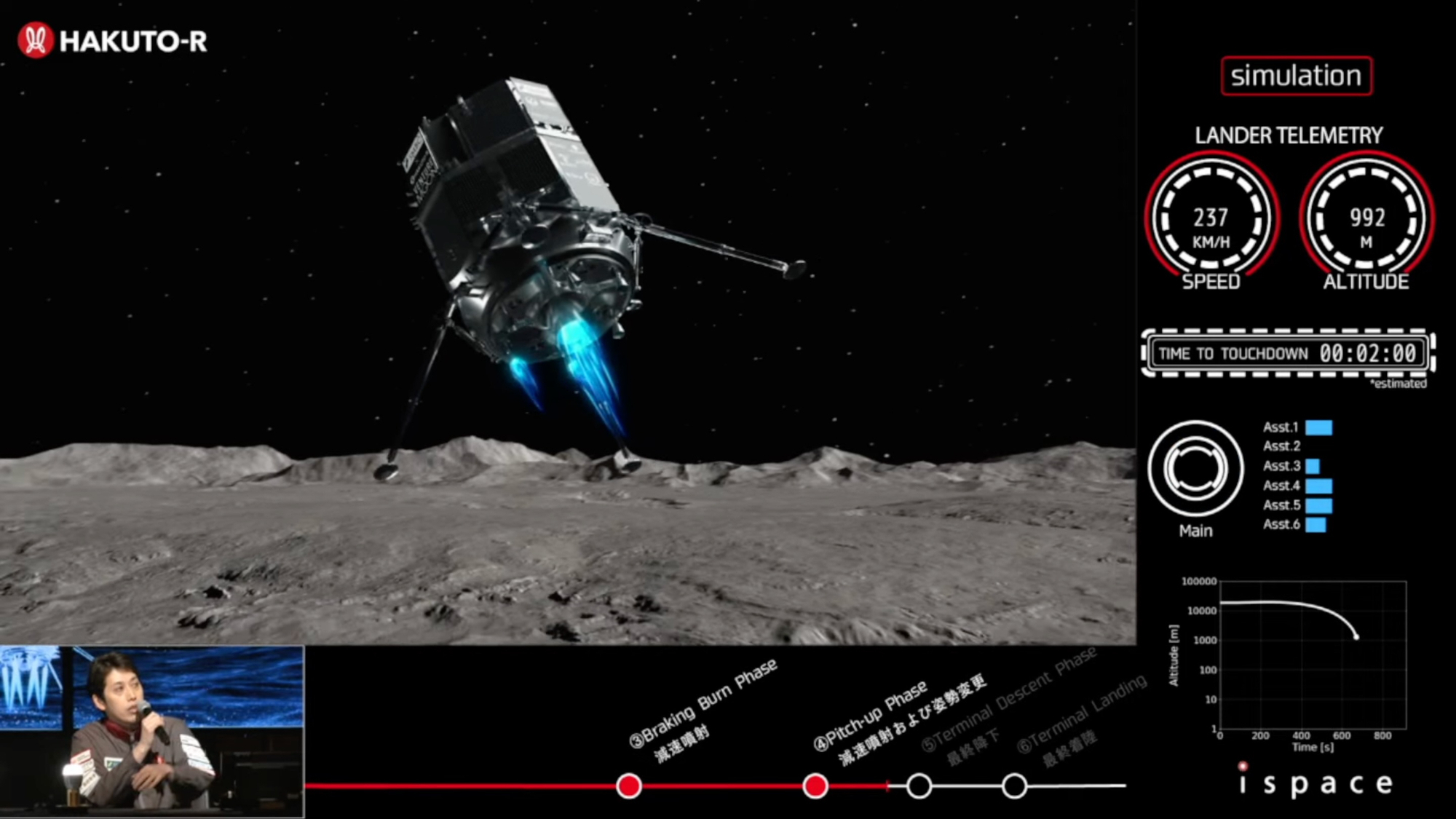
The Japanese company’s Resilience spacecraft aimed to make a soft touchdown in the Mare Frigoris (“Sea of Cold”) region of the moon‘s near side today (June 5) at 3:17 p.m. EDT (1917 GMT; 4:17 a.m. on June 6 Japan Standard Time).
But telemetry from the lander stopped coming in about one minute and 45 seconds before the scheduled touchdown, raising doubts about Resilience’s fate.
It was reminiscent of ispace’s first lunar landing attempt, in April 2023. The spacecraft also went dark during that try, which was eventually declared a failure.
If at first you don’t succeed, try again
Resilience stands 7.5 feet (2.3 meters) tall and weighs about 2,200 pounds (1,000 kilograms) when fully fueled. It’s the second of ispace’s Hakuto-R lunar landers, which explains the name of its current flight: Hakuto-R Mission 2.
Hakuto is a white rabbit in Japanese mythology. The ispace folks first used the name for their entry in the Google Lunar X Prize, which offered $20 million to the first private team to soft-land a probe on the moon and have it accomplish some basic exploration tasks.
The Prize ended in 2018 without a winner, but ispace carried on with its lunar hardware and ambitions. (The “R” in Hakuto-R stands for “reboot.”)
The company made big strides on Hakuto-R Mission 1, which successfully reached lunar orbit in March 2023. But that spacecraft couldn’t stick the landing; it crashed after its altitude sensor got confused by the rim of a lunar crater, which it mistook for the surrounding lunar surface.
ispace folded the lessons learned into Hakuto-R Mission 2, which launched on Jan. 15 atop a SpaceX Falcon 9 rocket from Florida’s Space Coast.
That was a moon-mission twofer for SpaceX: Resilience shared the rocket with Blue Ghost, a robotic lander built and operated by the Texas company Firefly Aerospace that carried 10 scientific instruments for NASA via the agency’s Commercial Lunar Payload Services (CLPS) program.
Blue Ghost arrived in orbit around the moon on Feb. 13 and landed successfully on March 2, pulling off the second-ever soft lunar touchdown by a private spacecraft. That mission went well from start to finish; the solar-powered Blue Ghost operated on the moon for two weeks as planned, finally going dark on March 16 after the sun set over its landing site.
Resilience took a longer, more energy-efficient path to the moon, which featured a close flyby of Earth’s nearest neighbor on Feb. 14. The lander arrived in lunar orbit as planned on May 6, then performed a series of maneuvers to shift into a circular path just 62 miles (100 kilometers) above the surface.
That set the stage for today’s action. Resilience used a series of thruster burns to descend, decelerate and steer its way toward a landing in Mare Frigoris, a vast basaltic plain that lies about 56 degrees north of the lunar equator.
It’s still unclear if that touchdown was a success. ispace ended its webcast today about 20 minutes after the scheduled touchdown time, saying that the mission team was still analyzing data. An update is expected via a press conference a few hours from now, according to the company.
If Resilience succeeded today, it would be just the second soft lunar touchdown for Japan; its national space agency, JAXA, put the SLIM (“Smart Lander for Investigating Moon’) spacecraft down safely in January 2024.
Private moon exploration is heating up
Today’s landing attempt was part of a wave of private lunar exploration, which kicked off with Israel’s Beresheet lander mission in 2019. Beresheet failed during its touchdown try, just as ispace’s first mission did two years ago.
Pittsburgh-based Astrobotic had an abortive go in January 2024 with its Peregrine lunar lander, which suffered a crippling fuel leak shortly after launch and ended up crashing back to Earth. A month later, Houston company Intuitive Machines made history with its Odysseus craft, which touched down near the lunar south pole.
Odysseus tipped over shortly after touchdown but continued operating for about a week. Its successor, named Athena, also toppled during its lunar touchdown on March 6 — just four days after Blue Ghost hit the gray dirt — with more serious consequences: The probe went dark within a few short hours.
Peregrine, Blue Ghost, Odysseus and Athena all carried NASA science payloads. They were supported by the agency’s CLPS program, which aims to gather cost-efficient science data ahead of crewed Artemis moon landings, the first of which is slated for 2027.
Resilience carries five payloads, but they don’t belong to NASA; Hakuto-R Mission 2 is not a CLPS effort. Three of these five are pieces of science gear that aim to help humanity get a foothold on the moon: a deep-space radiation probe developed by National Central University in Taiwan; a technology demonstration from the Japanese company Takasago Thermal Engineering Co. designed to produce hydrogen and oxygen from moon water; and an algae-growing experiment provided by Malaysia-based Euglena Co. (Algae could be an efficient food source for lunar settlers someday.)
The other two payloads are a commemorative plate based on the “Charter of the Universal Century” from the Japanese sci-fi franchise Gundam and a tiny rover named Tenacious, which was built by ispace’s Luxembourg-based subsidiary.
Tenacious was designed to roll down onto the surface and collect a small amount of moon dirt, under a contract that ispace signed with NASA back in 2020.
The rover carries a payload of its own — “Moonhouse,” a tiny replica of a red-and-white Swedish house designed by artist Mikael Gensberg. If all goes to plan, the rover will lower the Moonhouse off its front bumper onto the lunar dirt, establishing a colorful artistic homestead in the stark gray landscape.
Resilience, its payloads and Tenacious were expected to operate for about two weeks, or one lunar day. Like Blue Ghost, Resilience is solar powered and will go dark when the sun disappears over the horizon in Mare Frigoris.
It’s unclear if any of this will come to pass, however; we’ll have to wait for an update from ispace to learn of Resilience’s fate.
More exploration to come
Whatever happened today — landing success or failure — ispace has big lunar goals. The company plans to launch another moon mission in 2026, which will feature a larger, more capable lander named Apex 1.0.
And things will only get more ambitious from there, as ispace works to help humanity get a foothold on the moon.
“From Mission 3 and beyond, we will increase the frequency of lunar landings and rover expeditions to transport customer payloads to the moon,” the company’s website reads. “Our landers will deploy swarms of rovers to the lunar surface to pioneer the discovery and development of lunar resources, enabling the steady development of lunar industry and human presence on the moon.”