

Marine Technology TV presenter and editor Celia Konowe caught up with Chris Gibson, VideoRay’s Vice President & General Manager for UUV, at Oceanology International in London this month to discuss the latest trends in ROV capabilities.
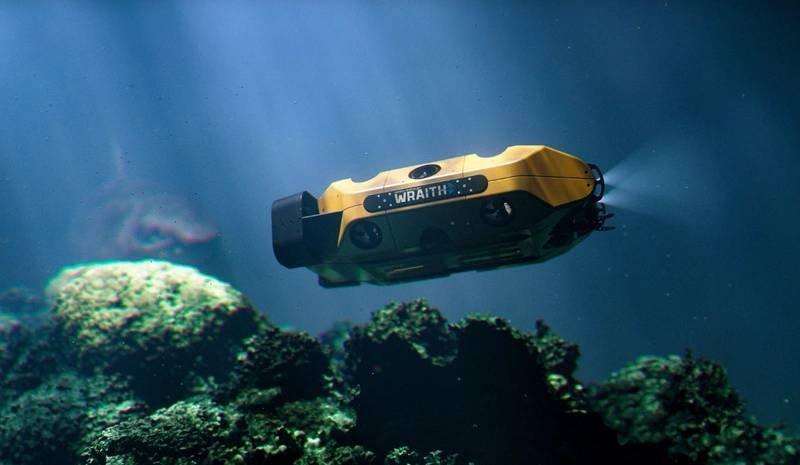
The company has just launched its Mission Specialist Wraith, the newest addition to the Mission Specialist Unmanned Underwater Vehicle (UUV) series designed for demanding subsea operations.
Wraith delivers true six-degree-of-freedom maneuverability through 10 vectored thrusters, allowing it to hold any attitude—vertical, inverted, or fully rolled—while maintaining stability, power, and control in strong currents and at depth. The platform supports a wide range of payloads, including advanced imaging, navigation, and manipulation tools, making it well suited for subsea inspection, defense, and scientific missions.
“One of the one of the trends that we’re seeing right now is our customers want us to go deeper,” says Gibson. “Our traditional ROV systems were 300-meter rated, so 1,000 feet. We’ve been asked to go pretty quickly to 1,000 meters. We delivered systems earlier or late last year and later this month to the US Navy for 4,000-meter capabilities, and we should be at 6000 but at beginning of next year.”
The Jan/Feb issue of Marine Technology Reporterfeatures UUVs. In the issue, Duane Fotheringham, president of the Unmanned Systems group in HII’s Mission Technologies division, explains how the scale of underwater vehicle uptake is growing. “Customers are moving away from buying one or two vehicles for experimentation and toward fleet-level quantities. That shift signals that unmanned undersea systems are transitioning from trials into sustained, operational use with real training, logistics and lifecycle expectations.”
User experience holds enormous weight for customers shopping for underwater vehicles. Systems need to be efficient, customizable and ultimately useful for the desired work. “Customers want systems that can handle uncertainty, operate with limited communications, and integrate smoothly into broader maritime forces that include crewed ships, aircraft and other unmanned platforms,” said Fotheringham. “They’re also looking for reduced operator burden.”
Also in the issue, Amir Garanovic, managing editor of Offshore Engineer, takes a dive into SMD’s electric ROV, Quantum EV. The Quantum EV is designed to support work-class subsea intervention while reducing the inefficiencies associated with conventional hydraulic ROV systems.
According to SMD’s product documentation, electric propulsion allows a higher proportion of input power to be converted into usable thrust reaching 63%, compared with hydraulic systems capable of 34% conversion, while also reducing topside power and equipment requirements.
The first Quantum EV is expected to be integrated into Jan De Nul’s Fleeming Jenkin cable-laying vessel ahead of commercial deployment this year.