
North Carolina tackles toxic firefighting foam
By Will Atwater
Within months of becoming chief of Double Creek Volunteer Fire and Rescue in November 2025, Jimmy Brown received sobering news: His station’s well water was contaminated with PFAS at levels that exceeded federal limits.
The station in Pinnacle, northwest of Winston‑Salem near Pilot Mountain, is one of 392 rural fire departments across the state whose wells were tested for PFAS in a recent study.
Since the revelation in 2016 that PFAS, or per‑ and polyfluoroalkyl substances, were being released into the Cape Fear River by the Fayetteville-based Chemours, awareness of the chemicals has risen across the state.
PFAS have come to be known as “forever chemicals” since they resist breaking down in the environment. They also have been linked to multiple health risks.
The study was conducted by the North Carolina Collaboratory, a research group formed in 2016 by the General Assembly. The collaboratory harnesses the expertise of university researchers to address state and local government issues.
Jeff Warren, executive director of the collaboratory, which is based at UNC Chapel Hill, said researchers initially focused on collecting and destroying containers of PFAS‑laden firefighting foam under a legislature‑funded Aqueous Film‑Forming Foam Take‑Back Program. Building on that work, collaboratory researchers decided to test wells at rural fire departments and later shared a list of stations with elevated PFAS readings with the North Carolina Department of Environmental Quality.
Six of the 392 stations had elevated PFAS levels: Pleasant Garden and Oak Ridge (both in Guilford County), New Hope (Wake County), Eli Whitney (Alamance County), South Salisbury (Rowan County) and Double Creek near Pinnacle (Stokes County).
Michael Scott, director of DEQ’s Division of Waste Management, said his staff used that list to offer free PFAS testing for homes and businesses on private wells in about a quarter-mile radius around the six affected stations, including Double Creek.
“We’ve done fairly extensive sampling thus far in Pleasant Garden around that fire station,” Scott said, adding that crews have begun sampling private wells in several other communities.
“The well has been shut off from the station, and the collaboratory and DEQ have brought in bottled water as well as a 6,500‑gallon tank of potable water that has been plumbed into the station,” Brown said. “All the water here now is 100 percent safe, and the collaboratory and DEQ are working with the Office of the State Fire Marshal to see what steps we need to take to get back to using the well water.”
Protecting firefighters from ‘forever chemicals’
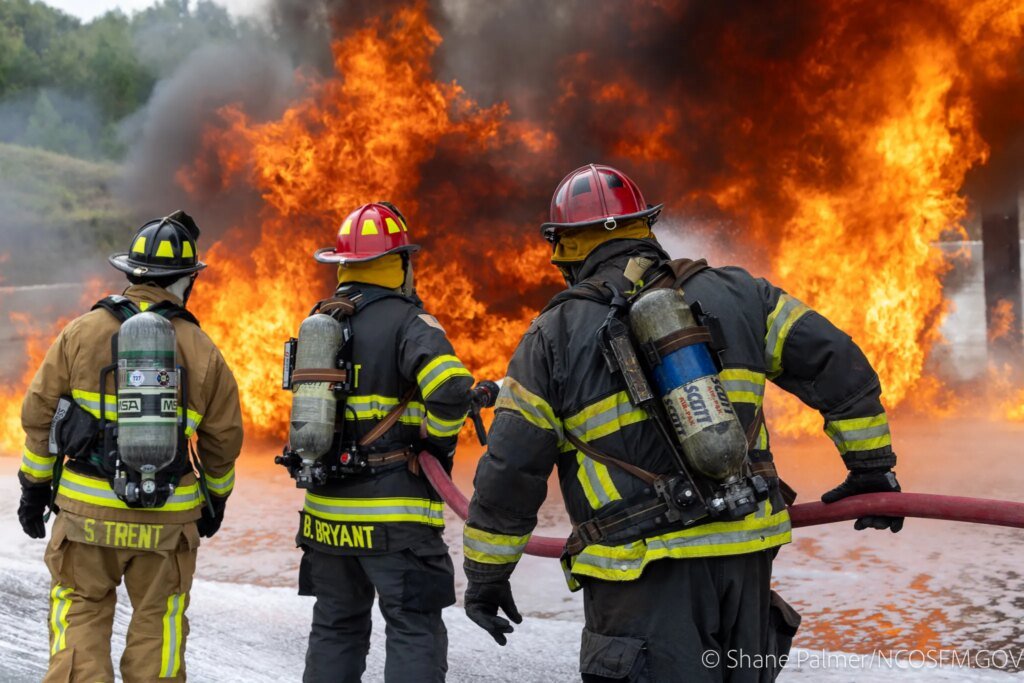
In recent decades, PFAS had become nearly ubiquitous in firehouses. The chemicals are used in firefighting gear to make it water- and chemical-resistant, and firefighters have used PFAS foams to suffocate flames.
But likely because of PFAS exposure and smoke inhalation risks, researchers are finding that firefighters face higher rates of some cancer diagnoses and deaths than the general population. Researchers analyzed nearly 30,000 U.S. career firefighters and found that they have about a 9 percent higher risk of being diagnosed with cancer and a 14 percent higher risk of dying from cancer compared with U.S. background population rates. Studies show elevated risks for particular cancers among firefighters — including multiple myeloma, non‑Hodgkin lymphoma and testicular cancer — compared with the general population.
In recent years, researchers, state and federal officials, and manufacturers have ramped up efforts to reduce firefighters’ exposure to harmful chemicals by phasing out fluorinated firefighting foams, developing PFAS‑free protective gear and setting national drinking‑water limits for six PFAS.
In 2024, the U.S. Environmental Protection Agency set enforceable limits for six PFAS in public drinking water: 4 parts per trillion for PFOA and PFOS, and 10 parts per trillion for PFNA, PFHxS, PFBS and HFPO‑DA (GenX chemicals). The agency also created a hazard index to regulate mixtures that contain two or more of those PFAS. These limits are the highest amounts of those chemicals legally allowed in drinking water under federal law.
Those new standards set the ceiling for public drinking‑water systems, and now North Carolina and other states are working to update groundwater standards so state regulators can use similar PFAS thresholds when they respond to contaminated wells and groundwater.
Due to those health concerns and the legacy stockpiles of PFAS‑laden foam sitting in stations across the state, North Carolina is one of several states that have launched a take-back program to get that older foam out of firehouses and destroy it.
120,000 gallons
North Carolina’s take-back program is a voluntary, statewide effort led by the NC Collaboratory to help fire departments and public airports identify problematic foam in their inventories and ensure that it is collected, stored and ultimately destroyed. This work is in partnership with the Office of the State Fire Marshal, the Department of Environmental Quality and academic researchers.
In the 2023 state budget, lawmakers in Raleigh allocated $20 million in one-time funds to the collaboratory for programs related to management of PFAS-containing foams and for research on the chemicals.
In 2024, Preston Clark joined the collaboratory to manage the take‑back program. Before he arrived, a statewide firefighting foam inventory analysis was done to determine how much of the product was in North Carolina and where it was stored. He said the total came to “about 120,000 gallons.”
Clark said fire departments participating in the voluntary program have so far indicated they want to dispose of about 60,000 gallons, an amount that could grow as the effort ramps up.
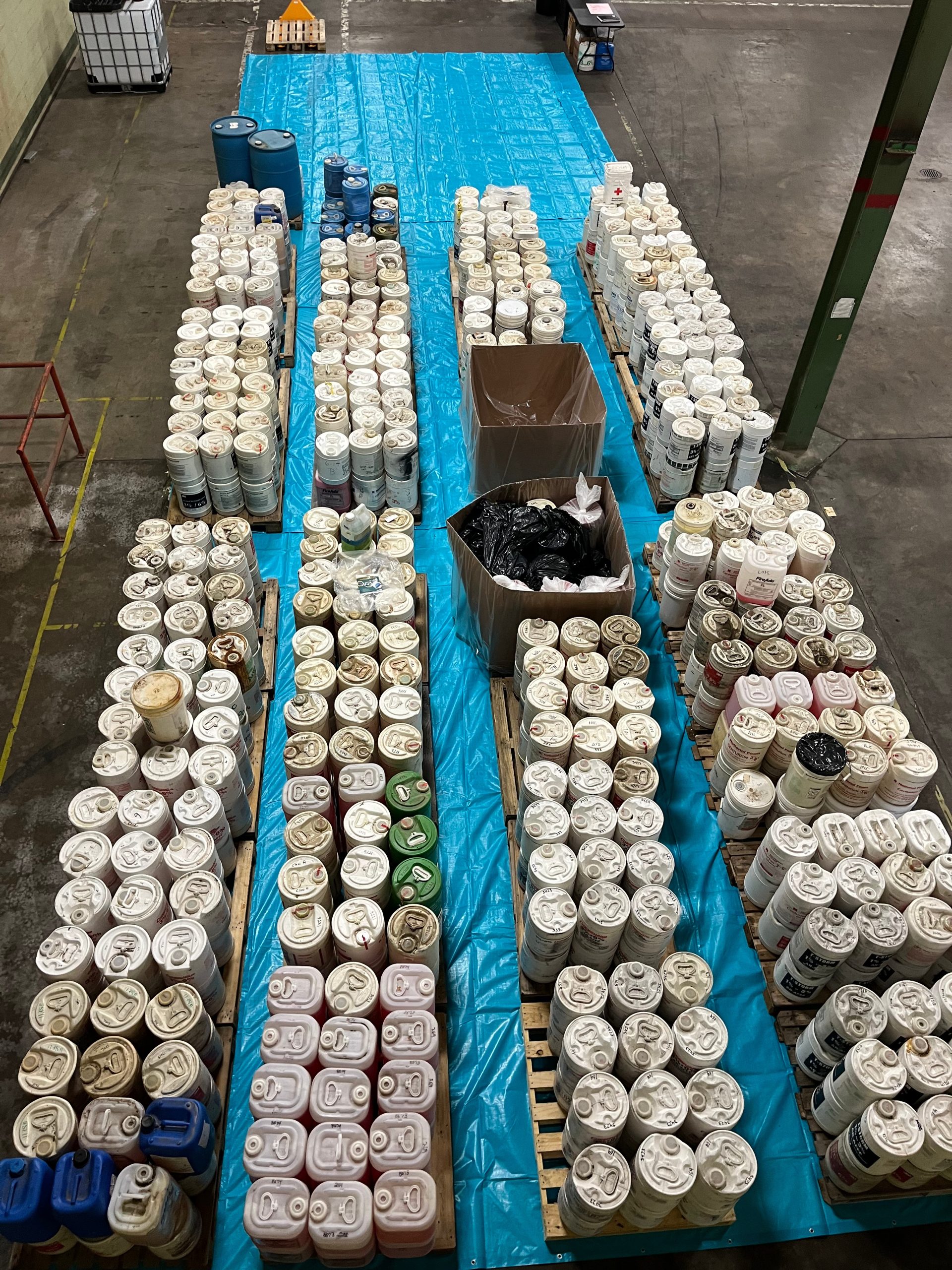
After the collaboratory and state officials finished cataloging the material and where it was, they shifted to collecting the foams and setting up a central drop site sponsored by the Charlotte Fire Department where participating stations could unload it, Clark said.
Now the foam is sitting in a warehouse in Haw River until it can be sent for final destruction.
Samples of every foam formulation are sent to Duke University and N.C. State University labs to build a chemical database or “fingerprint” that researchers can use for future forensic work, according to the collaboratory.
Clark said the program is in a pilot phase to see which companies can reliably destroy the high concentrations of PFAS in the foams, a process that differs from treating PFAS in general waste streams. The collaboratory selected three vendors after a competitive bid process.
By June, Clark said, the collaboratory expects to have results and to have selected vendors to handle the foams. He said he feels “pretty good about where we’re at with the research identifying where PFAS is found in the fire service and how much of a concern it is.”
He added that the findings should help fire professionals pinpoint their greatest PFAS risks and identify where they can eliminate PFAS‑laden products altogether.
Well water testing
It was as they were collecting foam for the take back program that the collaboratory decided to test 392 wells at rural stations that used the water for activities, including cooking, drinking and laundry. That’s how the six — including the one at Double Creek — were identified.
“These first six were so hot that we decided to go out and re-sample” to be sure they hadn’t been otherwise contaminated, Warren said. After the tests were run a second time the results were “pretty much spot on,” he said.
Warren said the lab looked for 54 PFAS compounds in each sample and then added them up to get a total PFAS number for each well. At the low end, the sum of those 54 PFAS in the Eli Whitney station well in Alamance County was 4,173 parts per trillion, while the highest total was 20,625 ppt at the New Hope Fire Department in Wake County.
Overall, Warren said, roughly 5 percent of the 392 stations tested had elevated PFAS levels, which he called good news for the vast majority of departments.
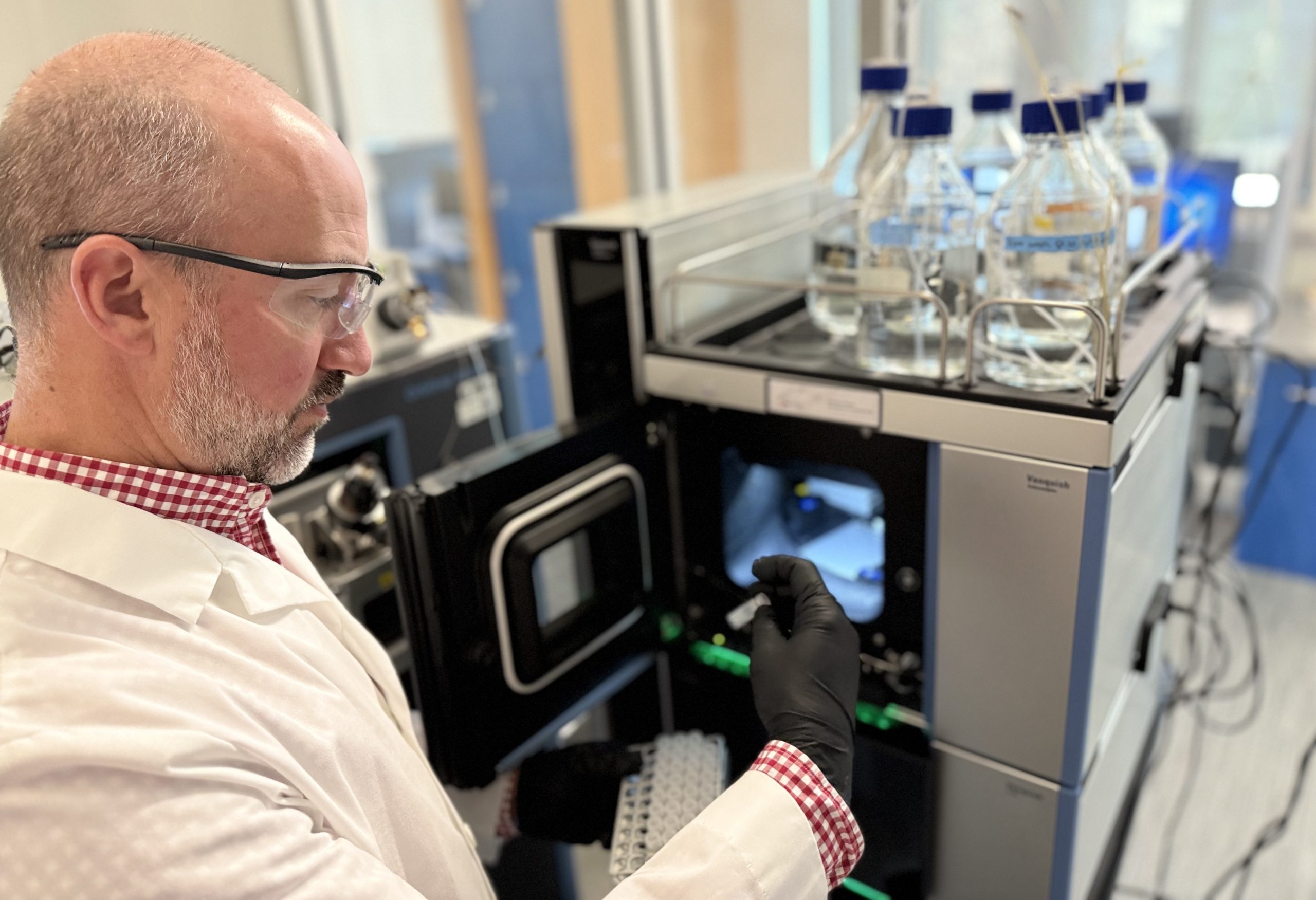
Water samples collected from wells have been tested and cross checked in the labs of researchers Lee Ferguson at Duke University and Detlef Knappe at N.C. State University.
“When we find an elevated analysis hit, we do several things,” Ferguson said. “Detlef and I cross check those numbers he’s analyzing.
“We also send our teams back out to resample to make sure about these numbers before we take action.”
Warren said that if the PFAS content level verifiably exceeds federal standards, the collaboratory follows a notification protocol, which involves contacting public officials, including district legislators, mayors, county health directors, the State Fire Marshal’s Office, North Carolina Department of Environmental Quality and the North Carolina Department of Health and Human Services.
Building a study cohort
Now, the collaboratory is facilitating cancer screening that’s available to firefighters in the departments where PFAS groundwater levels are high.
“In 2024 our research team received funds from the Collaboratory to develop what we call the North Carolina Firefighter Cancer Cohort Study, which basically provided funds for firefighters here in North Carolina to become enrolled in the National Fire Fighter Cancer Cohort Study,” said Duke University researcher Heather Stapleton.
Since enrollment began in July 2024, more than 800 firefighters statewide have joined, and Stapleton’s lab has PFAS blood measurements for each of them.
Pleasant Garden was the first department where firefighters asked to be tested after their contaminated well was identified, Stapleton said. Her team drew blood from 26 firefighters there, analyzed the samples at Duke, sent each person an individualized report and then held an in‑person meeting, along with a short explainer video, to walk through the results and answer questions.
On average, Pleasant Garden firefighters had PFAS levels about three times higher than other North Carolina firefighters, but individual results varied widely depending on how long people had worked there and how much station water they drank.
She said her team pointed firefighters to guidance from the National Academies of Sciences, Engineering and Medicine, which recommends that people with elevated PFAS exposure consider blood testing and notes that if the sum of seven specific PFAS in blood exceeds 20 parts per billion, there may be increased risk for conditions such as thyroid disease, kidney and testicular cancer and high cholesterol.
Stapleton said the study team and NC DHHS have developed one‑page summaries that firefighters can bring to their physicians so they can put the results in context and decide what, if any, additional monitoring makes sense.
This <a target=”_blank” href=”https://www.northcarolinahealthnews.org/2026/04/08/north-carolina-pfas-firefighting-foam-cleanup/”>article</a> first appeared on <a target=”_blank” href=”https://www.northcarolinahealthnews.org”>North Carolina Health News</a> and is republished here under a <a target=”_blank” href=”https://creativecommons.org/licenses/by-nd/4.0/”>Creative Commons Attribution-NoDerivatives 4.0 International License</a>.<img src=”https://i0.wp.com/www.northcarolinahealthnews.org/wp-content/uploads/2021/10/cropped-favicon02.jpg?fit=150%2C150&ssl=1″ style=”width:1em;height:1em;margin-left:10px;”>
<img id=”republication-tracker-tool-source” src=”https://www.northcarolinahealthnews.org/?republication-pixel=true&post=67115″ style=”width:1px;height:1px;”><script> PARSELY = { autotrack: false, onload: function() { PARSELY.beacon.trackPageView({ url: “https://www.northcarolinahealthnews.org/2026/04/08/north-carolina-pfas-firefighting-foam-cleanup/”, urlref: window.location.href }); } } </script> <script id=”parsely-cfg” src=”//cdn.parsely.com/keys/northcarolinahealthnews.org/p.js”></script>