
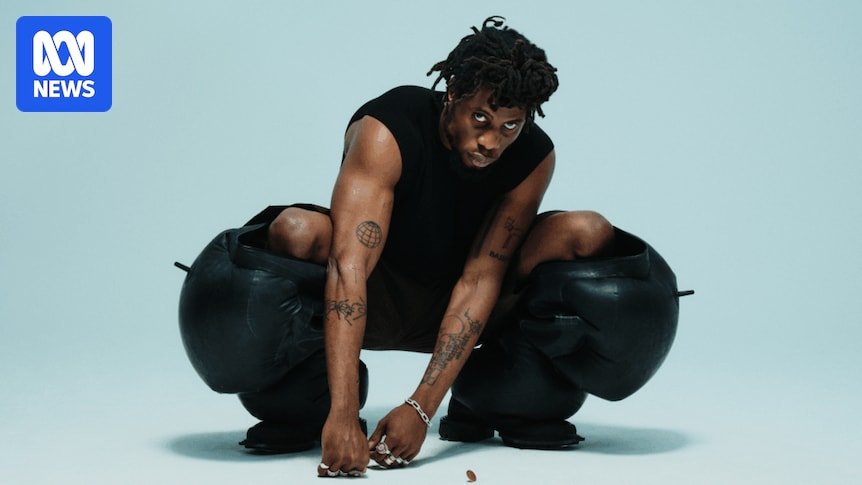
Obongjayar understands the wisdom of the old saying that variety is the spice of life.
“Sometimes you might like rice, sometimes you may like beans. You might want to go get Thai or Japanese or French food,” he says.
The cuisine analogy has arisen as the 32-year-old musician’s way of describing his approach to making art.
His music is a multicultural melange that draws from his Nigerian roots, the thriving musical communities of his adopted London, and the “anything-goes” attitude of modern pop auteurs.
“Human beings are nuanced, we have lots of different flavours, and all kinds of things add up to what our influences are. Our influences then become what we bring to the world,” he says.
“I don’t believe there’s just one way of making things or one angle to look at.“
That multiplicity informs Paradise Now, Obongjayar’s auspicious second album and one of 2025’s best.
It cemented him as a shapeshifter, capable of producing stylistically adventurous songs that are difficult to pigeonhole but easy to admire.
Breezy West African grooves drift effortlessly toward glossy synth-pop, four-to-the-floor funk workouts give way to gritty guitars or soothing lullabies.
Loading Instagram content
Paradise Now eludes neat genre labels and actively refuses to be boxed into diasporic stereotypes. The cover depicts Obongjayar literally breaking through a glass ceiling.
“Don’t get me wrong. I think labels or genres have a place, absolutely,” he says.
“But I believe it’s — I wouldn’t say disrespectful … it’s lazy, just because someone is of a certain heritage or wherever they’re from, you could just be ‘OK, that’s what that is’ you know?
“Artists of a certain place might also feel, ‘I have to be this thing because that is what I have been told to do.’
The genre-defying Paradise Now was one of 2025’s best album releases. (Supplied: September Recordings)
“That attitude completely blocks you from seeing beyond or reaching towards what’s possible. It’s a shame when artists are looked at in a way that isn’t nuanced.”
Obongjayar’s own tastes and influences are varied, obliterating reductive tags like World Music designed to categorise acts to a particular section of a record store or streaming service.
“I’m an Afrobeats artist, definitely. That’s what I grew up knowing. That’s the rhythm that I understand. But I’m adding onto that lineage and into something else,” he says.
He’s not justan Afrobeats artist. He’s building on what’s gone before.
“Exactly. I don’t know what it is I am. My DNA is Afrobeat. That’s my heartbeat,” he says.
“But I’m also a rock and roll artist. I’m a punk artist. I’m also a funk and jazz artist.
“Because I love those things and they’ve inspired me to tack on to the lineage that was my original DNA.
“I wasn’t born with dreads. I grew dreads. You start somewhere and then you grow into something else.”
From Nigeria to global collaborations
Steven Umoh, or “OB” as he prefers in person, grew up in Nigeria’s “tourism capital” Calabar. He was raised by his devoutly Christian grandmother after his mother fled to the UK, pregnant with Umoh’s younger sister, to escape their abusive father.
At age 17, he relocated to Britain to live with his mum and began, inspired by Kanye West, 50 Cent and Lil Wayne, dabbling in making hip hop (and recording with an American accent).
His music developed and, at 24, caught the attention of XL Recordings head Richard Russell, which led to a signing and a string of EPs.
His vivid debut album, 2022’s Some Nights I Dream Of Doors, was accompanied by a developing reputation for scene-stealing collaborations.
Iconoclasts like Danny Brown, Sampha and Pa Salieu tapped OB for his distinctive voice and artistry.
Then there was Fred again.., the UK super-producer who recast Obongjayar’s tender I Wish It Was Me into Adore U, a platinum-certified hit in Australia and the UK that saw the two join forces on stages around the globe.
Loading Instagram content
“Those things expose me to a completely new demographic of people that I wouldn’t have been able to access,” OB says.
But he firmly emphasises that he’s seeking out fellow artistry, not opportunity.
“If you’re working with people because of how big they are, what you think you might be getting from them or them you — whatever it is, you’ve already lost, bro. It might work, but it’s not real,” he says.
“The people I’ve collaborated with are people that I genuinely love and understand what they do. When we come together, it doesn’t feel like a mechanical thing.”
In everything Obongjayar does, it’s about authenticity. And he’s found a kindred soul in Little Simz, one of the most acclaimed and culturally significant British rappers of her generation.
“Love her,” he says. “The thing with me and Simz is we get each other. I trust her. I know what I’m getting back.”
Loading SoundCloud content
The pair have collaborated frequently. And Simz is the only feature guest on Paradise Now. She delivers a brazen verse on Talk Olympics, a playful indictment on vacuous gossiping and social media speculation.
“When we perform together. It just feels so smooth. It just works,” OB says. “Like two puzzles that join to make a full piece.
“Sharing knowledge and sharing beauty, that’s what collaboration should be about. And Simz is that person for me.”
The power of positivity
Another example of Obongjayar’s range is, quite literally, his elastic vocals.
Paradise Now parades his ability to mutate from low, husky tones to a feathery falsetto, often within a single song.
He brings a honeyed croon to Born In This Body, confessing to the self-scrutiny provoked by unrealistic body standards, rhythmic chattering on Talk Olympics, then barks verses and sings high-pitched barbs on Jellyfish.
The latter is a politically charged clash of feverish electronics and beats that likens British politicians to the titular spineless sea creature.
Loading Instagram content
When songwriting, Obonjayar is someone driven by instinct, not agenda.
“I’m not thinking, ‘OK, I’m gonna write a political song now,'” he says.
“It’s how I’m feeling. I’m feeling angry at the government.
“Or making No Surrender, I’m like partying all night. Because all these things happen in different facets of life, and that’s how music should be made.
“Music is supposed to be about the artist’s perspective and how they see the world and what they have to say about that feeling in a particular moment in which they felt it.
“I’m a very self-aware person. I’m constantly thinking, constantly writing and making music or trying to discover … myself and show people what it is that I can see through music.”
Loading Instagram content
If being an artist is showing people his perspective through music, what excites Obongjayar in the world he’s seeing right now?
“The world is burning right now, bro,” he responds.
“It’s hard to be excited about anything when there’s just so much chaos, every day. It’s constant. Then we’re all distracted by social media. We’re worrying about the wrong thing.
“It is so demoralising to wake up every day and see how bad things are getting and how obvious it is that people are picking sides and completely ignoring the good.
“It’s hard to look past that. But I’m happy to be alive; that’s what I’m excited about.”
Obongjayar’s recently completed Australian tour included headlining shows in Sydney and Melbourne. (Supplied: George Muncey)
That includes his second tour of Australia, where Obongjayar has seen first-hand the importance of connection and community, especially in tough times.
“It means a lot. It means you’ve done something that has impacted people and kept them still coming back, which is great. I hope when we come back [to Australia] next it’s going to be even bigger and better and stronger, you know?” he says.
Performing mid-album breather, Prayer, has become a new favourite moment of his set list.
“Because it reminds me that there’s hope. As dark as things are, it’s just that little glimmer somewhere,” he says.
Bringing the light
When Double J speaks to Obongjayar, it’s ahead of being bumped up to play two sets at WOMADelaide, “one of the best festivals out here,” he’s been told.
He’d also heard great things about Golden Plains, and the Victorian festival’s tradition of attendees raising the boot to honour their favourite performance.
“I wish I didn’t hear about that because now I’m going be thinking about it,” OB fretted ahead of the event.
“I’ve jinxed it; it’s gonna make me scared if people don’tput their boots up.”
He shouldn’t have worried. Obongjayar’s high-energy, shirtless showing earned the boot from more than a few festival-goers.
Whether fans are raising their footwear, voices or hearts and hopes, Obongjayar is there to match it.
“Right now, it’s crazy times! The evil is on the rise and the light is completely overshadowed. We have and try to shine the little light that we have to overcome the darkness,” he says.
Is that his sense of artistic responsibility?
“I don’t feel responsible to bring the light. I am the light!” he says.
“I believe I stand for good and what comes from me is good. I’m not a soldier man, nobody’s telling me what to do. I don’t feel any pressure it just is what it is.”