
Operation Transparency: Epstein Files
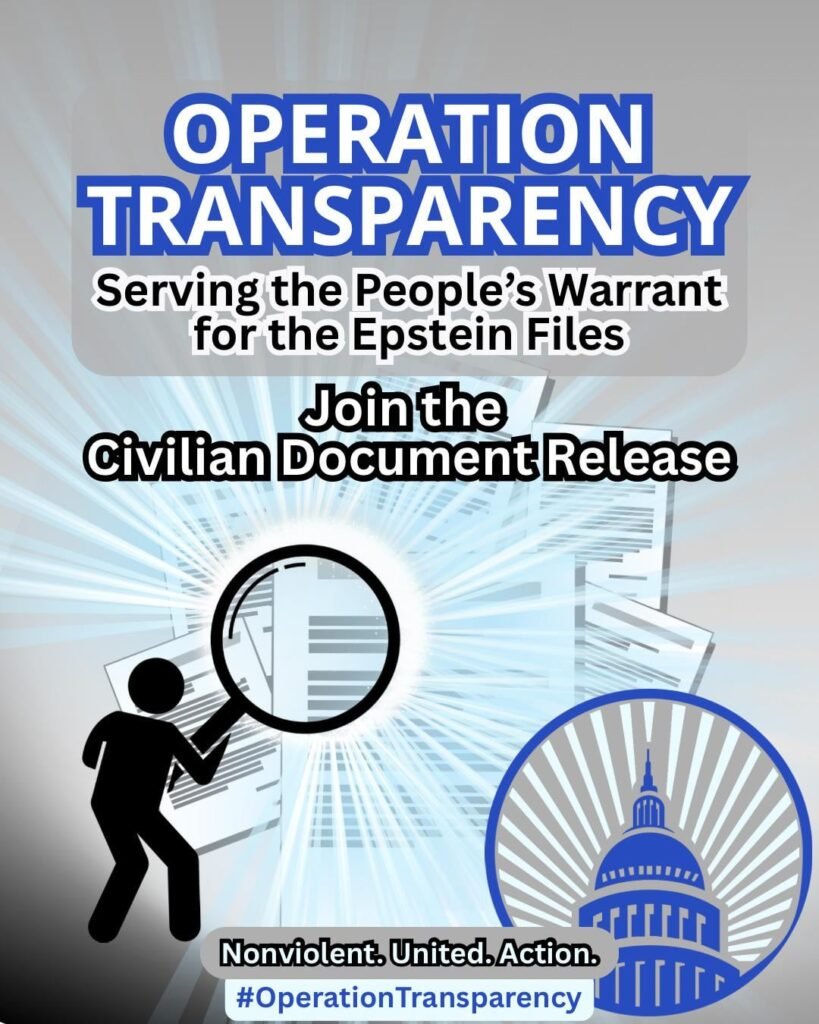

I’m looking for feedback on an idea I have called Operation Transparency: The Epstein Files. Here’s what I created:
Operation Transparency & Civilian Document Release: The Epstein Files
A Proposal from Acorn
Operation Transparency is a nonviolent direct action campaign with the goal of compelling the immediate release of all government-held documents connected to Jeffrey Epstein and his network which have been concealed by federal agencies and the MAGA administration.
The campaign escalates from a public demand and deadline for release, to visible media actions, and culminates in disciplined Civilian Document Release events held at key institutions such as the Department of Justice, congressional offices, the White House, newsrooms, and U.S. embassies and consolates.
This initiative responds to persistent government secrecy and institutional failures by using proven, strategic civil resistance tactics. It demonstrates that when legal and political appeals are ignored, the power of transparency must rise from below and be reclaimed through collective action.
Goal and Rationale
Operation Transparency is a nonviolent campaign to compel the public release of all government-held documents connected to Jeffrey Epstein and his network, focusing especially on records concealed or withheld by federal authorities and powerful institutions.
By using disciplined civil resistance, Operation Transparency seeks to expose and recover public-interest documents, called the Epstein Files, kept from the public by the MAGA administration and its enablers.
The Civilian Document Release initiative aims to apply organized, disciplined, and nonviolent pressure on institutions such as Congress and the Department of Justice, which have failed in their duty of transparency and accountability to the public.
Why Strategic Civil Resistance?
This project draws on a tradition of nonviolent direct action, also known as civil disobedience, that operates independently from compromised institutional channels.
Studies show that nonviolent civil resistance is significantly more effective than armed resistance, with some research indicating it is roughly twice as successful when aiming for maximalist goals (such as regime change). From 1900 to 2006, nonviolent campaigns succeeded about 53% of the time, compared to only 26% for violent campaigns when aiming to remove a head of state from office or aiming for territorial liberation. This greater effectiveness is attributed to nonviolent movements' ability to gain wider participation, shift loyalty within security forces, and gain legitimacy both domestically and internationally.
As legal requests and appeals are routinely ignored, people reclaim democratic power through collective, open action when secrecy and corruption threaten community well-being. Nonviolent civil resistance stands apart from institutional politics, which rely on public cooperation for legitimacy.
When those systems become engines of secrecy, it is the responsibility of everyday people to withdraw their cooperation and expose injustice. Presidents, courts, law makers, elections, and bureaucratic processes derive legitimacy from public cooperation.
Power in society does not descend from the top; it ascends from below. Governments, courts, and corporate structures rely on the daily cooperation of individuals, workers, and consumers.
When that cooperation is withheld in a focused and nonviolent way, the architecture of secrecy falters.
This proposal draws inspiration from Casino-Free Philadelphia’s Operation Transparency (2007), which used the "Citizen Document Search", a tactic known as public search and seizures, which broke open secret casino licensing processes through a series of well-timed, media-oriented actions. Their disciplined, creative noncooperation forced institutional transparency, shifting public and judicial opinion in their favor.
Proven Tactics From Earlier Movements
This proposal is built on the proven tactic of nonviolent search and seizure by the people which was first developed by activists in Canada and later used successfully by local movements. These previous efforts show that open, transparent actions can create high-pressure dilemmas for those who resist releasing public documents:
• Campaigners issue a public ultimatum, demanding document release by a clear deadline.
• Should the target institution reveal the documents, the public learns the truth.
• If the institution resists and activists are arrested during nonviolent searches, it exposes the injustice and generates media scrutiny, often causing the release of the documents.
• Actions are public, transparent, and media-savvy, creating anticipation and forcing a response either way.
Notably, Casino-Free Philadelphia’s campaign involved washing the windows of government offices to “promote transparency,” dramatizing their demand. After deadline-driven document searches, and media attention generated by planned arrests, the commission eventually released almost all requested records.
Strategic Framework and Structure
Operation Transparency: The Epstein Files builds on that model to pursue public access to federal files concerning Epstein-linked political networks.
The campaign will:
-
Announce a public demand for the release of key documents on a specific date, with a set deadline.
-
Stage media-visible actions (like public searches, creative stunts, and participatory demonstrations) to increase pressure and anticipation. These actions will likely be during business hours but some supportive actions can be scheduled outside of business hours.
-
Carry out disciplined Civilian Document Releases at government offices if the deadline is not met, asserting the public’s right to know and forcing a dilemma for authorities. These should be done during business hours. This is where some participants will risk arrest.
The action’s structure makes clear that civilians are asserting (not begging) for their right to transparency. This distinction defines civil resistance.
Nonviolent Discipline
Nonviolent action works because it amplifies strategic clarity. Every participant must embody the principles of integrity, dignity, and restraint. Following the model used by Casino-Free Philadelphia, all participants will affirm the following guidelines before taking part:
In our actions, we will:
– Bring humor and creativity.
– Maintain a dignified, calm, and friendly attitude toward all present.
– Act transparently, with clear intentions.
– Keep our focus on the purpose: public liberation of truth.
In our actions, we will not:
– Use or threaten violence.
– Damage property.
– Use drugs or alcohol during the activities.
– Risk arrest without prior training.
– Run or escalate tension during actions.
By clearly defining our boundaries, we ensure mutual trust and shared accountability, creating safety and focus during the action.
The Action is the Message
Nonviolent action sends its message not through demands, but through decisive, symbolic enactment. The act itself communicates the injustice and embodies the desired alternative. When participants attempt to nonviolently search for and release hidden documents, the act itself reveals institutional secrecy and asserts civic legitimacy. This dramatizes the power imbalance and spotlights the need for transparency, rallying public witnesses and the media.
Traditional protest asks authority to change. Strategic nonviolent action demonstrates that power already resides with the people. Even if participants are arrested, the ensuing controversy brings attention to the records and can tip public opinion, often leading to their release. Direct action tactics create stories that build anticipation and shift the odds in favor of openness.
When operation participants assert their right to access to withheld documents through disciplined nonviolent participation, the act becomes both message and method. Each step of cooperation withdrawal, public exposure, and creative defiance reinforces the truth that an informed population is the foundation of a functioning democracy.
Expected Impact
Public Awareness: Heighten public awareness by generating news and discussion about withheld documents.
Institutional Pressure: Compel public officials and congressional figures to respond under scrutiny.
Movement Power: Strengthen collective understanding of bottom-up power, inspiring further acts of nonviolent resistance for transparency and justice.
Operation Transparency & Civilian Document Release reclaims people power as a lived truth. By acting where institutions have failed, civilians remind the nation that democracy endures only through participation, courage, and collective noncooperation with secrecy and corruption.
As Gandhi taught, authority exists only by the consent of those who obey it. The path to reclaiming transparency lies not through permission, but through disciplined, creative, and courageous action.
Now, it’s time to show what power looks like when it flows upward.
The Demand Issued
We, the people, demand that the United States government release the Epstein Files—including the names of all alleged perpetrators—no later than [insert date]. For too long, agencies have hidden critical truths behind closed doors, enabling corruption and betraying the public’s trust. This injustice ends now. If these records are not released, we will issue People’s Warrants and mobilize nonviolent Civilian Document Release actions at key institutions nationwide/worldwide. Together, we will shine a light where secrecy reigns, reclaim our right to know, and hold power accountable. The era of silence is over. Stand with us and demand real transparency for justice and democracy.
People’s Warrant for Transparency
Statement of Purpose
We, as members of the public, issue this People’s Warrant for Transparency in defense of the people’s right to know. This warrant arises from the failure of governing institutions to act in the public interest, and from their continued concealment of records that rightfully belong in public hands specifically, the Epstein Files withheld from disclosure.
When official bodies abandon transparency, accountability passes to the people, for democracy relies on informed participation and truth.
The principles of democracy presume informed participation, and that participation depends upon access to truth. The suppression of public documents therefore constitutes a direct harm to both trust and self-government.
Grounds for Action
This warrant is grounded in:
-
The inherent right of the public to oversee government conduct.
-
The duty of free people to withdraw consent from secrecy and corruption.
-
The nonviolent principle that truth must be pursued through peaceful means, even when those in power resist exposure.
The power that sustains institutions flows upward from the people. When secrecy replaces accountability, that power must be reclaimed and redirected toward transparency.
Scope and Intention
This warrant justifies peaceful entry and inspection of official premises to locate, identify, and publicly document materials unreasonably withheld. Participants act without hostility or destruction, using only truth and conscience as instruments of their release.
The intent of this action is not to seize through force, but to reveal through integrity, to make visible that which has been hidden, and to remind all institutions that their authority depends conditional public consent.
Declaration
By this warrant, we affirm that transparency is not a privilege granted by power but a duty owed to the people.
We proceed with nonviolent determination, open hands, and visible actions.
We act in the open, to bring light, for all to see.
People’s Warrant for Transparency
(Spoken Version)
We stand here together as members of the public, acting in defense of our shared right to know.
This is a People’s Warrant for Transparency.
When those entrusted with power conceal truth from the people, they abandon their duty.
A government that hides the record of its actions denies the foundation of democracy itself.
We act today without violence. We carry no arms. We intend no physical or psychological harm to anyone.
Our purpose is simple: to bring hidden documents into the light, so that the public may see what has been done by those in power.
This warrant authorizes a peaceful release for truth.
We come not to take by force, but to reclaim by right: openly, respectfully, and together.
Transparency is not granted from above. It rises from below, through the conscience of free people.
With calm resolve, we proceed.
Potential Locations to Serve the People’s Warrant for Transparency
• Department of Justice Headquarters (Washington, DC)
• Regional and State Department of Justice Offices (field offices across all states)
• Congressional Offices in Washington, DC (Senate and House office buildings)
• District and State Congressional Offices (local offices of Senators and Representatives nationwide)
• The White House (the core symbol of executive power)
• US Embassies and Consulates (international sites representing US governance abroad)
• State Capitol Buildings and Government Complexes (centers of state-level legislative and executive power)
• Local Government Offices (city halls, municipal records offices, local boards of elections)
• News Media Outlets and Major Newsroom Headquarters (e.g., The New York Times, Washington Post, CNN, Fox News, NPR)
• Federal Agencies Known for Withholding Information (FBI, CIA, DHS, IRS regional and DC offices)
• Office Complexes of Corporate Contractors Linked to Public Records or Cloud Storage (firms known for holding, processing, or archiving government documents)
• Academic Institutions with Government Ties or Major Research Archives (universities with federal research contracts, public policy institutes)
• Civil Rights and Watchdog Organizations’ Offices (to call on them to join transparency efforts)
• Sites of High-Profile Public Events or Hearings (venues during major legislative sessions, government summits, or public commission meetings)
