
Solid Fuel Ducted Ramjet (SFDR) Technology, Working, Latest News
Solid Fuel Ducted Ramjet (SFDR) Technology is an advanced air-breathing propulsion system using a solid fuel gas generator. Read more about Solid Fuel Ducted Ramjet (SFDR) Technology, Working, Latest News.
Solid Fuel Ducted Ramjet (SFDR) Technology Latest News
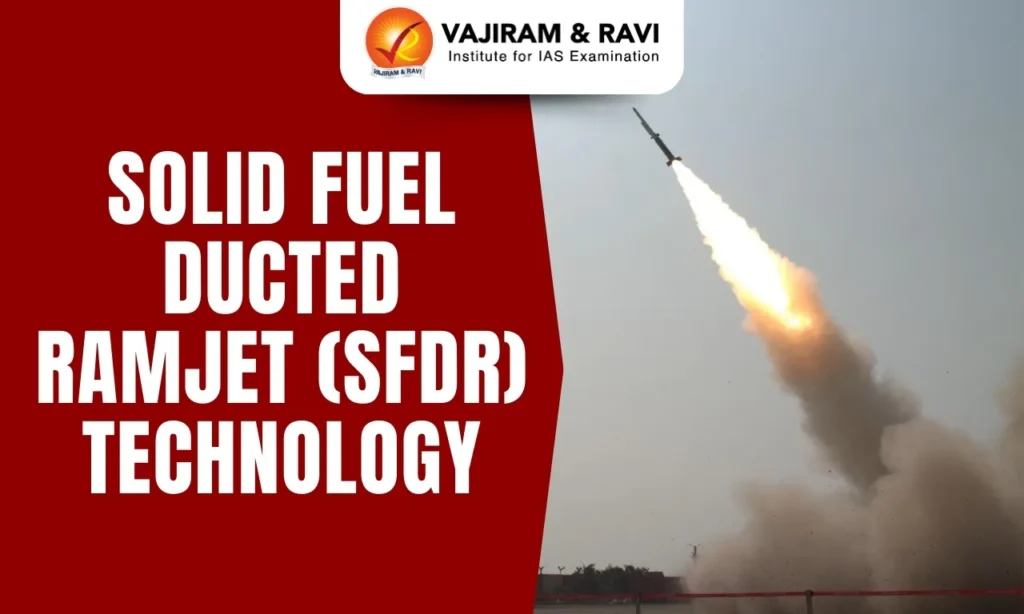
Recently, the Defence Research & Development Organisation (DRDO) has carried out a successful demonstration of Solid Fuel Ducted Ramjet (SFDR) technology from the Integrated Test Range (ITR), Chandipur off the coast of Odisha.
About Solid Fuel Ducted Ramjet (SFDR) Technology
- It is an advanced air-breathing propulsion system using a solid fuel gas generator.
- It has been developed by Defence Research and Development Laboratory (DRDL), Hyderabad in collaboration with other DRDO laboratories.
- Working:
- It uses solid fuel instead of liquid fuel to make the system simpler, safer, and easier to store and transport.
- Unlike conventional rockets, SFDR does not carry an oxidiser, making it lighter and more efficient.
- SFDR provides sustained thrust over a longer duration and allows thrust modulation during flight.
- The SFDR system allows missiles to fly faster, farther and remain manoeuvrable throughout their flight, unlike conventional rocket-powered missiles.
Significance of Solid Fuel Ducted Ramjet (SFDR) Technology
- SFDR technology significantly enhances long-range air-to-air missiles by providing sustained propulsion throughout much of the missile’s flight.
- It places India into an elite league of nations possessing this technology that enables developing long-range air-to-air missiles to give tactical edge over the adversaries.
What is Ramjet?
- It is a propulsion system that relies on the missile’s high forward speed to compress incoming air, eliminating the need for a compressor and enabling efficient high-speed flight.
Source: PIB
Solid Fuel Ducted Ramjet (SFDR) Technology FAQs
Q1. What type of missiles can SFDR Technology be used for?+
Q2. What is SFDR Technology?+
Tags: solid fuel ducted ramjet (sfdr) technology

Vajiram Prelims Team
At Vajiram & Ravi, our team includes subject experts who have appeared for the UPSC Mains and the Interview stage. With their deep understanding of the exam, they create content that is clear, to the point, reliable, and helpful for aspirants.Their aim is to make even difficult topics easy to understand and directly useful for your UPSC preparation—whether it’s for Current Affairs, General Studies, or Optional subjects. Every note, article, or test is designed to save your time and boost your performance.
Related Posts
Courses