
How did Prince’s cool tracks like “Little Red Corvette” and “When Doves Cry” emerge from a place as famously uncool as Minnesota?
That’s the question legendary TV host Dick Clark asked the 21-year-old singer-songwriter during a memorable 1980 interview on American Bandstand.
Attend the book signing
6:30 p.m., Feb. 10
Changing Hands Bookstore
300 W. Camelback Rd.
Phoenix, AZ 85013
Free
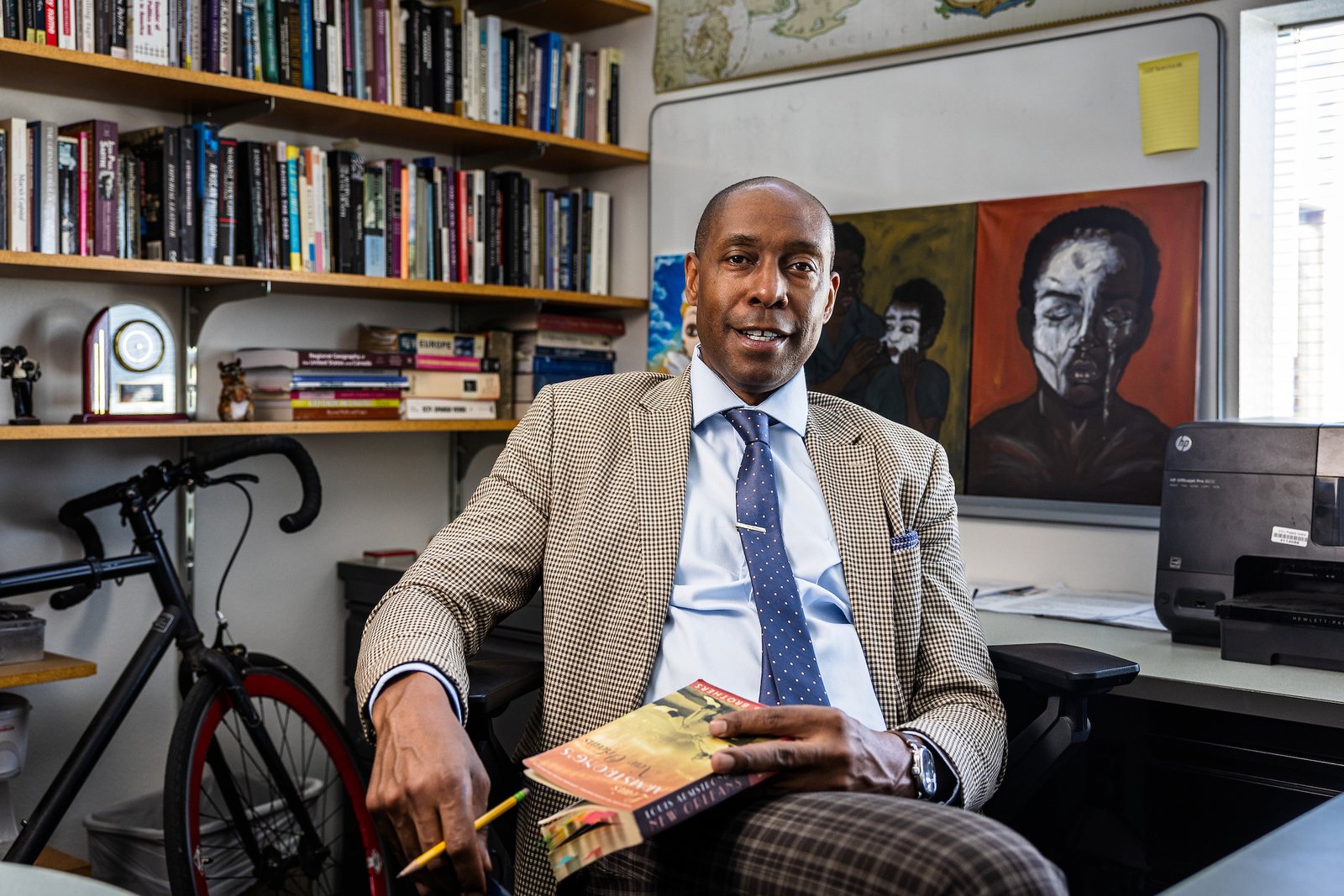
It’s the same question that Arizona State University Associate Professor Rashad Shabazz answers in his new book “Prince’s Minneapolis: A Biography of Sound and Place,” which comes out on Feb. 17. A book signing is scheduled for Feb. 10 at Changing Hands Bookstore in Phoenix.
The book is about more than just music history. It investigates how Minneapolis’ racial dynamics, music education systems and culture played a part in creating the “Minneapolis sound.”
It is also the inspiration behind a new course that Shabazz, a historical geographer specializing in race, culture and the built environment, is teaching at ASU this semester called “The Geography of Music.”
From New Orleans to Minneapolis and beyond, students in the class are examining the social forces that were embedded in specific locations and how those translated into the melodies, harmonies, lyrics and instrumentation of popular American musical forms.
“We’re going up to Minneapolis … and then we’re going to skirt over to New York City and examine the birth of hip-hop and rap music,” Shabazz said.
The Prince connection
Shabazz was 8 when the Prince hit “Little Red Corvette” came on the radio. To this day, when he hears that song, it takes him back to that moment.
“The sound just captured me,” he said. “I was very moved.”
But it wasn’t until he attended college in Minnesota that Shabazz came to really appreciate Prince’s music.
At the time, some in the music world were divided in their devotion between two greats: Michael Jackson and Prince. The record-breaking hit “Thriller” put Shabazz squarely in Jackson’s camp.
A “Jackson vs. Prince” debate with his girlfriend led to a night of driving around Minneapolis immersed in Prince’s music, a moment that fundamentally changed his appreciation for the local legend.
“When I started to listen, I mean really listen, I heard Prince in a very different way,” Shabazz said. “He played all these instruments. He wrote the lyrics, he wrote the music. He recorded it and he did all the compositions. And all of the different sounds were unbelievable.”
Today, Shabazz describes Prince as a savant and a musical genius.
“He is one of the greatest musicians of all time,” Shabazz said. “On par with people like Mozart and the Beatles.”
But he stops short of attributing all of that musical genius — the composing, the singing, the dancing — to an individual accomplishment.
“Prince’s music wasn’t just a product of individual genius but was deeply rooted in the specific history and environment of Minneapolis,” he said.
The influences behind Prince’s sound
To write the book, Shabazz studied Prince’s environment and asked key questions: What gave rise to the Minneapolis sound? How did it evolve? Who are the people who helped its revolution? What were the institutions it was connected to?
And the history unfolded.
Prince’s music wasn’t just a product of individual genius but was deeply rooted in the specific history and environment of Minneapolis.
Rashad ShabazzAssociate Professor, School of Social Transformation
Prince’s father, John L. Nelson (whose stage name was Prince Rogers), was a jazz pianist, songwriter and composer, and his mother, Mattie Shaw, was a jazz singer. Both were accomplished musicians who significantly influenced his musical journey.
Prince also grew up in Minneapolis, which had one of the most advanced, mandatory public school music education systems in the United States. Students received comprehensive K-12 training in notation, voice, instrumentation and sight-reading, providing the foundational skills for Prince to become a multi-instrumentalist.
And then there were the sounds that surrounded him growing up in the segregated Black world of south Minneapolis.
“Musically, there was funk, rhythm and blues, a kind of early rock and roll … and jazz, of course, it’s hot to jazzification,” Shabazz said. “And then, in the 1970s, when Prince was a teenager, there was punk rock and indie rock happening on the white side of town. And there was this folk scene that popped up on the west side of the city.
“He fuses these musical landscapes that are divided by race and space — this Black scene that’s on the north, this white scene of downtown — and what he does is he musically, sonically brings them together.
“He fits R&B to punk. He brings in a kind of smooth poppy sound that you might associate with funk hits. He finds a way to work these rhythms, harmonize these instruments, to create this really amazing symphony. But it was really fostered through these conflicts, divisions and tensions.
“Prince found ways to connect all of these different sounds. And in doing that, he gave the world some of the most vivid music ever created.”