
The true Houston connection behind an iconic video game villain
In the 2010 video game Fallout: New Vegas, the player is tasked with traveling through a post-apocalyptic American west to obtain a data storage device for the enigmatic Mr. House, who rules over a futuristic Las Vegas from his casino.

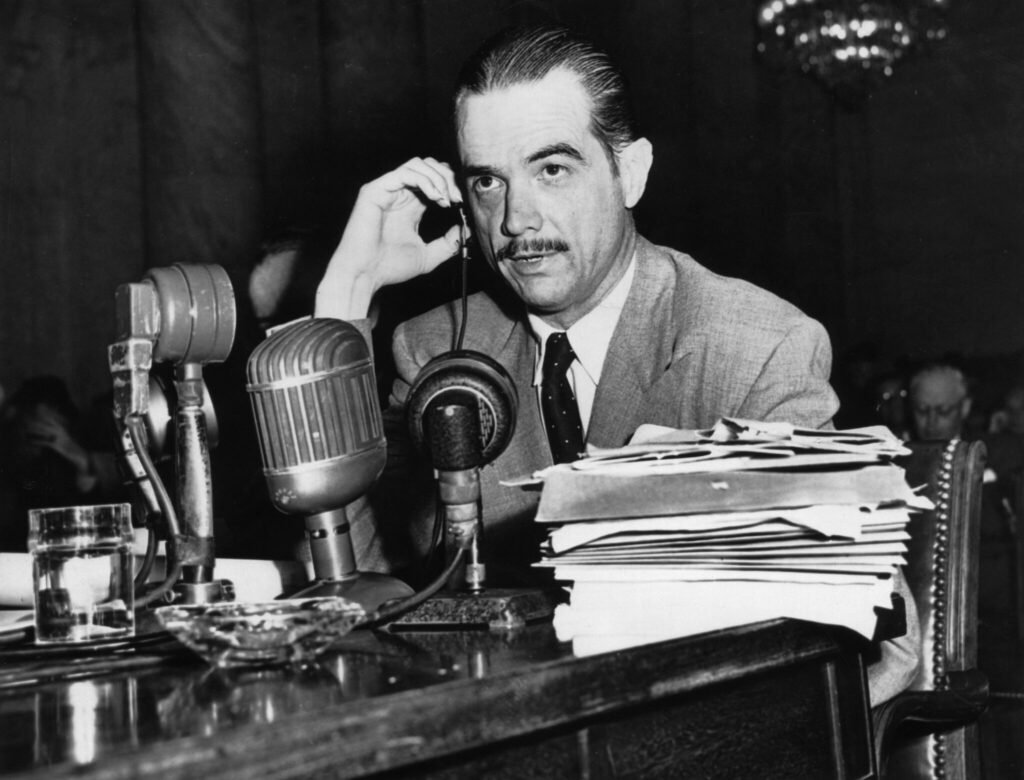
When you finally meet him, you learn that Mr. House is less of a man and more of a superintelligence uploaded onto a computer. His body, kept alive through nuclear war, is in cryogenic stasis. He appears to the player as the image of a dapper 1950s man with a suit and a mustache, and he wants your help to influence the future of New Las Vegas. The character is pure science fiction, but he’s based on Howard Hughes, a real, enigmatic Houston tycoon who influenced Las Vegas and the greater Houston area. Hughes died 50 years ago this month.
A reclusive tycoon

The Hughes Tool Company Plant, where oil field equipment is manufactured – one of the Houston, Texas, industries owned by Howard Hughes, record-smashing world flier. His father founded the company.
A talented inventor and engineer in his own right, the young Hughes was born in Houston to an inventor father, Howard Hughes Sr. Howard Sr. had founded the Hughes Tool Company and invented a drill used during the Texas Oil Boom, bringing him a great fortune. Hughes’ father died in 1925 when Hughes was 17, and the company passed to him. Hughes sold his majority interest in the business shortly after in 1925, and became extremely wealthy before moving to Los Angeles with his wife, the niece of William Marsh Rice (yes, of that Rice family) with the hopes of becoming a filmmaker. Using his newfound fortune in the wake of his father’s death, Hughes produced films like 1930’s Hell’s Angels and the 1932 version of Scarface, the latter of which was remade with Al Pacino in 1983.
Article continues below this ad
In 1932 Hughes, a lifelong aviation enthusiast, founded the Hughes Aircraft Company, which became an important government defense contractor and built planes used in World War II like the H-4 Hercules. Hughes also set several airspeed records and was an avid flyer. A near-fatal plane crash in 1945 would leave him with chronic pain and contribute to paranoid, erratic behavior later in life. Hughes moved to Las Vegas in his final years and amassed a massive real estate holdings empire that included clubs, casinos, newspapers and hotels. He died in 1976, but he influenced the stereotype of a strange, eccentric and reclusive billionaire. That persona would make its way into Fallout: New Vegas.
“We don’t have to dream that we’re important. We are.”

Mr. House, seen here in the 2010 video game Fallout: New Vegas, was based on the real Houston industrialist and film tycoon Howard Hughes.
In a 2011 Q&A, FNV lead designer Joshua Sawyer discussed much of the real life influences that inspired the game’s various factions. One of those was the character of Mr. House, designed by game writer John Gonzalez. House, Sawyer wrote, was “most heavily inspired by Howard Hughes.” In an interview with PC Gamer, Gonzalez expanded on how he learned about Hughes and how his research inspired the House character.
Article continues below this ad
“House was inspired by this early phase of research that I did when I was on the project, where we didn’t have money for a research trip or anything like that, so I just dove into some books,” Gonzalez told PC Gamer last year. “One of the fascinating stories of Vegas, of course, is the involvement of Howard Hughes. And then Howard Hughes kind of morphed into this more Fallout version of a tech magnate.”
The similarities are impossible to miss. In the game, House, too, is the son of a wealthy tool magnate who is orphaned at a young age and has a successful career in business before becoming FNV‘s antagonist. Besides having nearly the same background, there are numerous references to Hughes in the Mr. House character. For one, their appearance is nearly identical. There’s a portrait of Mr. House found in his apartment atop the Lucky 38 casino in the game that is based off of a real portrait of Hughes posing in front of an Army plane. In the game, House’s robot secretary Jane is an homage to the real actress Jane Russell, an actress who starred in a number of films Hughes produced through his production company, RKO. Hughes also had ties to the CIA and had some dealings with the mob. In FNV, Mr. House has his tendrils in a myriad of organizations throughout the game’s world.
Article continues below this ad
And like Mr. House (who one faction in the game calls “Mr. Not At Home” for his enigmatic nature), Hughes was extremely reclusive and erratic at the end of his life. When he moved to Vegas, Hughes purchased the Desert Inn hotel and moved in so he didn’t have to leave his room, living in a penthouse. (Mr. House living at the top of a casino is a reference to this).
Hughes also suffered from severe obsessive-compulsive disorder, reportedly eating the same dinner every day: a New York strip steak cooked medium rare, dinner salad, and peas. In another tale, Hughes became obsessed with Baskin Robbins’ banana nut ice cream flavor and had the company ship its last batch to him, only to tire of it.
Hughes, like the video game character he influenced, had grand designs for the world. Today, Hughes’ impact can be seen most acutely on the way his real estate empire shaped Las Vegas. The Howard Hughes Holdings, a real estate business bearing his name that spun off from his original holdings company, still manages and builds master-planned communities in The Woodlands and surrounding Houston area just as Hughes’ did in Vegas.
Article continues below this ad
But next time you play Fallout: New Vegas, don’t forget the Houston connection as you unplug Mr. House’s body from its life-support system, you monster.