
The announcement by the US vice-president, JD Vance, that the country is seeking to create a new critical minerals “trading bloc” is a final, exotic, nail in the coffin of the old global trading system. The era of mass abundance, as supplied by unfettered free trade and global markets – “neoliberalism” – is over. We live in a new world of strategic competition between states over scarce but essential resources, with shocks to supplies from human activity and natural disasters an ever-present risk.
This means recalibrating how we think about our economy: the new economic fundamentals today are resource constraints and climate and nature crises, and these, rather than human activity, will increasingly shape the world we inhabit. Flows of finance and stocks of wealth will matter less than stocks and flows of real material resources.
There are two drivers of this shift. The first is the surge in demand for electricity across the globe. After a decade and more in which electricity demand in the developed world was stagnant or even falling, the last few years have seen an extraordinary resurgence in rich-world electricity demand – matching the continuing industrialisation and consumer booms of the fast-growing global south countries. The electrification of transport, and the datacentre build-out powering artificial intelligence, along with continued strong demand for industrial production, are all at the cutting edge of shaping what the International Energy Agency calls a new “Age of Electricity”.
For the first time since the Industrial Revolution, demand for coal, the filthiest of fossil fuels, is set to peak and then decline. “Peak coal” is being brought about by massive investments in renewable energy across the globe, led by China, which has seen renewable electricity overtake coal-generated for the first time. Even with rising demand, the IEA forecasts a cleaner future global electricity system. The transition is real – whatever Vance or Donald Trump may wish for.
But this transition, the product of deliberate choice by governments and investors, is only half the story. The other half is being forced on us by the Earth’s changing climate. As temperatures rise, with last year yet again one of the warmest on record, so, too, has demand for airconditioning. This is adding major strains to electricity systems: at the height of the 2023 heatwave, factories in Sichuan province, China, were shuttered by its regional government to preserve scarce electricity supplies for a sweltering population running their aircon units at full-tilt. In India, electricity demand surged 9% during 2024’s heatwaves, forcing the country to lean more heavily into coal and gas generation – directly threatening progress on reducing emissions in a terrible example of climate blowback.
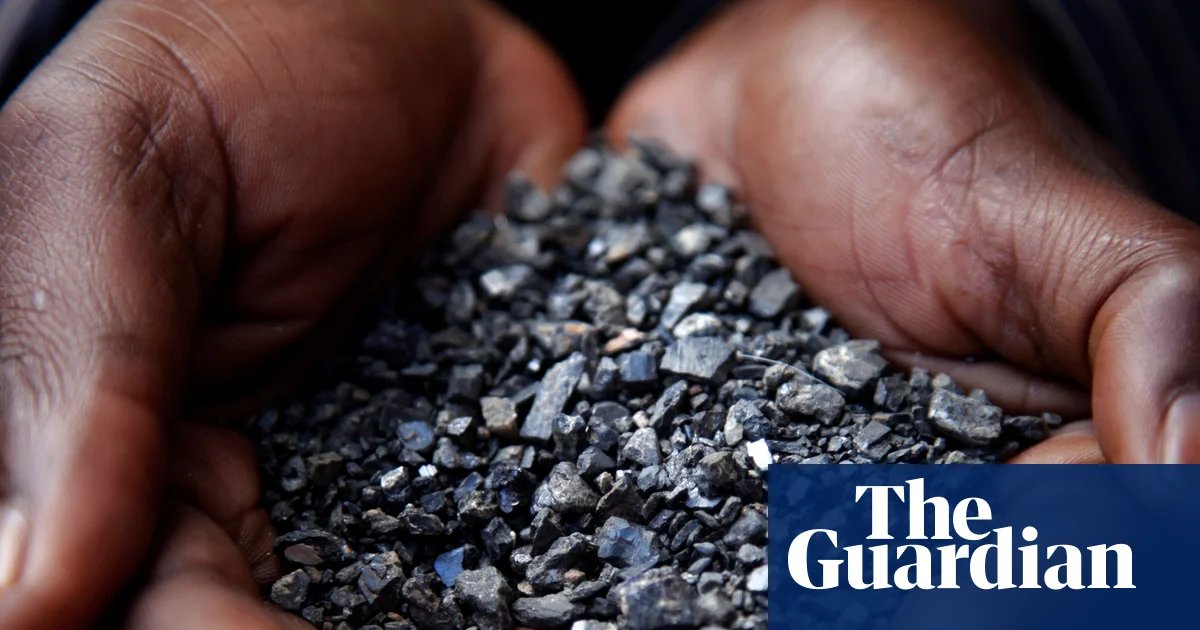
And that electric surge is reshaping the demand for raw materials. Below the Age of Electricity is an Age of Copper – and graphite, lithium, cobalt; neodymium for magnets; yttrium for smartphone screens; scandium, europium, tantalum … A kaleidoscope of rare earths and critical minerals that make the transition possible, but whose supplies across the world are limited, and increasingly jealously guarded.
If, for example, you want to build electric vehicles on a massive scale, you need batteries. And batteries, with current technologies, need lithium. World Bank projections suggest that global production of lithium must rise by 450% by 2050 to match projected demand. This is creating a bonanza for countries in the “Lithium Triangle” of Chile, Argentina and Bolivia, where 75% of known global reserves are found.
Electrical goods also need wiring. Demand for copper is already surging – but usable supply is lagging behind. Copper prices surged 20% over 2025 to all-time highs, as demand raced ahead of supply, leaving a “copper deficit” of 200,000 tonnes. This imbalance is set to worsen. S&P Global forecast a 10 million tonne “copper deficit” globally by 2040.
It is decades of patient investment and deliberate policy that has led to China being in the dominant position across essential mineral supply chains. Chinese companies control more than 50% of the globe’s refined copper production, with four of the world’s largest smelters located inside the country. Chile, which has the world’s largest reserves of the metal, produces around a quarter of the world’s unrefined copper, and about three-quarters of this is sold to China. Hefty investments in the Democratic Republic of the Congo are projected to give Chinese firms control of 46% of the world’s cobalt supply by the end of this decade. China is the dominant supplier of 19 out of 20 critical minerals surveyed by the International Energy Agency, commanding 90% of global refining capacity in some cases.
It is this, above all else, that is concentrating minds in Washington. The pressure of competition for scarce but essential resources is forcing the US to ape its geopolitical rival. State ownership has become fashionable in the land of free enterprise: the US took equity stakes in five mining and refining companies last summer, concentrated in critical minerals, and is arranging the government-backed buyout of 40% of Glencore’s cobalt-copper mines in DRC. Trump’s animosity to renewables isn’t only prejudice: the drive to “drill, baby, drill” at home, or the seizure of oil in Venezuela, is the self-interested US response to the creation of a Chinese “electrostate”.
But control of production is only part of the response. Control of existing stocks also matter, especially where there are real threats to fresh supplies. Leaks from China’s National Food and Strategic Reserves Administration last year detailed plans for the bureau, which oversees the country’s reserves of key commodities, from oil to pork bellies, to buy “cobalt, copper, nickel and lithium” and other metals. Total amounts bought, and current reserves held, are confidential, but estimates suggest that China’s stockpiles of industrial metals have ramped up significantly over years, and now come to several million metric tonnes in total. Stockpiles of non-ferrous metals were boosted after the pandemic to take advantage of a price slump, including a record purchase of 15,000 tonnes of cobalt, essential for electronics, while significant purchases over the last 12 months almost certainly contributed to rising global prices.
Japan and South Korea both maintain similar robust official metal stockpiles although on a smaller scale. Resource-poor Japan established its rare metal stockpiling system as far back as 1983, but it was China’s slashing of its own rare exports by 40% in 2010, provoking a price spike and shortages, that drove a step-change in national strategy. Dependent for more than 90% of its rare-earth imports from China, Japan both invested heavily in exploration and refining for new sources, and rapidly built up its own stockpiles. Its 2020 critical minerals strategy targets 60 days’ supply for most metals, while high-risk materials, such as those sourced from politically unstable countries, targets 180 days.
India, which has long maintained wheat and rice reserves, approved plans in January 2025 to establish its own strategic reserve as part of a national critical minerals mission. Australia announced its own version in January this year, focused initially on antimony, gallium and rare-earth metals. The European Union is urging member states to develop coordinated stockpiles, as “rising geopolitical tensions, the mounting impacts of climate change, environmental degradation, and hybrid and cyber-threats” imperil the bloc’s supplies.
When the US announces, as it did last week, that it will be investing $12bn (£9bn) in building a “strategic minerals reserve”, with the first depot at Hawthorne army base, Nevada, it is responding to the same logic. When it signs reams of critical mineral deals with other countries to create Vance’s “trading bloc”, it is scrabbling around for security in a world where championing free trade no longer hands it an automatic advantage.
Nor are the threats to supplies only from other states. The natural world is a growing source of instability. Summer 2024 was one dramatic version of this when Spruce Pine, a mining town of 2,000 in North Carolina that also happens to be the world’s primary source of ultra-high quality quartz for semiconductor production, was battered by Storm Helene, closing its mines. For a few days, the world’s silicon chip production hung in the balance. PwC estimates that 70% of the world’s production of copper, cobalt and lithium will be at risk of drought over the next few decades; already, water-intensive copper mining and refining operations in Chile have been hit by the country’s mega-drought.
The rush to hoard precious metals is not the action of states secure in the knowledge that a vast, globalised market will always be ready to supply whatever is needed. This is what states do when they realise resource pressures are real – and other states have an incentive to carve them out. It’s a world of state versus state competition, on behalf of their national businesses. One tonne of copper stockpiled in Nevada is a tonne that can’t be used in Shenzhen, and vice versa. This is the new, zero-sum logic of the global shortage economy.

Leave a Reply