
This year, School of the Environment marks 125 years since founding
Paul-Alexander Lejas
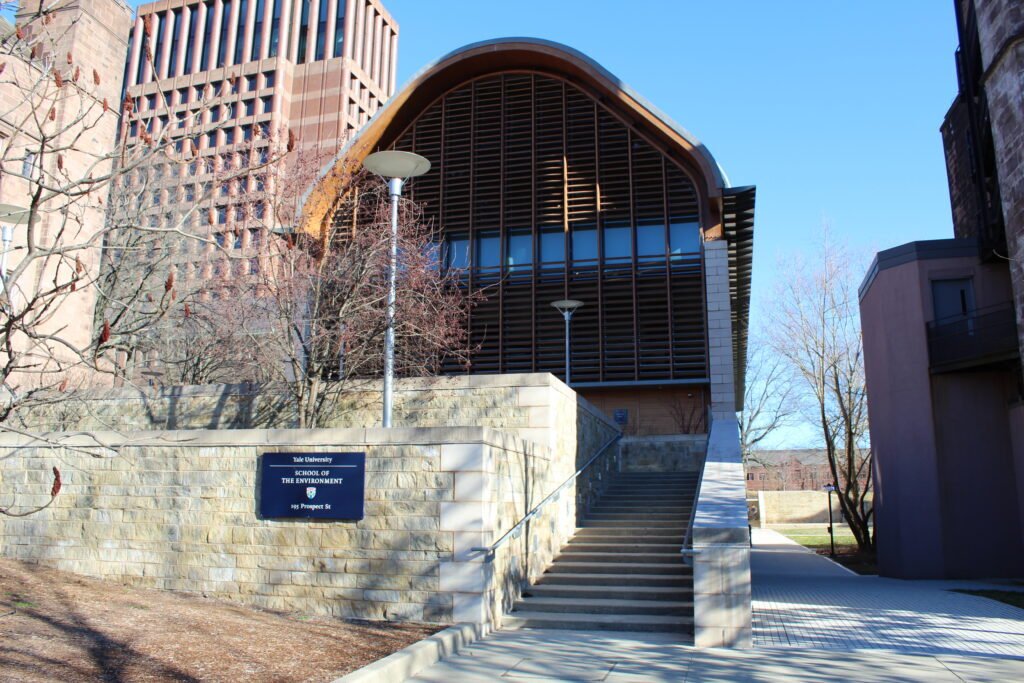
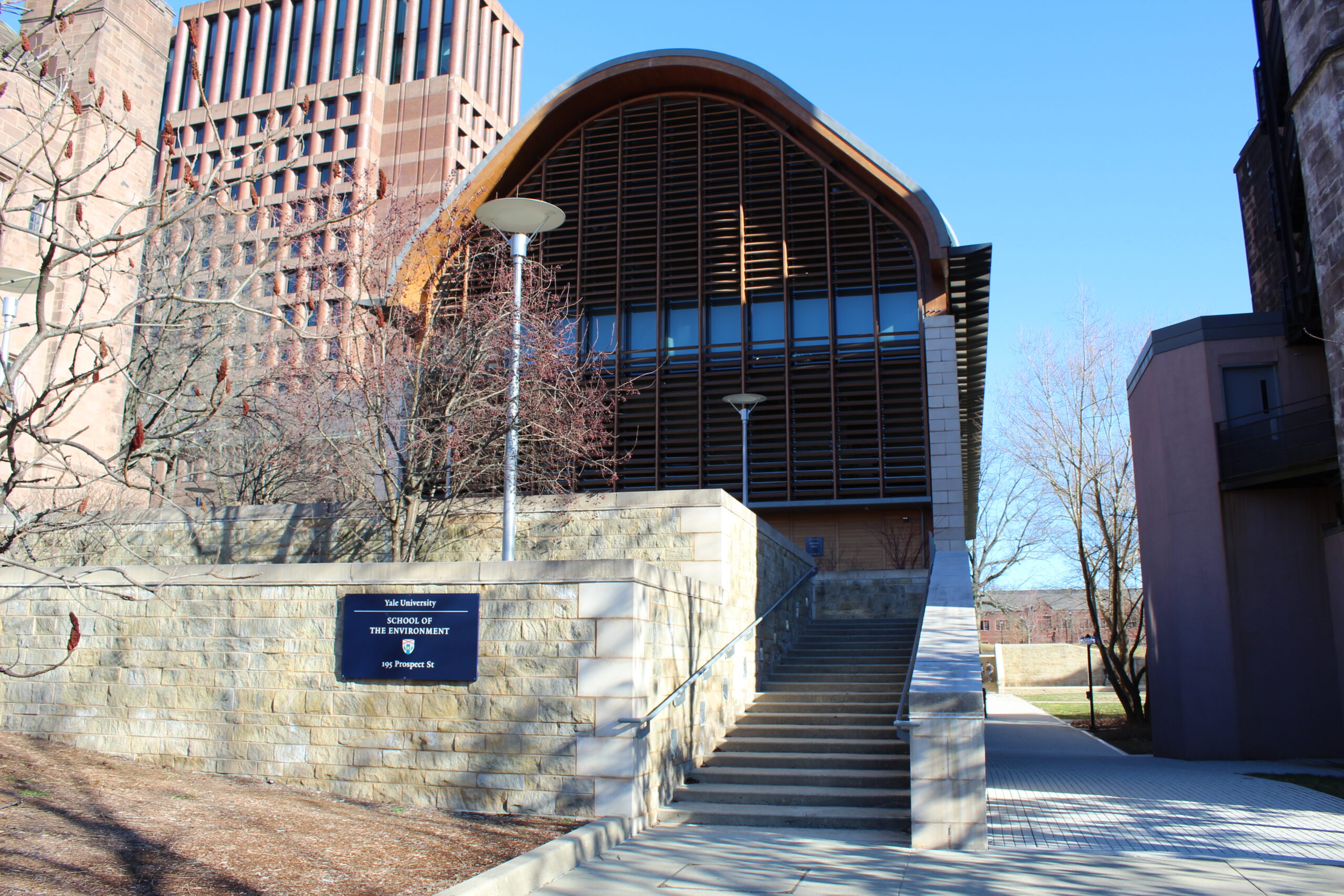
Great Quercus rubra red oaks felled from the Yale Forests form the foundation of Kroon Hall. Their beams and planks, tight with grain hardened by the elements, are one of many natural materials collected from Yale’s sustainable forests.
The building, home for students of the Yale School of the Environment, has become an incubator for the very hands that return to care for the forests and their trees — a cycle of stewardship has continued since the school’s founding in 1900.
For 125 years, the Yale School of the Environment has educated foresters, conservationists and environmental stewards. Over 5,800 graduates have been with the school from its founding as The Yale Forest School to the rooms of Kroon Hall today.
“Commemorating our 125th Anniversary over the past year has been a source of inspiration and hope for all of us who care deeply about the environment and our school community,” environment school Dean Indy Burke wrote to the News in an email. “It has given us the opportunity to reflect on the scope of our impact — with YSE alumni holding environmental leadership positions in 80 countries around the world — the resilience of our community, and, perhaps most importantly, the urgency of the work ahead.”
Terry Baker ENV ’07, the president of the school’s Alumni Association Board, attended the school’s reunion weekend from Oct. 24 to 26 and described the events as “inspiring,” especially upon seeing the class of 1975 celebrating their 50th graduation anniversary.
“It was great to see familiar faces and meet new alumni and current students. As we all shared experiences, it highlighted our shared passion for this work and how YSE connects us to an aligned goal of a healthier planet and communities,” Baker wrote in an email to the News.
History of the school
On Sept. 29, 1900, the News reported the creation of the School of Forestry. The original school was established through a gift from James Pinchot and was led by his son, Gifford Pinchot, class of 1889, the school’s first president.
The original school consisted of seven students and a two-member faculty, and operated within professor O.C. Marsh’s former residence. The school later moved to Sage Hall on 205 Prospect St. in 1923 with a generous $300,000 donation from William H. Sage, class of 1865, the News reported at the time.
When the school celebrated its third decennial reunion from Feb. 21 to 22, 1930, the News recounted some figures related to the school, including its collection of 30,000 forestry-related volumes, 1,300 acres of Yale Demonstration and Research Forest and a recent donation by George H. Myers of 8,000 acres which would go on to become the Yale-Myers Forest.
In 1972, the Yale Forestry School changed its name to the Yale School of Forestry and Environmental Studies to reflect its broader course offerings and transition away from focusing strictly on forestry.
At its 100th year, the school had 270 students, a third of whom represented over 20 different countries.
Dean James Gustave Speth ’64 LAW ’69 told the News in 2000, “The world keeps changing. Today we need to address energy and climate change, deforestation and biodiversity loss, and new areas such as trade and international development.”
Alumni reflect on time at Yale
Bryan Garcia ENV ’00 came to YSE after serving in Kazakhstan with the Peace Corps for two years, he said. He is now the president and CEO of the Connecticut Green Bank, which works with private sector disciplines to support the green economy and achieve public sector goals.
“I entered as an environmental education interested student, and I left as a multi-disciplinary thinker who was prepared to confront environmental problems through the lens of government and business,” Garcia said in an interview.
Garcia estimates that 90 percent of his classmates felt like “the world was coming to an end.” But, what gave him hope “were the optimists that were the 10 percent of the class.” He felt particularly inspired by professor Steven Kellert GRD ’71 who emphasized the importance of leaning into the humanist perspective and human relationship with nature.
In the years since graduating, Garcia returned to Yale from 2007 to 2011 as the program director for the Center for Business and the Environment. He continues to believe that his Yale degree has held him to higher standards, he said.
“One of the many great things of the School of the Environment is its diversity, in gender, in race, you know, in every discipline and bringing all of that into a learning environment where everybody gets to learn from each other,” Garcia said. “Then, you are motivated and inspired by guests who come in and speak, your colleagues, who have their own shared experiences, and all of those things reinforce your education and what you get from it.”
Charissa Leising ENV ’13 came to the school as a conservation biologist but transformed her knowledge into studying industrial ecologies, she said. Her post-graduation career has taken her through electronics recycling at Apple, grocery chain sustainability at Albertson’s and material recovery with the Fijian government.
“You have some of the most diverse and creative, innovative thinkers. My classmates while I was there, I continued to learn a lot from them,” Leising said in an interview. “I’ve talked to plenty of my friends, other alumni, about their experience and their thoughts, even on the silly side. It’s really kind of those lifelong connections that you make and kind of the diversity of thought.”
Leising also credits her classmate Ben Goldfarb ENV ’13 for helping her land her first internship with clothing brand Patagonia — an opportunity that she said helped launch her into the rest of her career in corporate sustainability.
“You’ll never again get to be in a place that’s just so rich culturally with knowledge and history and everything,” Leising said. “Just take advantage of, kind of the breadth of what Yale University has to offer.”
Kroon Hall was opened in 2009 and uses 50 percent less energy than a similarly sized building, according to a press release issued at the time of the opening.
(function(d, s, id) {
var js, fjs = d.getElementsByTagName(s)[0];
if (d.getElementById(id)) return;
js = d.createElement(s);
js.id = id;
js.src = “//connect.facebook.net/en_US/sdk.js#xfbml=1&version=v2.3”;
fjs.parentNode.insertBefore(js, fjs);
}(document, ‘script’, ‘facebook-jssdk’));