
UConn Health Offers New Level of Precision in Cancer Care
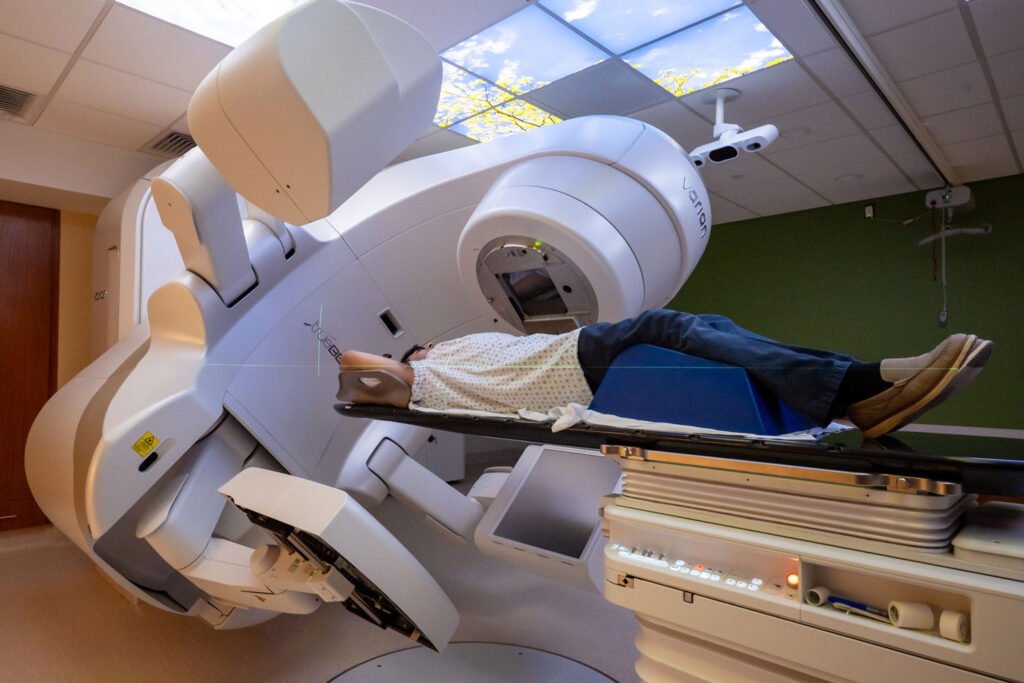
Advanced radiotherapy with unprecedented levels of safety and accuracy is now available to patients at UConn Health’s Carole and Ray Neag Comprehensive Cancer Center.
Radiation therapy technologists have been using the TrueBeam Linear Accelerator, on par with leading cancer centers throughout the world, since late February.
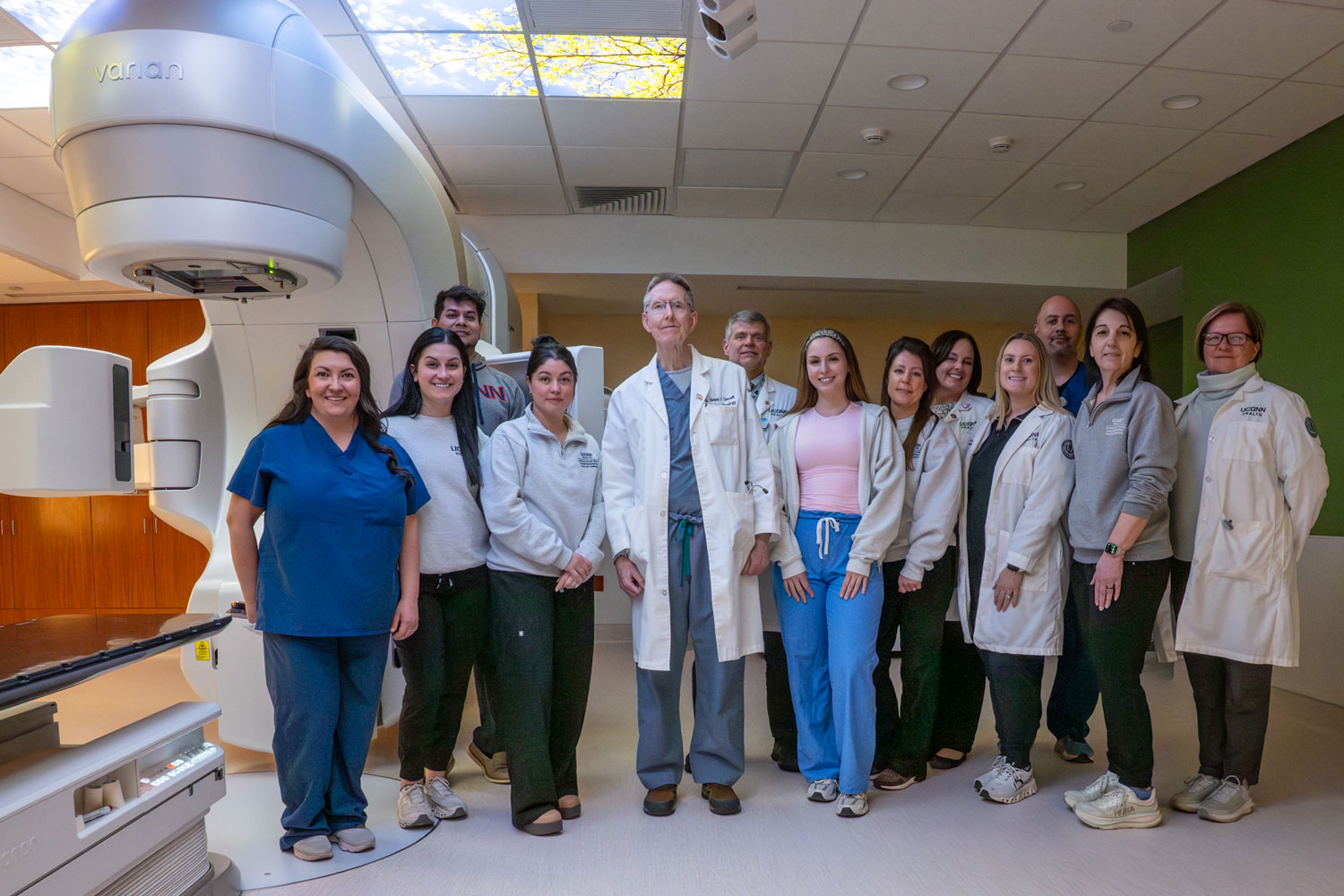
“It’s a fully integrated system with sub-millimeter accuracy and real-time, on-demand imaging capabilities, promising improved clinical outcomes for our patients with breast, prostate, lung, and brain cancers, among other diagnoses,” says medical physicist Doug Boccuzzi.
The patient lies on a table and the technology moves around him or her, controlled from an adjoining room, delivering pinpoint doses of radiation to the target tissue, minimizing exposure to surrounding tissue.

“The image guidance, meaning our imaging during treatment to make sure we’re in the right spot, is much better, so the quality of the image guidance is way better,” says Dr. Robert Dowsett, chief of UConn Health’s Division of Radiation Oncology. “In addition, the actual accuracy of the machine is sub-millimeter, which means when we’re doing very fine work, we can be confident that what we think we’re hitting we’re actually hitting accurately. It’s just a really streamlined, very easy-to-use machine, very efficient. Our other machine’s quite good, but this is actually a leap up.”
Dowsett points out that a necessary design element of the machine is weight distribution of its heavy components while it rotates around the patient, enabling it to maintain its accuracy regardless of the angle.
“For the patient, the elements of automation, robotic features, and surface-imaging guidance provide speed and accuracy for a more comfortable and high-quality patient experience,” Boccuzzi says.
Fellow medical physicist Holly Lincoln says the TrueBeam also enhances patient safety by reacting to patient movements.
“It automatically stops treatment delivery in order to allow for adjustments to the patient position and will only resume treatment once the patient is properly aligned, ensuring the radiation is delivered only to the location that is intended,” Lincoln says.
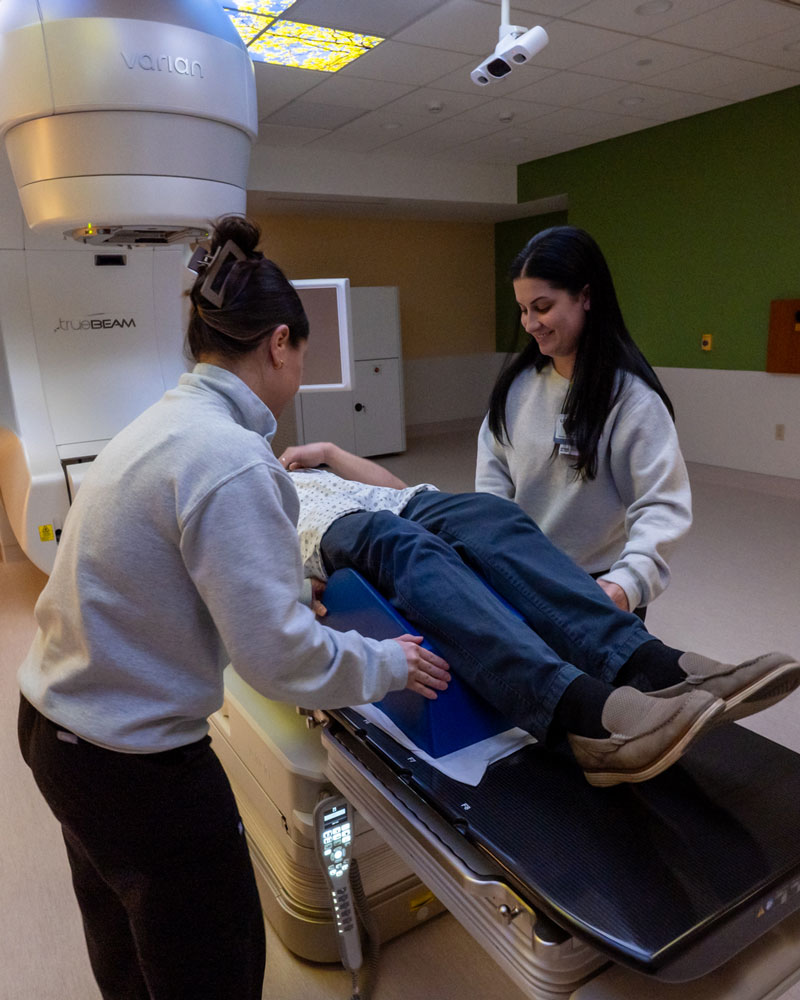
The technology is conducive to individualized treatments. Some patients may use it daily for a series of lower doses, some may come in weekly over the course of several weeks, or it could be a single treatment with a high dose. For most treatments, the patient is on the table for 15 to 25 minutes.
Radiation therapy can be an early step in someone’s cancer care, such as when the initial diagnosis is brain metastasis, or it could come later on, following surgery and months of chemotherapy for breast cancer, for example.
“It’s extremely versatile, but typically we’re treating prostates and some breasts, but what we’re most excited about is very fine brain work,” Dowsett says. “We’re treating brain metastasis with very small radiation fields, for instance, or even arterial venous malformations, which are benign things we try to close up. Anything that precision is required, we would definitely put on this new machine.”
Patients generally find their way to radiation oncology through a neurosurgeon, medical oncologist, or surgical oncologist. The TrueBeam technology is common at major cancer centers, and this is the latest version of the machine, but Dowsett says it’s just part of the larger picture of cancer care at UConn Health.
“The decision to come here I think is because of the holistic approach we have; we have excellent medical oncology, excellent surgery, and excellent radiation,” Dowsett says. “This is a compliment to an excellent cancer program. It shows an incredible investment by the University and the hospital in keeping with up-to-date technology. They’ve invested in a beautiful facility. We have outstanding staff and they have to have tools to work with, and I think this is an excellent machine for that.”
Learn more about the Division of Radiation Oncology in UConn Health’s Carole and Ray Neag Comprehensive Cancer Center.