
When America went to war with Iran last month, the U.S. military faced an enemy using mass-produced drones to deadly effect.
The same weapons have been used for years in Ukraine – some of them supplied by Iran to Russia. Unmanned and remotely-controlled, drones have transformed the Ukrainian battlefield. They’re estimated to inflict around 80% of combat casualties on both sides.
The technology is nothing short of revolutionary – and it’s evolving rapidly. As we discovered, to adapt to the new era, the U.S. military is learning lessons from Ukraine.
Forget everything you think you know about warfare. The traditional front line in Ukraine has expanded to a roughly 10-mile-wide strip called the kill zone. Anyone who sets foot there can be spotted by a drone operator – and hunted down. This was a narrow escape for some Ukrainian soldiers. They call these Frankenstein Tanks – retrofitted with cages and mesh to deflect drone strikes. Netting covers roads close to the front – designed to catch them before they hit their target. To evade interference from electronic jammers, both militaries launch drones attached to miles-long spools of fiber-optic wire – leaving behind a digital spider’s web.
But the drones are not just in the air.
Holly Williams: Continuously innovating
Scout: Yes
Beside a frozen lake, Ukraine’s security service took us to see one of their most treasured weapons.
Holly Williams: It looks a bit like a fishing boat, Scout. That’s an outboard motor?
Scout: Yeah, yeah.
60 Minutes 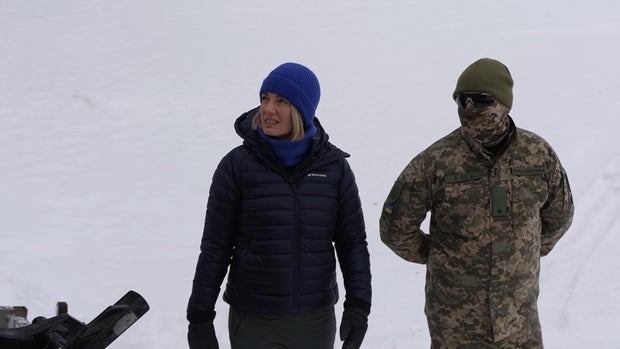
It’s a sea drone, developed in Ukraine, called Sea Baby. We’re protecting this operator’s identity because he’s a target for Russian assassination.
Holly Williams: What’s the payload on this?
Scout: It currently will take 2000 kilograms.
Holly Williams: 2000 kilos of explosives. Is that enough to take out a Russian warship?
Scout: Yes.
Produced for around $300,000, Ukrainian sea drones have destroyed warships that cost tens of millions. Ukraine says it’s used them to sink or disable 11 Russian vessels.
Holly Williams: Which one is more useful: a warship, or a sea drone like the Sea Baby?
Scout: Sea drone, I think. It’s really hard to destroy these drones because they are smaller. That’s why to have like ten ships like this is much better than having one big one.
Holly Williams: Wow. To be clear, you’re saying you’d rather have ten sea drones than a warship.
Scout: Yeah.
Oleksandr Kamyshin: Necessity is the mother of invention.
Oleksandr Kamyshin started out the war as the CEO of Ukraine’s railways. He was so good at his job – helping millions of Ukrainians to evacuate – that President Volodymyr Zelenskyy recruited him to become the architect of Ukraine’s drone program.
Oleksandr Kamyshin: Cheap, fast, efficient.
Kamyshin told us he helped boost Ukraine’s production from 2,000 drones a year to 4 million. For the outnumbered Ukrainians – the inexpensive new technology has allowed them to level the battlefield.
Oleksandr Kamyshin: It’s a data driven war, with big numbers. It’s a numbers game.
Holly Williams: What do you mean by a numbers game?
Oleksandr Kamyshin: We have to count everything. We have to count number of drones we use, efficiency of each of them, cost to kill for every Russian.
Holly Williams: And what is the cost of killing every Russian?
Oleksandr Kamyshin: You would be surprised, but the cost of killing every Russian is less than $1000 now. That’s why they send so many people to die on the front line. They don’t count them. They don’t value them.
Holly Williams: Would you want to be in Vladimir Putin’s shoes right now?
Oleksandr Kamyshin: No. Strategically he lost. He wanted us to become weaker; we became much stronger.
60 Minutes 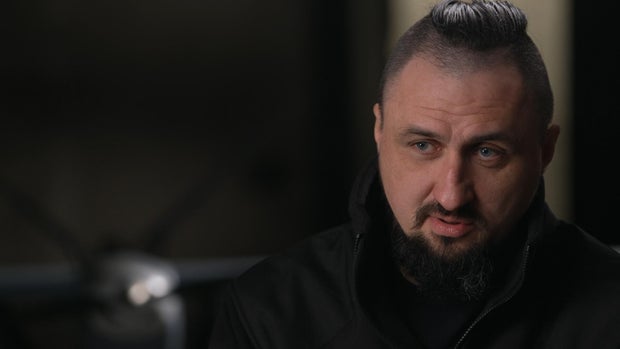
Ten retired U.S. generals told us they agree that Russia isn’t winning the war – despite its territorial gains. Some cautioned that Ukraine isn’t winning either – but with the help of drones, has managed to draw Russia into a stalemate.
Holly Williams: This is like a kind of obstacle course for drones…
Ukraine’s military has set up drone training academies to teach the new technology and the rapid shifts in tactics that come with it.
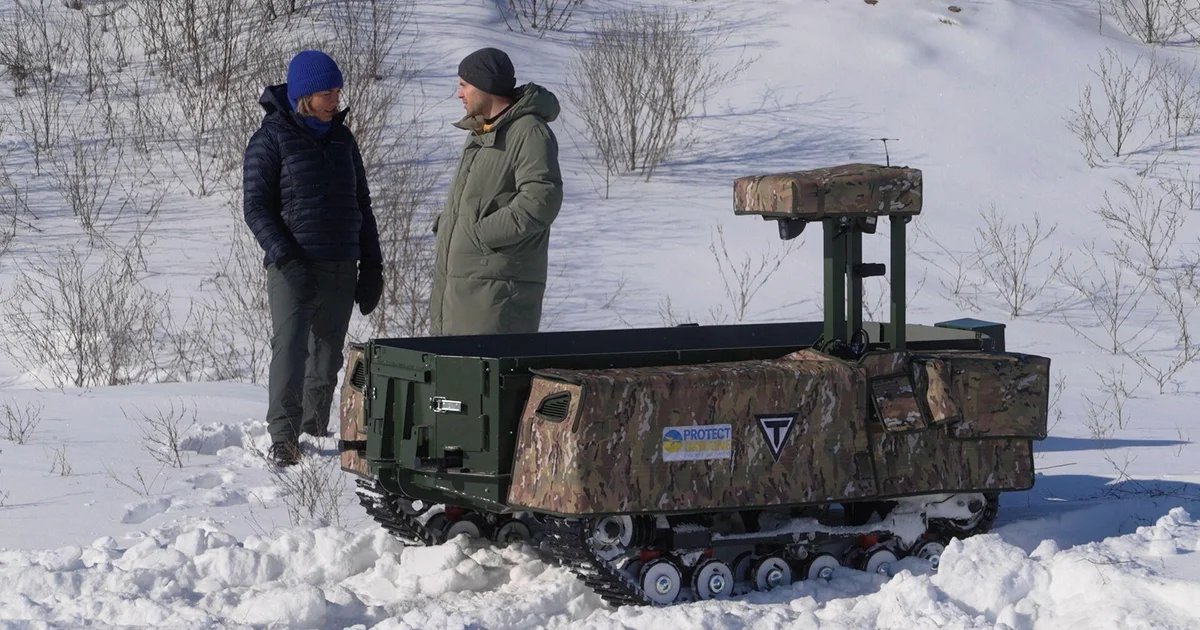
This ground drone mounted with a .50 caliber machine gun recently held off a Russian attack single-handedly for 45 days straight. In January, three Russian soldiers surrendered to a similar robotic drone.
Roman Tkachenko: Our main idea, we can send the robot and to not risk with a human life. So for us, it’s a human life is most important.
Ukraine says it makes more than 95% of its own military drones – harnessing talent from some unusual places. Roman Tkachenko is a former brewery engineer who founded a company called Tencore – and developed these remote-controlled, armored evacuation drones to transport wounded soldiers. They gave us a demonstration at a military training ground – and claim the drones have saved hundreds of lives.
Holly Williams: How do you figure out what your next design needs to be?
Roman Tkachenko: We are working with the end users.
Holly Williams: End users…That means the soldiers who are on the front line?
Roman Tkachenko: Yeah.
Holly Williams: The soldiers said we need a drone to do evacuations and you built it.
Roman Tkachenko: Yep. That’s how it works in Ukraine. We are designing for soldiers.
The same drone base can be adapted to mount a 40-mm grenade launcher – controlled from a bunker which could be hundreds of miles away.
Holly Williams: When it comes to drones, how quickly is the technology changing?
Oleksandr Kamyshin: Innovation cycle is roughly one week. It means from the point you send a drone to the front line, get the feedback, change something, and get the new version, it could be as short as one week.
Holly Williams: Are the Russians also innovating?
Oleksandr Kamyshin: Yes. Definitely. We have to admit it.
Holly Williams: Who has the edge?
Oleksandr Kamyshin: At this point, I would say that it’s equilibrium.
Equilibrium in a drone arms race – and both sides will take any help they can get.
Airlogix makes aerial surveillance drones for the Ukrainian military. Their production’s spread across more than 20 sites to minimize risk – because they’ve already been bombed twice by Russia.
It’s a dangerous business – but the company recently secured over a million dollars from an American investment fund that specializes in Ukrainian drone technology. It’s run by two former U.S. Marines: William McNulty, who has a background in humanitarian work; and Lenore Karafa, who built a career in finance after leaving the military. They told us their investors are wealthy individuals who support Ukraine.
60 Minutes 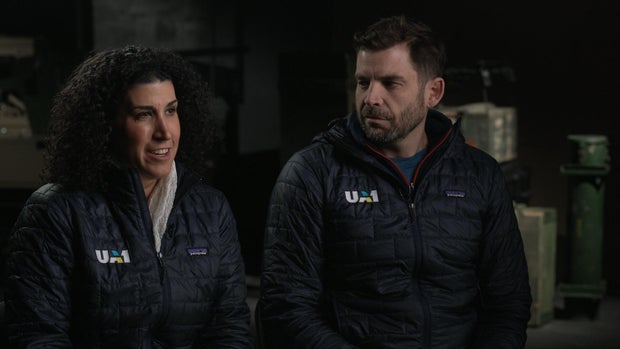
Lenore Karafa: I worked at one or two jobs after the military that were more about the money than anything else… that is not my main motivation.
William McNulty: You didn’t join the Marines for the money?
Holly Williams: What’s your main motivation?
Lenore Karafa: Service, patriotism, democracy, mission.
Holly Williams: And Ukraine ticks all of those boxes?
Lenore Karafa: It ticks all of those boxes.
William McNulty: I fell in love with the Ukrainians when I arrived. How could you not? And how can you not just come to help the people that are literally fighting for what NATO was created for? To stop Russian aggression.
At a NATO training exercise in Estonia last year, the alliance tested its vulnerability against drones. Around a thousand NATO personnel were defeated in the drill by a group of drone operators – some of them Ukrainian.
Holly Williams: Is this a revolution in warfare?
Lenore Karafa: It is.
Holly Williams: No question in your mind?
William McNulty: No question.
Lenore Karafa: No question. In every war – like – there is innovation from, going from horses to tanks to machine guns, and then tactics evolve in response to that. And that is why it’s just incredibly important for the US, for our European allies, to learn these lessons from Ukraine.
William McNulty: There’s a real risk that the U.S. would lose its military supremacy if it doesn’t adapt to modern conditions on the battlefield. We’re going to be going up against these same unmanned systems that Russia is using against Ukraine.
The U.S. military told us it intends to hang on to its supremacy – not by buying, stockpiling or replicating Ukraine’s drones – but by tapping into the same passion for innovation the Ukrainians have. At the Wiesbaden Garrison in Germany, “The Forge” is one of dozens of drone innovation labs set up by the U.S. military around the world. Any service member with an idea – or just an interest – can request to spend time in one of the labs.
60 Minutes 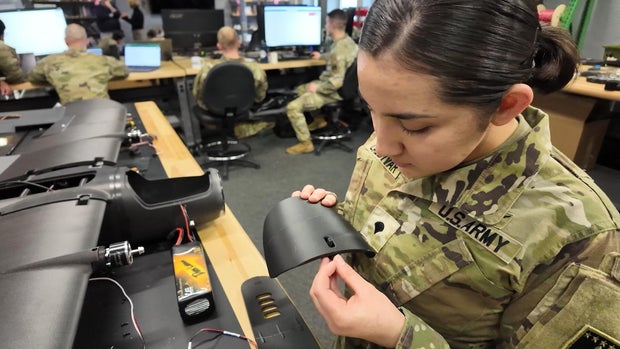
Ronan Sefton: It’s adding a culture of innovation. And that’s new. That’s not something that we’ve really seen in the last 20 years.
Holly Williams: Is it possible that a soldier will walk into one of those innovation labs with an idea that could be a breakthrough in drone technology?
Ronan Sefton: It’s entirely possible. The thing with drones and innovation is what I would describe as unlimited innovation potential. If you can think of it, you can make a drone do it.
Capt. Ronan Sefton was first deployed to Germany with the Army’s 2nd Cavalry Regiment – not long after Russia launched its invasion in 2022. His job was to give basic training to over 8,000 Ukrainian soldiers. But he told us, almost immediately, the Americans began learning from the Ukrainians.
Ronan Sefton: The first really poignant lesson for us was, there needs to be more drones. They need to be everywhere involved in the training to add to the realism.
Holly Williams: So the Ukrainian soldiers were giving that to you as feedback?
Ronan Sefton: Absolutely.
Holly Williams: Did you then talk to your commanding officers about it?
Ronan Sefton: We went to every senior commander we could. The thing that we wanted to communicate was, “This is important, it’s changing warfare, and here’s how we can actually implement it now.” “We’re already doing it, we should scale this.”
The message got through – and now Sefton’s joined the Army’s Ukraine Lessons Learned Task Force. It has the job of translating experience from Ukraine’s scrappy fighting force to America’s sprawling military. He told us the new technology does not make the U.S. military’s traditional firepower obsolete – but it needs to adapt, urgently, countering the drones developed by America’s adversaries.
Holly Williams: You still need Howitzers, you still need Abrams. But you have to figure out how to get the drones to work with the Howitzers and Abrams.
Ronan Sefton: Exactly. And that’s the challenge, but also the goal – to become ready for the next conflict. We see it with the armed forces of Ukraine. They have learned these lessons through blood. There will of course be additional lessons that we will learn, perhaps through blood. But it will only make us better at what we already are.
The day after that interview, the United States went to war – and the Iranian drones began flying. The first Americans killed in the conflict were targeted with a drone. The U.S. military is now learning its lessons in blood, just as Ukraine did.
Produced by Erin Lyall. Field producer, Oleksandr Churkin. Associate producer, Georgia Rosenberg. Edited by Sean Kelly.