Will the Dickerson data center project impact MoCo’s environment?
Editor’s note: This is the second of a two-part series on data centers in Montgomery County. Part one, which was published April 6, 2026, explains why a data center developer is planning to build a campus in Dickerson.
On a sunny mid-March day in Dickerson, the high-pitched croaking of frogs fills the air during spring mating season in the C&O Canal National Historical Park while ducks and geese paddle in the adjacent Potomac River.
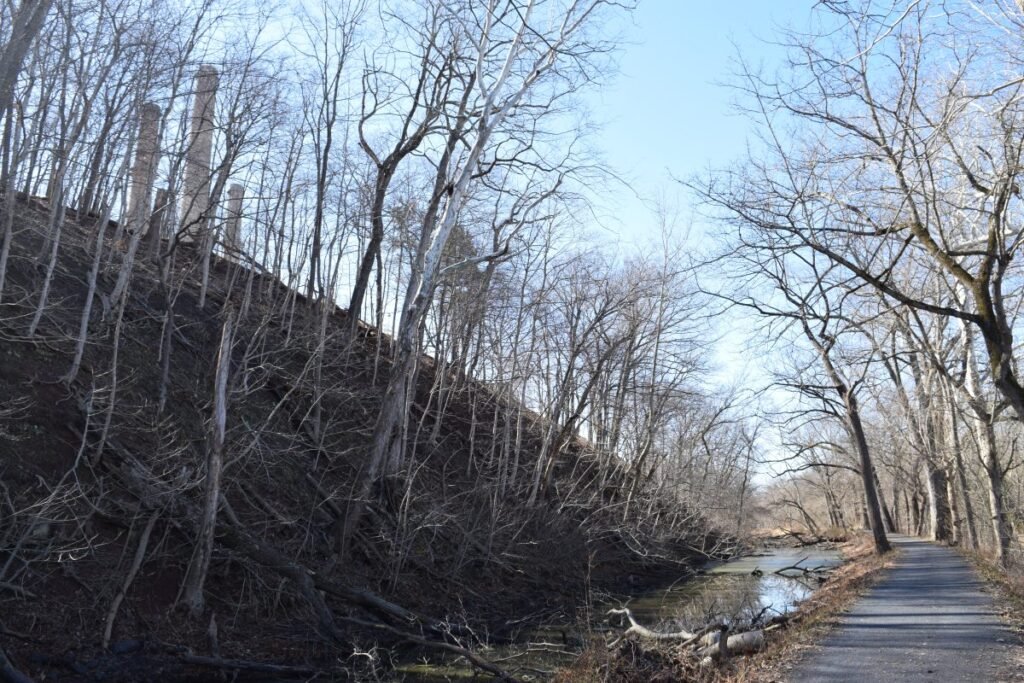
About 1,000 feet east and beyond a hill overlooking the park sits the site where California data center developer Atmosphere Data Centers is planning to construct a 110-acre data center campus. The parcel is among 700 acres on Martinsburg Road owned by Terra Energy, a Florida-based company, that also includes a decommissioned coal-fired power plant – its smokestacks a reminder that fossil fuels were burned there to provide energy.
Growing regional concern over the power needs of data centers has put Atmosphere’s plans squarely in the spotlight — though a data center proposal for the site has been in the works for years. Terra Energy filed an initial application to build a data center campus within the site of the retired coal-fired power plant in December 2023, county records show.
Montgomery County Councilmember Marilyn Balcombe, whose District 2 includes the area, notes that Terra Energy had been in talks with Upcounty civic and environmental groups about a possible data center campus in Dickerson since before she joined the council in December 2022.
Now, however, local officials and environmentalists are sounding the alarm about possible environmental and climate impacts of the Dickerson data center and others that could be built in the county – with County Councilmembers including Balcombe pushing for stricter rules governing the facilities and some community members suggesting a temporary moratorium on construction.
Local activists, including Mike Tidwell, founder and director of the Takoma Park-based advocacy group Chesapeake Climate Action Network, are calling for the data center campus and all future data center projects in the county to be run entirely on renewable clean energy.
Atmosphere has not committed to running the 360-megawatt campus on clean energy — and that disappoints Tidwell.
The data center campus would run on electricity from the regional power grid, and power would be supplied by FirstEnergy transmission lines that border the site, according to Atmosphere. Construction of the campus would require additional on-site electrical infrastructure, such as a substation and a switchyard. There are no plans to use renewable energy sources to power the campus.
“Without a clean energy commitment … this one data center in Montgomery County will emit 1 million tons of carbon dioxide per year,” Tidwell said, noting that much carbon dioxide is the equivalent of adding 200,000 gasoline-powered cars onto county roadways every year.
-

A turtle basks on a log in the C&O Canal in Dickerson. Photo credit: Elia Griffin -

The C&O Canal National Historical Park runs parallel to the Potomac River and the former site of the decommissioned Dickerson coal-fired power plant. Photo credit: Elia Griffin -

The C&O Canal National Historical Park in Dickerson. Photo credit: Elia Griffin
“It will literally blow up the county’s climate goals,” he said, referring to the county’s 2021 Climate Action Plan. The initiative aims to cut greenhouse gas emissions 80% by 2027 and 100% by 2035, and improve resilience to climate change.
That’s why Angie McCarthy, a Marylanders for Data Center Reform member and a Maryland conservation advocate for the Chevy Chase-based Nature Forward (formerly known as the Audubon Naturalist Society), joins other local advocates in encouraging Atmosphere to use batteries for backup energy storage and as an alternative to the diesel generators Atmosphere has proposed.
“Data centers need 24-hour access to the grid … [and] because of their voracious need for energy, a lot of our options often are posed as … we need to develop more natural gas and coal power. But we have seen in other states and through other localities that that is simply not the case,” McCarthy said.
Ben Mann, a Bethesda resident who leads real estate broker Cushman & Wakefield’s data center capital markets practice in the greater D.C. area, told Bethesda Today that those who call for hyperscale data centers to use batteries rather than generators for backup power underestimate the sheer number of batteries that would be needed keep the facilities running in the event of an outage.
“There’s not enough lithium in the world to build all these batteries,” he told Bethesda Today in a Feb. 27 interview.
Atmosphere says on its website that it develops and operates the “greenest and most energy-efficient data centers on Earth,” with a focus on sustainable technologies and advanced cooling systems. Atmosphere CEO Chuck McBride said the company was “founded specifically to rethink how data center campuses are designed and powered,” and its mission is centered on building campuses that “prioritize energy efficiency, advanced cooling systems, and lower overall environmental impact.”
Still, the company plans to use diesel generators as backup power for the campus, raising red flags for environmental advocates because of the carbon emissions and air pollution they produce. Those emissions also are associated with public health risks such as asthma, heart disease and cognitive decline, they say.
According to Atmosphere, all of the diesel generators that will power the data center campus during a potential emergency power outage will have emissions control technologies. Those technologies include selective catalytic reduction and diesel particulate filters.
Kevin Walton of Climate Coalition Montgomery County, a network of local organizations and individuals dedicated to addressing climate change, said advocates are not opposed to data center development but want to ensure that such facilities are constructed “in a manner appropriate for the site and for residents.”
-

Smokestacks from the decommissioned Dickerson coal-fired power plant can be seen from the C&O Canal towpath. Photo credit: Elia Griffin -

The C&O Canal towpath passes by an entrance to the Dickerson coal-fired power plant site. Terra Energy owns the property and is in charge of the future of the power plant infrastructure. Photo credit: Elia Griffin -

An entrance to the former GenOn Dickerson Generating Station at 21200 Martinsburg Road. A posted sign indicates there is a forest conservation plan application pending for the site. Photo credit: Elia Griffin
He’d like to see the facilities run on renewable energy, especially for backup power, and handle power demand responsibly.
“We hope that if [data centers] can be more flexible, then it won’t necessarily cause an increase in power costs,” Walton said, noting concerns that the electricity demands of data centers are driving up costs for Maryland residents.
The proposed Dickerson data center development, Walton added, also could pose an issue for recreation on the C&O Canal, and that would be a topic advocates need to “pay attention to” as the project continues.
McBride noted to Bethesda Today that the C&O Canal park is “not adjacent” to the proposed data center campus, which is northeast of the Potomac River. The project “will comply with all applicable environmental regulations and permitting requirements designed to protect surrounding natural resources and wildlife,” he said.
Impact on water resources
Caroline Taylor, executive director of the Montgomery Countryside Alliance, said she has been talking since 2023 with Atmosphere and Terra Energy. Based in Poolesville, the alliance advocates for the residents and farmers of the county’s Agricultural Reserve, a mostly northern portion of the county protected for agricultural uses.
One of Taylor’s key concerns about the Dickerson data center project has been its impact on water resources in the region. With Atmosphere’s plans to draw from the Potomac River for cooling, she’s no longer as concerned about the Piedmont Sole Source Aquifer, a federally designated groundwater source that provides water to wells at homes and farms, including in the Agricultural Reserve.
“For us in the Ag Reserve, in this western part of the county, the only place we get our water is from the ground,” Taylor said, noting she is still concerned about how the project’s water intake could impact the river’s ecosystem.
According to McBride, Atmosphere’s campus would use an average of 69,300 gallons of water daily for cooling. Usage would be lowest in cold weather and highest when air temperatures exceed 75 degrees.
The proposed maximum daily allowance for the campus would be 500,000 gallons, while the coal-fired power plant used up to 400 million gallons per day, according to McBride. Atmosphere has submitted water withdrawal and discharge permit applications to the Maryland Department of the Environment, aiming to be in “full compliance with county, state and federal environmental regulations,” the company says in a fact sheet about the project.
Experts are working to determine the impact of the proliferation of data centers on the Potomac River Basin and water demand.
The Interstate Commission on the Potomac River Basin, a compact that conducts research and deals with water quality and quantity issues, released a study in March about data centers and water use in the Potomac River Basin. “While future data center growth and its associated water demands remain uncertain, it could place significant pressure on regional water supplies, potentially requiring substantial infrastructure investment to maintain system reliability,” the study notes.
The Potomac River Basin – a watershed that stretches across Maryland, Pennsylvania, Virginia and West Virginia – is home to one of the largest concentrations of data centers in the world to date, according to the report. Those facilities primarily draw their water from public utility suppliers — not directly from the Potomac River. However, the river itself provides 75% of water supply for the region’s three primary utilities – including WSSC Water – that serve 5 million people, according to the report.
Commission Director of Communications Renne Bourassa told Bethesda Today in March that despite long-standing drought conditions in the basin, the Potomac River is “healthier than it has been in decades,” with data showing improvements to water quality — despite the January Potomac Interceptor collapse and sewage spill near Cabin John.
Bourassa said the commission is recommending “more transparency” from data center developers about their water use.
Rallying for ‘clean’ data centers
Meanwhile, local activists and some officials continue to call for clean energy data centers.
Ahead of a March 13 county executive candidate forum at the Silver Spring Civic Building and hosted by WAMU’s Politics Hour with Kojo Nnamdi, about 60 environmental advocates rallied outside on Veterans Plaza, chanting, “Hey, hey! Ho, ho! Dirty data centers have got to go!” and carrying signs that read, “NO dirty data center, YES 100% clean energy.”

County Councilmembers Andrew Friedson (D-Dist. 1) and Evan Glass and Will Jawando (both D-At-large) spoke at the rally, expressing their support for the clean energy goal. The three are seeking the Democratic nomination for county executive in the June primary.
During the rally, Glass said he was disappointed his recent bill to create a task force to study the benefits and drawbacks of potential data centers in the county failed to make it past a council committee. But he was determined to convince his fellow lawmakers to put a pause on data center development to “get this right.”
“The fight is not stopping. We are going to make sure that whatever happens here in Montgomery County, we get it right because we see what’s happening down in Loudoun County across the Potomac” River, Glass told the crowd.
Loudoun County, a Northern Virginia jurisdiction known as the world’s densest data center hub, is home to tens of millions of square feet of data centers, earning it the nickname Data Center Alley.
Friedson told the crowd he sees an opportunity to approach the coming of data centers the “right way” by creating local regulations for the industry that “lead by example.”
“The new technological revolution is coming, and rather than just fighting it … we can make sure that when it happens … that we are shepherding in a new generation of clean energy,” Friedson said.
Jawando agreed.
“We’re not against innovation. We’re not against technology. But we are for clean energy,” he told a cheering rally crowd. “We don’t need to be first in this race to the bottom. We need to be right. … We don’t have to rush into it. There’s no rush,” he said.
-

Environmental advocates are demanding the Dickerson data center to be run on 100% renewable, clean energy. Photo credit: Elia Griffin -

County Councilmember Will Jawando speaking to a crowd outside of the Silver Spring Civic Center at the March 13 rally in support of clean energy data centers. Photo credit: Elia Griffin